


China’s women gave the country its third gold medal in table tennis on Tuesday.
Having done their job, they did not take long to hit their coach with a request — time off to be tourists in London.
“I arrived in London more than 10 days ago, but I have not been to any famous places like Big Ben,” said Li Xiaoxia, who won singles gold several days ago.
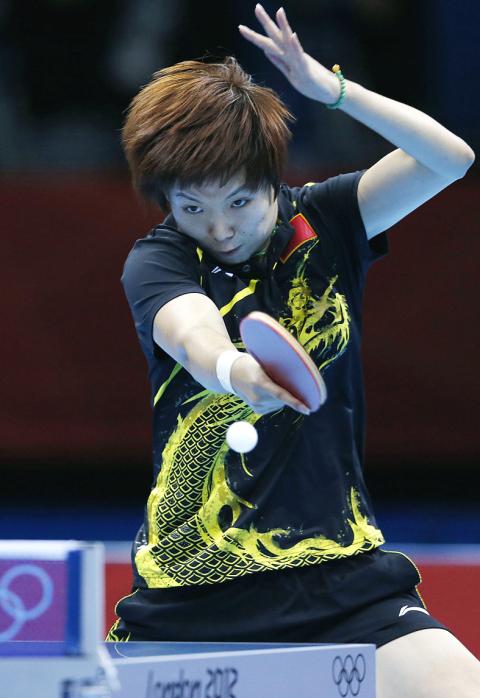
Photo: EPA
She teamed with silver medalist Ding Ning and Guo Yue to win the team event on Tuesday, defeating Japan 3-0 in a sport China dominates like no other.
“I hope tomorrow I can do something like a city tour, but it will depend on the coach, if he will agree with that or not,” Li said.
That put coach Shi Zhihao on the spot, sitting a few meters away from Li.
“The last thing Li Xiaoxia said is wrong,” he replied. “After the Olympics, they can do whatever they want.”
China overwhelmed Japan and the Chinese men are prohibitive favorites to defeat South Korea and complete the sweep of four gold medals, repeating the feat China pulled off four years ago in Beijing.
Table tennis is China’s national pastime and the country has now won 23 of 27 gold medals since 1988 and they are almost certain to make it 24 of 28.
Expectations back home were high, an estimated 500 million were probably watching on TV, and the trio delivered.
With three China-born players, the Singapore women took the bronze medal, defeating South Korea 3-0.
The Chinese women are even more dominating in table tennis than the nation’s men. Only three women’s teams in the Olympics played without China-born players, or players with roots in China — North Korea, Japan and Egypt.
“The Chinese team is too strong,” said Ai Fukuhara, Japan’s most famous table tennis player and a national icon who is up there with female soccer star Homare Sawa.
China’s winning team represents the new generation, all 24 or younger, and the latest in a long line of famous female players.
Li is on course to match the record of several national icons.
Zhang Yining won four gold medals in the last two Olympics. Wang Nan won her four golds in three Olympics — 2000, 2004 and 2008 — while Deng Yaping started the string with four in 1992 and 1996, and went on to be one of the faces of the 2008 Beijing Olympics.
“In China there are so many excellent players,” said 19-year-old Kasumi Ichikawa, who played with Fukuhara and Sayaka Hirano. “In the next four years, I’d like to concentrate on improving my technique, and get stronger mentally and physically.”
Japan’s women defeated China in the final of the 2010 world junior championships, a team led by Ishikawa. So there may be hope.
For Japan, the silver was like a gold — and the women treated it that way, laughing, smiling and ready to celebrate.
“I need to buy some souvenirs before I go home,” Fukuhara said.
It was Japan’s first Olympic medal in table tennis, going back to 1988 when the game entered the Olympics.
“We are pleased, and this should encourage children in Japan to aim for Olympic medals and start playing table tennis when they are very small,” Hirano said.
Fukuhara is from the area in northern Japan that was devastated last year by the earthquake and tsunami.
“I promised the children of the affected area I would come back with a medal from the London Olympics,” Fukuhara said. “I am very pleased and happy to go back to the area, and show it to the children.”
They will be happy with silver, too.

Wilyer Abreu watched the ball leave the park and tossed his bat high in the air. His Venezuela teammates streamed out of the dugout in celebration. The comeback was on and the win over the reigning World Baseball Classic (WBC) champion Japan was within reach. Japan, their 11-game WBC winning streak on the line, held a 5-4 lead in the sixth inning of Saturday’s thrilling quarter-final matchup when Abreu put his team ahead with the biggest swing of the game: a three-run shot off Hiromi Itoh that sent the loanDepot Park crowd into a passionate roar and helped seize Venezuela’s 8-5
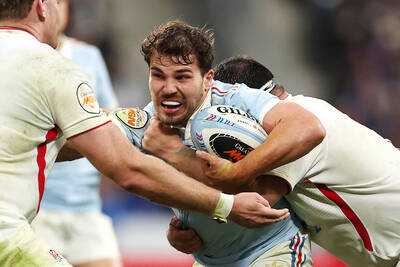
A BREATHLESS BATTLE: France clinched the championship in a vicious back-and-forth match with England, denying Ireland the title by just a few points France won back-to-back Six Nations titles after beating England 48-46 on a last-second penalty-kick by Thomas Ramos in a thriller for the ages on Saturday. England scored their seventh try in the 77th minute and converted for 46-45. If the score held for a few more minutes, Ireland would have been crowned the champion. But France pressed yet again with 14 men, lost possession, regained it, and earned two simultaneous penalties after the fulltime siren. Captain Antoine Dupont debated with referee Nika Amashukeli where the penalty spots were. Ramos, who did not miss a goal-kick all night, finally lined up his seventh

Home runs are greeted with a celebratory shot of espresso and the donning of an Armani jacket. Victories are marked with bottles of red wine while the soaring voice of opera singer Andrea Bocelli echoes through the locker room. Welcome to baseball, Italian-style. Written off as 80-1 underdogs before the World Baseball Classic started, Italy’s fairytale tournament has carried them all the way to today’s (Taipei time) semi-finals in Miami against Venezuela. On Saturday, Italy — who scored a stunning upset of a star-studded US lineup during the pool phase — kept their unbeaten campaign alive with a nail-biting 8-6
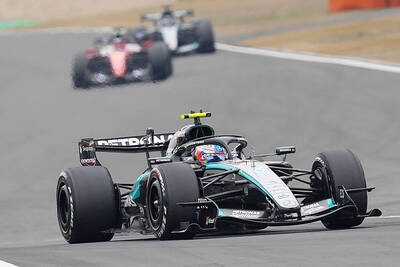
Kimi Antonelli became Formula 1’s second-youngest race winner with a composed drive to victory for Mercedes in an eventful Chinese Grand Prix yesterday. The 19-year-old Italian was the youngest pole position starter and briefly lost the lead to Lewis Hamilton of Ferrari at the start, but retook it soon after and was in control after that. “We did it! We did it!” Antonelli shouted to his team on the radio amid laughs and whoops. It was another 1-2 finish for Mercedes to start the season as Antonelli’s teammate George Russell came through a battle with both Ferraris to finish second. Lewis Hamilton was


 RSS
RSS