

Andy Murray had one eye on his opponent and one on the clock as his Wimbledon third-round clash against Marcos Baghdatis turned into a tension-soaked race against time under Centre Court’s roof on Saturday.
The scoreboard at the end showed the No. 4 seed had won 7-5, 3-6, 7-5, 6-1, but it was the time in the top left corner that had most people transfixed.
Murray had to get the encounter wrapped up before the 11pm cut-off time for play under the roof lights, a deadline imposed by local authorities, or he would have been forced to come back today to finish off the Cypriot.
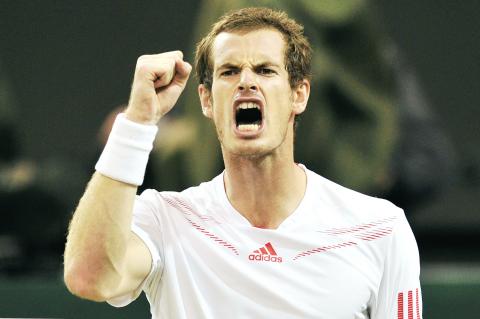
Photo: AFP
A mid-match wobble in which he lost the second set followed by an extended delay as the giant mechanical roof was heaved into place ensured the seconds were ticking away as he eventually stamped his authority on the match in the fourth set when Baghdatis seemed to lose heart.
With a double break in the bank, the result was hardly in doubt, but all eyes were on the umpire to see if he was going to allow the final game to play as the clock ticked past the deadline.
Murray did not even sit down when the players changed ends at 4-1, hurrying to the other end while glancing anxiously at the time. As it turned out, Murray wasted precious few seconds, racing through the final two games and firing down an ace to bring up match point.
When Baghdatis sent a forehand return long to bring an end to the spectacle the, clock had ticked round to 11:02pm, making it the latest finish in Wimbledon history.
“I think if the set had been tighter, it would have been distracting,” Murray, who had seemed in trouble when going a break down in the third set, told a small group of reporters while having his post-match aches eased by a massage in the locker room. “Because then momentum was with me, I just wanted to keep it going and play fairly quickly whereas for him, it would have been better to slow it down a little bit.”
“I was under the impression that at 11 o’clock we would stop regardless of what the score was and I broke serve to go 5-1 and then walked to the net because I thought we were to have to come back on Monday,” Murray said. “Even at 5-1, that match still could have gone on. It was just lucky I finished it in a couple of minutes.”
The match itself will not earn a place in the Murray scrapbook for the quality of the tennis on show, especially in the first three sets when the Cypriot was frequently able to dictate from the back of the court.
Murray, troubled by the windy conditions before the roof closed, had claimed the first set without setting Centre Court on fire, breaking in the 11th game as Baghdatis sent a risky dropshot attempt wide.
He looked to be cruising when he swiftly went a break up at the start of the second, but the flow turned and the Cypriot started to take the chances that Murray offered him.
The Briton was tumbling around the court, unable to stay on his feet and was even penalized for allowing balls to fall out of his pocket in mid rally.
The world No. 4 seemed able to craft break-point chances at will, but nine went begging in the second set, while Baghdatis clinically dispatched his own to draw level.
After a nip and tuck third that Murray, with tape on his knee and a grimace on his face, closed out with a sizzling backhand pass after recovering from 4-2 behind, came an all-out onslaught in which the Scot blitzed past Baghdatis to finish the match on fast forward.
After Rafael Nadal’s shock exit on Thursday last week and Roger Federer’s great escape 24 hours later, Murray’s victory meant it was the third night in a row the roof had been in play.
Like the other two, Nadal’s shock defeat by Lukas Rosol and Roger Federer’s great escape against Julien Bennetteau, its implementation was not without an element of controversy.
“I think with the roof there’s always going to be some difficult situations for the tournament director or the referee,” Murray said. “Like today it was a perfect example. Do we start the match with the roof on so there’s no delays, or, yesterday I think they got criticized quite a lot because it didn’t rain at all and the roof was shut the whole day, when it shouldn’t have been, because it’s obviously meant to be an outdoor event.”
Murray will now face Croatian Marin Cilic in the last 16.

The Football Association of Ireland (FAI) has found itself divided ahead of their two Nations League clashes with Israel, with the players disagreeing over whether to boycott the first game today and goalkeeper Gavin Bazunu withdrawing from the squad. After hours of fraught meetings among the players and occasionally involving coaches and officials, FAI chief executive officer David Courell said at a news conference that had been delayed by several hours that a “significant majority” of the squad had agreed to play the game in Hungary, but it was far from a unanimous decision. The handful of Irish journalists present questioned Courell

MORE MEDALS: Taiwan’s men’s table tennis team added a bronze to the nation’s medal haul, while the women’s basketball team advanced to the semi-finals Taiwan yesterday secured their first e-sports medal at the Aichi-Nagoya Asian Games, claiming bronze in the Naraka: Bladepoint tournament after falling 0-3 to China in the semi-finals. The Taiwanese squad, comprising Liu Tang-shiun, Chen Shang-yi, Cheng Hsu-yu, Yen Kai-en and Yeh Chih-yu, had already secured a place on the podium when they advanced to the final four as the runners-up in their preliminary group. The bronze is first e-sports medal Taiwan has won at this year’s Asian Games. Naraka: Bladepoint is a game in which the players fight each other to be the last one standing. The game incorporates martial arts-inspired melee combat. TABLE

CONFUSION, DISORDER: Late-coming entrants and insufficient logistics have given this year’s Games a shoddy execution, the organizing committee’s head said The chief organizer of the Asian Games apologized yesterday for the logistical headaches plaguing the event, saying a late influx of athletes and officials had made it difficult to run smoothly. The number of participants at the continental showpiece ballooned to 17,000 following a flurry of late entries — about 2,000 more than the organizing committee had initially projected. The unexpected surge strained accommodation and transport networks, prompting complaints from athletes and team officials over cramped rooms, small beds and travel delays. “There have been mistakes in accommodation and transport, for various reasons,” AINAGOC secretary-general Satoshi Murate told a press conference. “Whatever the
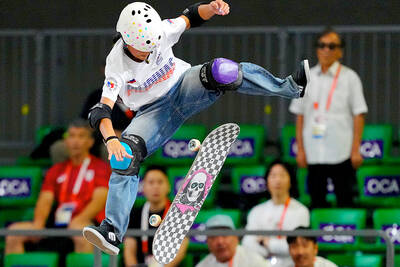
The Asian Games has crowned teenage champions before, but this edition has witnessed stunning successes by child prodigies, including Yuki Kurihara standing atop the podium aged just 11. The Japanese primary school student beat opponents three times his age on the way to a historic gold in e-sports in Nagoya. He is Japan’s youngest Asian Games winner in history and almost certainly the youngest the Games have ever seen. Kurihara did not even react after taking home the gold in Saturday’s final in Puyo Puyo Champions, a puzzle game where players try to clear their screen of colored blobs by lining them up


 RSS
RSS