


Serena Williams won two tennis Grand Slam singles titles in 2009, but she did not appear among the 50 top-earning American athletes ranked last summer by SI.com, whose formula included 2009 salaries or winnings and endorsements. The only woman on the earning lists was another tennis player, Maria Sharapova, who came in 20th among international athletes.
Sharapova might attribute her good fortune to the track and golf standout Babe Didrikson Zaharias, perhaps the first female athlete to endorse a national consumer product when she appeared in local ads for Chrysler’s Dodge automobiles in 1933. Whether she was truly the first is difficult to determine, in part because historians tend to disagree on what activity constitutes sport and whether endorsement of sports equipment or promotion of a sports event warrants consideration.
A recent study dedicated to finding proof of the first female athlete’s endorsement of a mainstream commercial product has led researchers on a journey spanning an era that includes the sharpshooter Annie Oakley, the professional walker Ada Anderson, the mountain climber Annie Smith Peck, the aviation pioneers Harriet Quimby and Elinor Smith, the distance swimmer Gertrude Ederle and the tennis star Suzanne Lenglen.
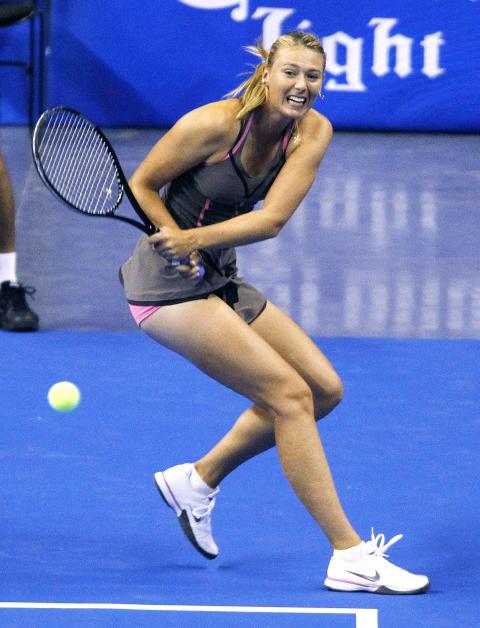
PHOTO: REUTERS
Oakley is generally viewed more as an entertainer than a sportswoman. She rose to fame initially by beating her future husband, Francis Butler, in an 1881 shooting competition in Greenville, Ohio. Her emergence as a star of Buffalo Bill’s Wild West Show made Oakley one of the first female advertising icons in promotional posters of the day.
However, apart from Oakley, women were not allowed to compete in organized sports and were excluded from the first modern Olympic Games in 1896 in Athens. The first female Olympians competed in the 1900 Paris Games.
Limited access served as one barrier for sportswomen, as did the often degrading jump to professional status from the amateur ranks. In the early 20th century, events like Wimbledon and other tennis, golf and basketball championships were restricted to amateurs. The appearance of any professionalism could generate the wrath of organizations like the Amateur Athletic Union.
As early as 1876, distance walkers like Bertha Von Hillern and Mary Marshall drew large crowds in Chicago, Philadelphia and New York. Two years later, an Englishwoman using the name Madame Anderson walked an estimated 1,207km miles in 750 hours over 28 days in Brooklyn. At the time, professional walking was popular and Anderson made about US$10,000 in gate receipts from the heavily promoted event.
On the peaks, Peck, at 45, climbed the Matterhorn in 1895. Two years later, with financing from the Sunday World in Dublin, she attempted the active Mexican volcano Popocatepetl, where she set an altitude record for women. Peck’s job was to provide the paper with an exclusive retelling of her relatively easy summiting, which the World rewrote to heighten the drama of her achievement. When she was featured on Hassan cork tip cigarette trading cards in 1911, Peck, then 61, placed a flag on the 6,401m-foot summit of Coropuna in Peru.
The same year, Quimby emerged as the US’ most prominent aviatrix by appearing in air shows across the country and in Mexico. She became the first female pilot to fly across the English Channel on April 16, 1912. Later that year, Quimby fell out of her aircraft in Boston and tumbled to her death.
Like Peck, Ederle was open to a paid relationship with a newspaper. In 1926, she entered into an agreement with the New York Daily News and the Chicago Tribune to provide details of her successful first swim across the English Channel. Ederle, a gold medalist at the 1924 Olympics in Paris, shifted into movies and the vaudeville circuit with Billy Rose’s Aquacade.
Smith’s achievements as a stunt pilot and in setting speed, altitude and endurance records in the 1920s and 1930s are noteworthy. Like Anderson and Peck, she was never engaged in side-by-side competition. Yet in 1934, Smith was the first woman to appear on a Wheaties box.
Zaharias was considered a more traditional athlete. She essentially turned pro coming out of high school in 1930 when she became a clerk for the Employers Casualty Company, based in Dallas, to play basketball.
As Babe Didrikson, she won gold medals in the 100m hurdles and the javelin and a silver in the high jump at the 1932 Los Angeles Olympics (in high hurdles, javelin and high jump), while building on her mastery of basketball, softball and golf.
She emerged as the first female athlete of the 20th century to fully leverage her sports prowess with business acumen.
Historians now think she became so visible and provocative after the Olympics that when she bought a Dodge, the company placed an ad showing her praising the car’s benefits in the Feb. 1, 1933, edition of the Chicago Daily News. The AAU responded by suspending her, without a hearing, from amateur competition.
Didrikson was reinstated as an amateur, but she turned pro later that year and signed with Chrysler to promote Dodge coupes at the Detroit Auto Show. Acting as a pro, she was free to endorse any product she wanted and constructed deals with the sporting goods company P. Goldsmith Sons and Wheaties in 1935. Those endorsements and another from Timex, as well as a lifetime deal with Wilson Sporting Goods in 1947, set the stage for athletes such as Sharapova and others to follow.

Revelations of positive doping tests for nearly two dozen Chinese swimmers that went unpunished sparked an intense flurry of accusations and legal threats between the World Anti-Doping Agency (WADA) and the head of the US drug-fighting organization, who has long been one of WADA’s fiercest critics. WADA on Saturday said it was turning to legal counsel to address a statement released by US Anti-Doping Agency (USADA) CEO Travis Tygart, who said WADA and anti-doping authorities in China swept positive tests “under the carpet by failing to fairly and evenly follow the global rules that apply to everyone else in the world.” The
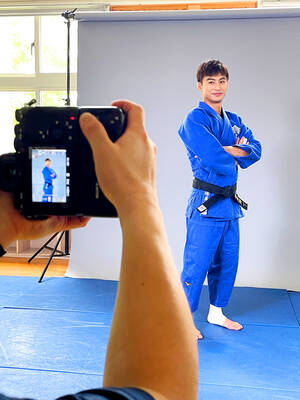
Taiwanese judoka Yang Yung-wei on Saturday won silver in the men’s under-60kg category at the Asian Judo Championships in Hong Kong. Nicknamed the “judo heartthrob” in Taiwan, the Olympic silver-medalist missed out on his first Asian Championships gold when he lost to Japanese judoka Taiki Nakamura in the finals. Yang defeated three opponents on Saturday to reach the final after receiving a bye through the round of 32. He first topped Laotian Soukphaxay Sithisane in the round of 16 with two seoi nage (over-the-shoulder throws), then ousted Indian Vijay Kumar Yadav in the quarter-finals with his signature ude hishigi sankaku gatame (triangular armlock). He

RALLY: It was only the second time the Taiwanese has partnered with Kudermetova, and the match seemed tight until they won seven points in a row to take the last set 10-2 Taiwan’s Chan Hao-ching and Russia’s Veronika Kudermetova on Sunday won the Porsche Tennis Grand Prix women’s doubles final in Stuttgart, Germany. The pair defeated Norway’s Ulrikke Eikeri and Estonia’s Ingrid Neel 4-6, 6-3, 10-2 in a tightly contested match at the WTA 500 tournament. Chan and Kudermetova fell 4-6 in the first set after having their serve broken three times, although they played increasingly well. They fought back in the second set and managed to break their opponents’ serve in the eighth game to triumph 6-3. In the tiebreaker, Chan and Kudermetova took a 3-0 lead before their opponents clawed back two points, but

Taiwanese gymnast Lee Chih-kai failed to secure an Olympic berth in the pommel horse following a second-place finish at the last qualifier in Doha on Friday, a performance that Lee and his coach called “unconvincing.” The Tokyo Olympics silver medalist finished runner-up in the final after scoring 6.6 for degree of difficulty and 8.800 for execution for a combined score of 15.400. That was just 0.100 short of Jordan’s Ahmad Abu Al Soud, who had qualified for the event in Paris before the Apparatus World Cup series in Qatar’s capital. After missing the final rounds in the first two of four qualifier


 RSS
RSS