


It has been a long wait, but Chinese tennis finally came of age yesterday.
Li Na’s upset victory over Venus Williams at the Australian Open coupled with Zheng Jie’s stunning run gave the world’s most populous nation two players in the semi-finals of a Grand Slam for the first time.
It has sparked huge interest in China with national broadcaster CCTV, newspapers and Web sites giving their exploits blanket coverage.
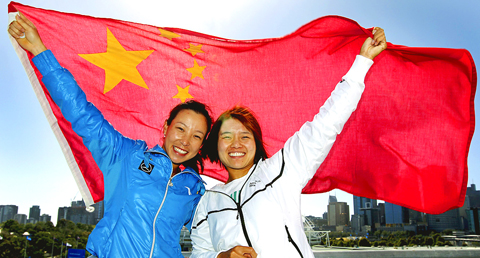
PHOTO: REUTERS
“More history beckons for Chinese tennis,” screamed the Global Times, a headline emulated across the Chinese media.
This is reflected by the number of Chinese journalists in Australia to cover the tennis.
They are usually outnumbered by their Japanese colleagues but this year at least a dozen Chinese media are at Melbourne Park — far more than usual.
Li and Zheng have been predicting great things for some time but it is only since they left China’s state sports system to manage their own careers that the pieces have started to fall into place.
In December 2008, the nation’s top four women’s players — Li, Zheng, Peng Shuai and Yan Zi — became the first Chinese athletes to be granted unprecedented freedom in managing their careers.
It has meant they can select their own schedules, coaches and back-up teams, and also not have to hand over a significant portion of their prize money to the Chinese Tennis Association.
The move initially raised doubts about whether the players would survive on the WTA tour, but Li and Zheng, in particular, have thrived.
Li’s come-from-behind 2-6, 7-6 (7/4), 7-5 upset of Williams is expected to propel her into the world’s top 10 — the first time a Chinese player has made the grade.
TOP 20
Zheng is forecast to move to 20 in the world after her 6-1, 6-3 quarter-final demolition of Russian Maria Kirilenko.
“For Zheng Jie, for me, for my country and my fans, it is a good thing,” said Li, whose bubbly personality and improved English has won over fans. “Tennis in China right now is getting bigger and bigger. We have three or four juniors playing here. We have many good players, but right now [for them] it’s step by step. They have to play small tournaments and make an impact.”
Zheng feels that with Li and her doing well and high-profile tournaments like the China Open and Shanghai Masters now on the schedule, the growth of the Chinese game has only just started.
“I feel tennis is very quickly going up [in popularity] in China,” she said. “You can see a lot of the newspapers coming here from China.”
“I think it [started to become popular] from 2004, Li Ting and Tian Tian won the gold medal from the Olympic Games,” she added.
Li and Tian’s Olympic medal was certainly a breakthrough, but so was Zheng and Yan’s Grand Slam doubles title at the 2006 Australian Open, and her run to the Wimbledon semis in 2008.
GROWING INFLUENCE
The growing profile of the game has already trickled down to children in China with many parents now encouraging their kids to play tennis rather than other sports.
“Table tennis and badminton are still the most popular but more mums and dads are taking their children to tennis clubs now,” Yan said.
Yet despite Chinese women doing well, men have still not made any impact.
“Maybe men need to work harder,” Zheng said.
They may also need to break free from the state system, which remains largely modeled on the old communist structure where children are identified for a certain sport, then funneled into government programs.
The model has certainly been successful, with China topping the gold medal count at the 2008 Beijing Olympics, but has drawn criticism from some for focusing on results rather than the welfare of athletes.

Revelations of positive doping tests for nearly two dozen Chinese swimmers that went unpunished sparked an intense flurry of accusations and legal threats between the World Anti-Doping Agency (WADA) and the head of the US drug-fighting organization, who has long been one of WADA’s fiercest critics. WADA on Saturday said it was turning to legal counsel to address a statement released by US Anti-Doping Agency (USADA) CEO Travis Tygart, who said WADA and anti-doping authorities in China swept positive tests “under the carpet by failing to fairly and evenly follow the global rules that apply to everyone else in the world.” The
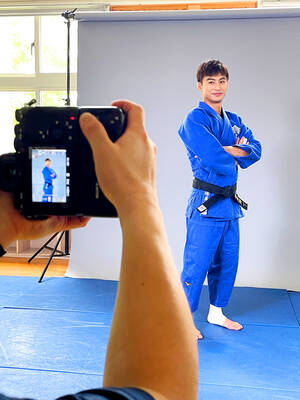
Taiwanese judoka Yang Yung-wei on Saturday won silver in the men’s under-60kg category at the Asian Judo Championships in Hong Kong. Nicknamed the “judo heartthrob” in Taiwan, the Olympic silver-medalist missed out on his first Asian Championships gold when he lost to Japanese judoka Taiki Nakamura in the finals. Yang defeated three opponents on Saturday to reach the final after receiving a bye through the round of 32. He first topped Laotian Soukphaxay Sithisane in the round of 16 with two seoi nage (over-the-shoulder throws), then ousted Indian Vijay Kumar Yadav in the quarter-finals with his signature ude hishigi sankaku gatame (triangular armlock). He

RALLY: It was only the second time the Taiwanese has partnered with Kudermetova, and the match seemed tight until they won seven points in a row to take the last set 10-2 Taiwan’s Chan Hao-ching and Russia’s Veronika Kudermetova on Sunday won the Porsche Tennis Grand Prix women’s doubles final in Stuttgart, Germany. The pair defeated Norway’s Ulrikke Eikeri and Estonia’s Ingrid Neel 4-6, 6-3, 10-2 in a tightly contested match at the WTA 500 tournament. Chan and Kudermetova fell 4-6 in the first set after having their serve broken three times, although they played increasingly well. They fought back in the second set and managed to break their opponents’ serve in the eighth game to triumph 6-3. In the tiebreaker, Chan and Kudermetova took a 3-0 lead before their opponents clawed back two points, but
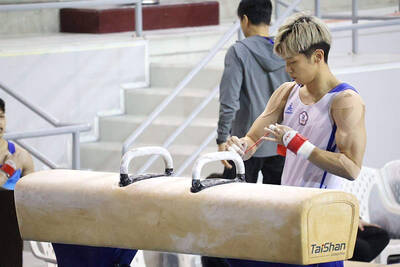
Taiwanese gymnast Lee Chih-kai failed to secure an Olympic berth in the pommel horse following a second-place finish at the last qualifier in Doha on Friday, a performance that Lee and his coach called “unconvincing.” The Tokyo Olympics silver medalist finished runner-up in the final after scoring 6.6 for degree of difficulty and 8.800 for execution for a combined score of 15.400. That was just 0.100 short of Jordan’s Ahmad Abu Al Soud, who had qualified for the event in Paris before the Apparatus World Cup series in Qatar’s capital. After missing the final rounds in the first two of four qualifier


 RSS
RSS