


Michel Platini, at one time the outstanding French soccer player of his day, dropped by Jerusalem earlier this month. He was received by Israeli President Shimon Peres and the two men discussed what role soccer might play toward peace in the Middle East.
The pair had been down this road once before. Three years ago, Peres and Platini helped put together a team of Israelis and Palestinians who took on a Spanish team in Seville. Now, Platini is the initiator. He visited Jerusalem in his capacity as the head of UEFA and offered Israel the prospect of hosting international tournaments if enough stadiums could be built.
Platini is trying, for a second time, to transform soccer. He fought in his school days for the sport to be an accepted profession in France. He transcended his game as a creator who could and did transform his generation. And he made his fortune in his father’s homeland, with the Italian club Juventus.
But in his second career, the often excruciating transition that professional sports figures face, Platini is taking on an even more difficult task.
Platini seeks something rather complex. He is trying to unite under a common set of operating principles the 53 members of UEFA: 27 states inside the EU and 26 outside it, including the whole of the former Eastern European bloc, and nations that lie outside the geographic borders such as Turkey and Israel. His ambition is to level the playing field between rich teams, those with TV contracts and billionaire owners, and the smaller fry who rely mostly on fan support.
He would like to rein in teams like Real Madrid, which spent US$433 million this summer to buy the rights to four superstars, and the big name teams from the high-level English Premier League. Some of these, like Chelsea and Manchester United, are bankrolled by sugar daddies from Russia, the US and the United Arab Emirates.
In February, Platini addressed the European Parliament for, appropriately, the 90 minutes that it takes to play a soccer match.
In an interview, he spoke about the January trading period, in which star players are transferred for millions of dollars from small market clubs to the dominant teams, which then sign the players to expensive contracts. One club in England, for example, bid US$150 million for the registration of a single player, the Brazilian Ricardo dos Santos Leite, known as Kaka, from AC Milan. (He ultimately signed with Real Madrid.)
“Is it morally acceptable to offer such sums of money for a single player?” Platini asked the lawmakers.
He said he would do everything he could to ensure that soccer operates within European law provided they amend the law to let him govern the sport. To do that, he said, he needed a US-style system that restricted spending to a percentage of every team’s revenues.
“We are currently looking at the idea of limiting, to a certain degree, a club’s expenditure on staff — salary and transfer fees combined — to an as yet undecided percentage of its direct and indirect sporting revenue,” he said.
Platini wanted to restrict the power of big clubs to sign up large numbers of players, particularly those under the age of 18. European law, however, prohibits any quota system that would deny the rights of workers to be employed anywhere they or the clubs choose. Restrictions on competition for players or on the right of workers to seek maximum compensation — familiar fixtures in the landscape of US sports — are illegal.
There were, and possibly still are, members of the European Parliament who believe in the adage that a soccer player is a person whose brains begin in the toes and end at the knees. The skepticism toward an ex-player pleading the case that soccer needs what sports get in the US — some acknowledgment of their special place in society, some freedom to develop their own laws — was palpable.
However, in September the European Commission held a conference on licensing systems for club competitions. This conference, for all sports, broadly supported Platini’s determination to bring big teams within Europe in a scheme to regulate the spending of clubs.
Perhaps just as surprising as the EU arguing the case for UEFA’s new proposals was the fact that Platini’s proposal was backed by leading clubs.
“I am nothing, just one man,” Platini said. “But I was elected by the national associations because I promised to make financial fair play in soccer. I don’t want to be above the law, I know that we could lose in the courts if clubs use lawyers to stop us imposing limitations. I asked the politicians to help protect us, if they trust what we are doing.”
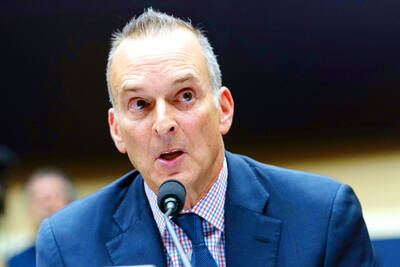
Revelations of positive doping tests for nearly two dozen Chinese swimmers that went unpunished sparked an intense flurry of accusations and legal threats between the World Anti-Doping Agency (WADA) and the head of the US drug-fighting organization, who has long been one of WADA’s fiercest critics. WADA on Saturday said it was turning to legal counsel to address a statement released by US Anti-Doping Agency (USADA) CEO Travis Tygart, who said WADA and anti-doping authorities in China swept positive tests “under the carpet by failing to fairly and evenly follow the global rules that apply to everyone else in the world.” The

Taiwanese judoka Yang Yung-wei on Saturday won silver in the men’s under-60kg category at the Asian Judo Championships in Hong Kong. Nicknamed the “judo heartthrob” in Taiwan, the Olympic silver-medalist missed out on his first Asian Championships gold when he lost to Japanese judoka Taiki Nakamura in the finals. Yang defeated three opponents on Saturday to reach the final after receiving a bye through the round of 32. He first topped Laotian Soukphaxay Sithisane in the round of 16 with two seoi nage (over-the-shoulder throws), then ousted Indian Vijay Kumar Yadav in the quarter-finals with his signature ude hishigi sankaku gatame (triangular armlock). He

RALLY: It was only the second time the Taiwanese has partnered with Kudermetova, and the match seemed tight until they won seven points in a row to take the last set 10-2 Taiwan’s Chan Hao-ching and Russia’s Veronika Kudermetova on Sunday won the Porsche Tennis Grand Prix women’s doubles final in Stuttgart, Germany. The pair defeated Norway’s Ulrikke Eikeri and Estonia’s Ingrid Neel 4-6, 6-3, 10-2 in a tightly contested match at the WTA 500 tournament. Chan and Kudermetova fell 4-6 in the first set after having their serve broken three times, although they played increasingly well. They fought back in the second set and managed to break their opponents’ serve in the eighth game to triumph 6-3. In the tiebreaker, Chan and Kudermetova took a 3-0 lead before their opponents clawed back two points, but
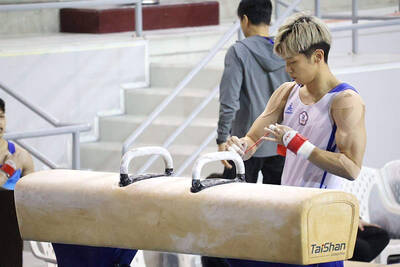
Taiwanese gymnast Lee Chih-kai failed to secure an Olympic berth in the pommel horse following a second-place finish at the last qualifier in Doha on Friday, a performance that Lee and his coach called “unconvincing.” The Tokyo Olympics silver medalist finished runner-up in the final after scoring 6.6 for degree of difficulty and 8.800 for execution for a combined score of 15.400. That was just 0.100 short of Jordan’s Ahmad Abu Al Soud, who had qualified for the event in Paris before the Apparatus World Cup series in Qatar’s capital. After missing the final rounds in the first two of four qualifier


 RSS
RSS