


Bloodied, bruised and battered, the two boxers have just completed a brutal bout in the ring in Berlin’s Mitte district and remove their gloves to face their next challenge: a round of speed chess.
Welcome to the bizarre world of chess boxing, developed in inner-city Berlin and featuring alternate rounds of chess and boxing in a fierce combination of brains and brawn.
Inspired by a science fiction book, the sport that emerged initially as an urban art event has grown into one enjoyed by many across three continents.
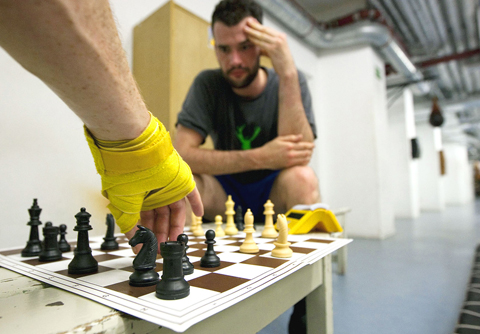
PHOTO: REUTERS
Boxers play six rounds of chess alternating with five of boxing as they put their physical and mental skills to the test.
Chess rounds last a total of four minutes, with the players wearing headphones to block out cheers, coaches’ advice and the commentator’s voice.
“This is all about discipline and control of your body and your mind,” said the sport’s founder, Iepe Rubingh, a Dutchman who set up the first club in Berlin.
Rubingh, a chess-playing artist, took up boxing in his 20s. It was around that time that he stumbled across the work of graphic artist Enki Bilal, whose novel Froid Equateur first featured the sport.
“I started quite late with boxing training. I thought about this sport and said: ‘This cannot be done. You cannot play chess after a round of boxing. You are just not capable, your body will not allow you,’” Rubingh said.
With huge amounts of adrenalin pumped into the body during the fight, a heart rate of 170 and more oxygen in the muscles than in the brain, chess boxers’ limits are really tested when they take off their gloves and sit down, sweaty and out of breath, at the chess board.
“When you sit down to play chess after your boxing round then you look at the board as if it is the first time you see it,” Rubingh said. “It is a bit like biathlon, with the skiing and shooting.”
“Adrenalin is massive, making it difficult to think straight, and it also makes you fearless and that is the biggest mistake you can make on the chess board at that time. You have to train hard for this changeover,” he said.
Chess boxers have little in common with the stereotype of a prize fighter, or a chess player for that matter. Many of them are 30 or older and are in top physical condition, with a high IQ and a rating under the Elo system used by the World Chess Federation (FIDE).
Berlin police officer Frank Stoldt is one of them. Long a kickboxer, the 40-year-old Stoldt, who has an Elo chess rating of 2,000, joined the Berlin chess boxing club the moment he heard about it.
“I thought they had invented the sport for me,” said Stoldt, interrupting a round of speed chess in a small training room in the Berlin gym.
“It is a unique sport, combining two seemingly opposite things. But it has huge potential. It is this testing of the human body and mind that makes it so exciting,” said Stoldt, a former chess boxing world champion, before taking up his skipping rope for a cardiovascular workout.
Some have called chess boxers the ultimate fighters, excelling in both physical and mental bouts. Winners in each of the four weight categories can be declared by a knockout or a checkmate, or when playing time runs out.
The sport has grown beyond Germany to Russia, the US, England and Australia. So far, only men’s competitions have been organized, but a small number of women are now training at chess boxing clubs.
Losing its main sponsor amid the economic crisis has done little to dampen the sport’s expansion plans, it seems. A European championship fight in England next month will be followed by the world championship in Russia’s Siberian city of Krasnoyarsk.
“Grass-roots level development is what we are doing right now and we can do that easily,” Rubingh said. “We do not need to organize a congress for 100 people like other federations.”
“We just need a group on Facebook,” Rubingh said during a tour of the visiting athletes’ Berlin accommodation, where the rooms were covered with wallpaper showing chess boxing scenes and sprinkled with quotes from famous boxers and chess players.
“Russia is the chess boxing nation and it is now waking up,” Rubingh said.
Eastern Europe, and Russia in particular, have proved to be fertile ground for the sport, with both boxing and chess widely played.
One of Rubingh’s plans is to stage an unofficial demonstration of chess boxing during the 2012 London Olympics.
“We are planning some guerrilla shows in London during the Games,” said Rubingh, who as an artist has blocked off roads in Tokyo and Berlin, causing traffic chaos.
“Our vision is to one day make it to the Olympics. I think there it would become the top discipline for the ultimate athlete,” he said.
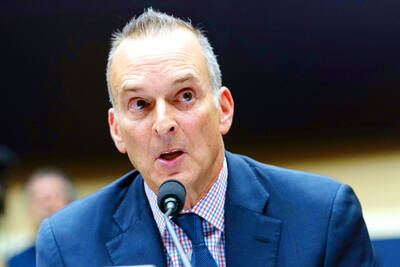
Revelations of positive doping tests for nearly two dozen Chinese swimmers that went unpunished sparked an intense flurry of accusations and legal threats between the World Anti-Doping Agency (WADA) and the head of the US drug-fighting organization, who has long been one of WADA’s fiercest critics. WADA on Saturday said it was turning to legal counsel to address a statement released by US Anti-Doping Agency (USADA) CEO Travis Tygart, who said WADA and anti-doping authorities in China swept positive tests “under the carpet by failing to fairly and evenly follow the global rules that apply to everyone else in the world.” The
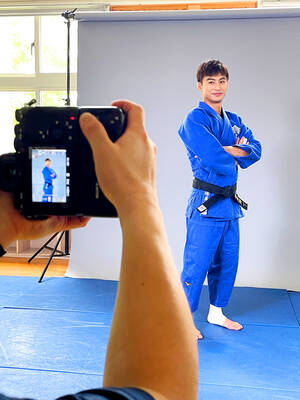
Taiwanese judoka Yang Yung-wei on Saturday won silver in the men’s under-60kg category at the Asian Judo Championships in Hong Kong. Nicknamed the “judo heartthrob” in Taiwan, the Olympic silver-medalist missed out on his first Asian Championships gold when he lost to Japanese judoka Taiki Nakamura in the finals. Yang defeated three opponents on Saturday to reach the final after receiving a bye through the round of 32. He first topped Laotian Soukphaxay Sithisane in the round of 16 with two seoi nage (over-the-shoulder throws), then ousted Indian Vijay Kumar Yadav in the quarter-finals with his signature ude hishigi sankaku gatame (triangular armlock). He

RALLY: It was only the second time the Taiwanese has partnered with Kudermetova, and the match seemed tight until they won seven points in a row to take the last set 10-2 Taiwan’s Chan Hao-ching and Russia’s Veronika Kudermetova on Sunday won the Porsche Tennis Grand Prix women’s doubles final in Stuttgart, Germany. The pair defeated Norway’s Ulrikke Eikeri and Estonia’s Ingrid Neel 4-6, 6-3, 10-2 in a tightly contested match at the WTA 500 tournament. Chan and Kudermetova fell 4-6 in the first set after having their serve broken three times, although they played increasingly well. They fought back in the second set and managed to break their opponents’ serve in the eighth game to triumph 6-3. In the tiebreaker, Chan and Kudermetova took a 3-0 lead before their opponents clawed back two points, but
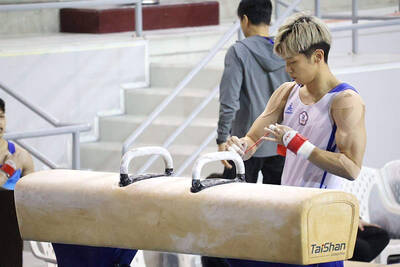
Taiwanese gymnast Lee Chih-kai failed to secure an Olympic berth in the pommel horse following a second-place finish at the last qualifier in Doha on Friday, a performance that Lee and his coach called “unconvincing.” The Tokyo Olympics silver medalist finished runner-up in the final after scoring 6.6 for degree of difficulty and 8.800 for execution for a combined score of 15.400. That was just 0.100 short of Jordan’s Ahmad Abu Al Soud, who had qualified for the event in Paris before the Apparatus World Cup series in Qatar’s capital. After missing the final rounds in the first two of four qualifier


 RSS
RSS