


The UK government is investigating whether some of the attackers in the deadly India shootings could be British citizens with links to Pakistan or the disputed territory of Kashmir, but there was no such evidence yet, officials said on Friday.
Earlier reports alleged at least one of the gunmen could have been a UK-born Pakistani.
But a UK Foreign Office spokeswoman, who spoke on condition of anonymity in line with the department policy, said none of the attackers identified so far was British.
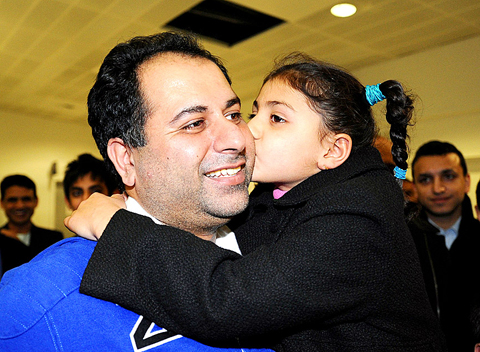
PHOTO: AFP
“Our deputy high commissioner in Mumbai has spoken to the Indian authorities who have said that there is no evidence that anyone, either those shot, or those detained, are British,” the Foreign Office spokeswoman said on Friday.
Indian Home Minister Jaiprakash Jaiswal said a captured gunman had been identified as a Pakistani. Authorities were still trying to confirm the identities of several of the attackers.
The group that claimed responsibility for the attacks, Deccan Mujahidin, was unknown to global security officials.
The name suggested the group was Indian though some security officials have said it may be an offshoot of the Indian Mujahidin.
One of the suspects reportedly called an Indian television station, speaking the main Pakistani language of Urdu, to demand the return of Muslim lands. That was a reference to Kashmir, territory claimed by both India and Pakistan.
Indian Foreign Minister Pranab Mukherjee said on Friday “elements in Pakistan” were to blame but gave no detailed information.
Indian officials have alleged that some of the explosives and ammunitions used in the deadly attacks that have killed more than 140 appeared to have come from the Pakistani port city of Karachi — a known hotbed of militant activity.
Pakistan officials, however, have said there was no clear evidence yet to support the claim. Pakistan’s head of Inter Services Intelligence agency was traveling to India to work with his Indian counterparts and examine existing evidence.
Britons with family ties to Pakistan, India and Kashmir have been involved in a host of attempted terrorist attacks in the UK since 2001.
Three of four British-born men who carried out the 2005 London transit network attacks, killing 52 commuters, had family ties to Pakistan. Indian-born Dhiren Barot was jailed in the UK in 2006 over plots to bomb the New York Stock Exchange, other US financial targets and landmark London hotels.
Barot, who was raised in the UK and regarded by British intelligence as a key al-Qaeda figure, traveled to Kashmir in 1995 to fight against Indian forces. The ongoing dispute over Kashmir has emerged as a recurrent theme in the radicalization of young British Muslims, commonly cited as a justification for their attacks.
British-born Parviz Khan, who was jailed for life over a plot last year to kidnap an unnamed British Muslim soldier and behead him, used fundraising for earthquake relief in Kashmir as a cover to collect funds for his plan.
The UK, home to nearly 2 million Muslims, also has a large Kashmiri population — many of whom identify themselves as being of Pakistani origin.
Anti-India sentiment runs deep in Kashmir, where many people favor independence from India or a merger with Pakistan.
The region is divided between the two countries and both claim it in its entirety.
Militant separatist groups have been fighting since 1989 to end Indian rule.
The uprising and a subsequent Indian crackdown have killed about 68,000 people, most of them civilians.
Elections are due next month in Kashmir. Campaigning already has been marred by violence. One person was killed in a hand grenade attack on Tuesday, the day before the Mumbai attacks.
“The issue of Kashmir clearly resonates in Britain,” the UK security official said on condition of anonymity because of the sensitivity of his work. “But we have yet to confirm whether any of the attackers were British or not.”
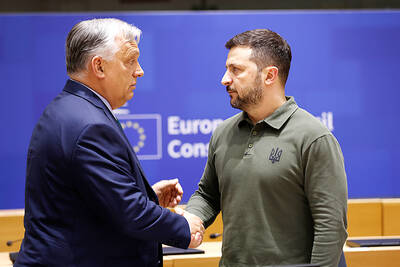
Hungarian authorities temporarily detained seven Ukrainian citizens and seized two armored cars carrying tens of millions of euros in cash across Hungary on suspicion of money laundering, officials said on Friday. The Ukrainians were released on Friday, following their detention on Thursday, but Hungarian officials held onto the cash, prompting Ukraine to accuse Hungary’s Russia-friendly government of illegally seizing the money. “We will not tolerate this state banditism,” Ukrainian Minister of Foreign Affairs Andrii Sybiha said. The seven detained Ukrainians were employees of the Ukrainian state-owned Oschadbank, who were traveling in the two armored cars that were carrying the money between Austria and
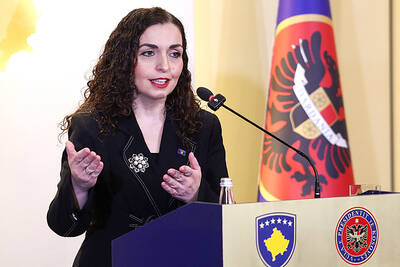
Kosovar President Vjosa Osmani on Friday after dissolving the Kosovar parliament said a snap election should be held as soon as possible to avoid another prolonged political crisis in the Balkan country at a time of global turmoil. Osmani said it is important for Kosovo to wrap up the upcoming election process and form functional institutions for political stability as the war rages in the Middle East. “Precisely because the geopolitical situation is that complex, it is important to finish this electoral process which is coming up,” she said. “It is very hard now to imagine what will happen next.” Kosovo, which declared

MORE BANS: Australia last year required sites to remove accounts held by under-16s, with a few countries pushing for similar action at an EU level and India considering its own ban Indonesia on Friday said it would ban social media access for children under 16, citing threats from online pornography, cyberbullying, online fraud and Internet addiction. “Accounts belonging to children under 16 on high-risk platforms will start to be deactivated, beginning with YouTube, TikTok, Facebook, Instagram, Threads, X, Bigo Live and Roblox,” Indonesian Minister of Communications and Digital Meutya Hafid said. “The government is stepping in so that parents no longer have to fight alone against the giants of the algorithm. Implementation will begin on March 28, 2026,” she said. The social media ban would be introduced in stages “until all platforms fulfill their
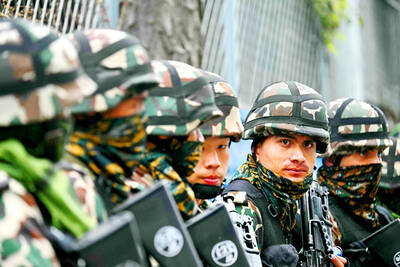
Counting was under way in Nepal yesterday, after a high-stakes parliamentary election to reshape the country’s leadership following protests last year that toppled the government. Key figures vying for power include former Nepalese prime minister K. P. Sharma Oli, rapper-turned-mayor Balendra Shah, who is bidding for the youth vote, and newly elected Nepali Congress party leader Gagan Thapa. In Kathmandu’s tea shops and city squares, people were glued to their phones, checking results as early trends flashed up — suggesting Shah’s centrist Rastriya Swatantra Party (RSP) was ahead. Nepalese Election Commission spokesman Prakash Nyupane said the counting was ongoing “in a peaceful manner”


 RSS
RSS