


At first, waiter Joseph Joy Pulithara thought the blasts were rows of liquor bottles exploding for some reason behind the Mumbai hotel’s sleek bar. Running to the scene, he found a woman screaming — and a young man spraying gunfire.
The gunman was a member of a team that was well-armed, well-prepared and had just begun a two-day siege that would shut down India’s financial and entertainment capital, leave more than 150 people dead and 370 injured, and turn the city’s ritzy seaside district into a scene of horror.
There was almost no time to escape.
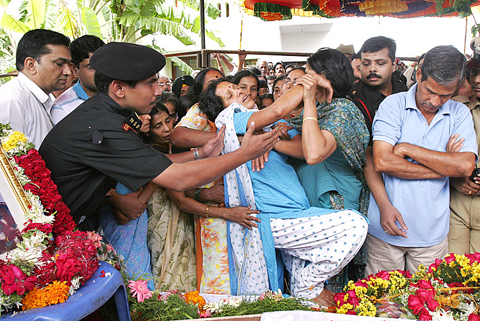
PHOTO: AP
“Within two minutes, they were on us,” Andreina Varagona of Nashville, Tennessee, said from her hospital bed in the intensive care unit. Wounded in the right leg and right arm, her curly brown hair was still caked with a friend’s blood two days later.
An Indian commando said the attackers were indiscriminate.
“Whoever came in front of them, they fired,” he said.
There were 10 targets across the city, including two five-star hotels, a train station, a popular restaurant and an ultra-orthodox Jewish center.
Inside the Taj Mahal and the Oberoi hotels, with their hundreds of rooms, the gunmen often seemed to have the advantage.
“These people were very, very familiar with the hotel layouts and it appears they had carried out a survey before,” an unidentified member of India’s Marine Commando unit said, his face wrapped in a black mask.
The gunmen moved skillfully through corridors slick with blood, thwarting efforts to pin them down, and switched off lights and plunged the rooms into darkness to further confuse the commandos.
The militants were ready for a long siege. One backpack the commandos found had 400 rounds of ammunition inside. Some of the gunmen carried almonds. They also had dollars, rupees and credit cards from local and international banks.
One gunman, who was still roaming the Taj Mahal nearly 48 hours after the assault began, was hiding in a ballroom, army commander Lieutenant General N. Thamburaj said.
“He is moving in two floors. There is a dance floor area where he has cut off all the lights. Sometimes he gets holed up in the rooms and makes that area dark,” Thamburaj said.
The commandos were hampered, too, because they could not use overwhelming force for fear of hitting the hundreds of civilians who were caught in the hotels.
Many guests hid in their rooms until they were rescued. Others were not so lucky.
The gunmen “appeared to be a determined lot, wanting to create and spread terror,” a commando said.
Pulithara found panicked diners and staff running through the hotel bar. In the chaos, it took him a moment to realize he had been shot.
“My friend said there was a hole in my pants, and I was bleeding,” said Pulithara, 22, who was hit in the leg.
He saw another colleague shot in the head.
“She died on the spot,” he said, but he managed to pull a tourist to safety through a fire exit. Then he ran down a flight of stairs, and was free.
Sajjad Karim, a British member of the European parliament, told CNN television on Friday of a harrowing encounter with a smiling gunman at the Taj Mahal hotel at the start of the bloody wave of attacks..
“You never expect to have to deal with this sort of a situation, but ... I found things happen literally within split seconds,” Karim said in the CNN interview from the British city of Manchester,
“He appeared in front of us. My concentration was more on the gun, the weapon that he was carrying than on him, himself,” he said of the gunman, whom he described as “a fairly young man of south Asian appearance.”
“And he was wearing a smile on his face as he started to spray the bullets,” he said.
For hundreds of others inside the hotels, however, the ordeal was just beginning.
Varagona, 45, a meditation teacher, says on her Web site she had taken the name Rudrani Devi, Sanskrit for “one who takes the pain away from others,” in 2002. She was having dinner with friends in the Oberoi’s plush restaurant when the gunshots rang out.
Survivors said the gunmen checked passports and looked for Americans and Britons, but Varagona said they just sprayed the room and didn’t seem to care who they killed.
“They might have been targeting Westerners, but they still shot the wait staff,” she said. “They were of Indian, Asian descent.
There wasn’t a foreigner among them.”
Varagona said the gunmen kept firing, and bodies fell to the floor, at least a dozen.
“There were bodies everywhere. I felt like I was in a movie,” Varagona said.
She dragged herself past the bodies and into the restaurant kitchen, where employees were huddled for safety. They picked her up, she said, and carried her out.
“If it wasn’t for the wait staff, I wouldn’t have made it out,” she said.
Among those killed was a friend on the meditation retreat who had been dining at Varagona’s table, Alan Scherr, 58, of Faber, Virginia, of the Synchronicity Foundation. Also slain was his 13-year-old daughter, Naomi.
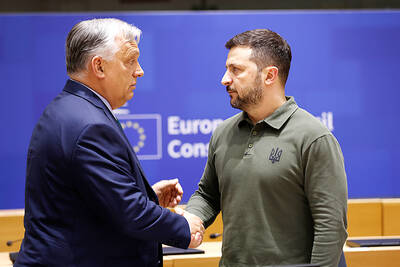
Hungarian authorities temporarily detained seven Ukrainian citizens and seized two armored cars carrying tens of millions of euros in cash across Hungary on suspicion of money laundering, officials said on Friday. The Ukrainians were released on Friday, following their detention on Thursday, but Hungarian officials held onto the cash, prompting Ukraine to accuse Hungary’s Russia-friendly government of illegally seizing the money. “We will not tolerate this state banditism,” Ukrainian Minister of Foreign Affairs Andrii Sybiha said. The seven detained Ukrainians were employees of the Ukrainian state-owned Oschadbank, who were traveling in the two armored cars that were carrying the money between Austria and
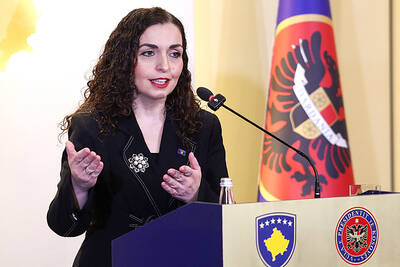
Kosovar President Vjosa Osmani on Friday after dissolving the Kosovar parliament said a snap election should be held as soon as possible to avoid another prolonged political crisis in the Balkan country at a time of global turmoil. Osmani said it is important for Kosovo to wrap up the upcoming election process and form functional institutions for political stability as the war rages in the Middle East. “Precisely because the geopolitical situation is that complex, it is important to finish this electoral process which is coming up,” she said. “It is very hard now to imagine what will happen next.” Kosovo, which declared

MORE BANS: Australia last year required sites to remove accounts held by under-16s, with a few countries pushing for similar action at an EU level and India considering its own ban Indonesia on Friday said it would ban social media access for children under 16, citing threats from online pornography, cyberbullying, online fraud and Internet addiction. “Accounts belonging to children under 16 on high-risk platforms will start to be deactivated, beginning with YouTube, TikTok, Facebook, Instagram, Threads, X, Bigo Live and Roblox,” Indonesian Minister of Communications and Digital Meutya Hafid said. “The government is stepping in so that parents no longer have to fight alone against the giants of the algorithm. Implementation will begin on March 28, 2026,” she said. The social media ban would be introduced in stages “until all platforms fulfill their
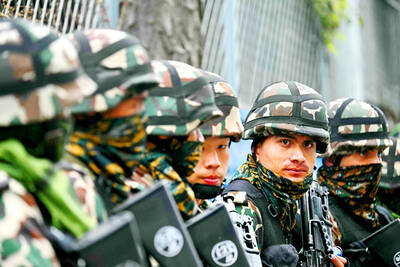
Counting was under way in Nepal yesterday, after a high-stakes parliamentary election to reshape the country’s leadership following protests last year that toppled the government. Key figures vying for power include former Nepalese prime minister K. P. Sharma Oli, rapper-turned-mayor Balendra Shah, who is bidding for the youth vote, and newly elected Nepali Congress party leader Gagan Thapa. In Kathmandu’s tea shops and city squares, people were glued to their phones, checking results as early trends flashed up — suggesting Shah’s centrist Rastriya Swatantra Party (RSP) was ahead. Nepalese Election Commission spokesman Prakash Nyupane said the counting was ongoing “in a peaceful manner”


 RSS
RSS