


Clapping rhythmically and shouting encouragement, thousands of Taiwanese fans rise to their feet in Taichung’s Intercontinental Stadium as Taiwan’s beloved Olympic baseball team charges onto a sun-dappled field. Cheerleaders — their bare midriffs tattooed with the Chinese characters for “home run” — encourage the crowd from near the Olympians’ dugout.
Welcome to Taiwan’s bid to turn the corner on international invisibility.
For a country deprived of membership in all but a handful of world organizations and treated as a pariah in capitals around the globe, Olympic baseball is a rare ticket to big-time legitimacy.
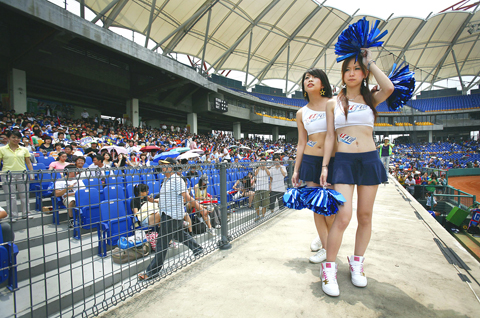
PHOTO: AP
When the squad arrives in Beijing on Sunday, it will be competing head to head with national teams from the US, Japan, Cuba and four other countries. All deny Taiwan diplomatic recognition, reflecting China’s insistence that the island is an integral part of its territory.
China has even stripped the island of the ability to compete in the Olympics under its official name of “Republic of China,” saddling it instead with “Chinese Taipei” — a moniker that doesn’t connote nationhood.
Now, Taiwanese baseball fans say, it’s time to get their own back — if only temporarily.
“The Olympics give us international exposure when we need it most,” said 37-year-old doctoral student Cheng Jen-wen, an enthusiastic backer of the Taiwanese team. “It helps to bolster our national identity.”
Many of the Taiwanese players agree.
“The Olympics are a very big opportunity for us,” said 19-year-old Kuo Yen-wen, who plays second base in a Florida-based rookie league as a prospect for Major League Baseball’s Cincinnati Reds. “It’s a wonderful chance to represent our country.”
Outfielder Lo Kuo-hui, 23, who plays for a Single-A affiliate of the Seattle Mariners, says the importance of baseball in Taiwan means added pressure for them in Beijing.
Smiling hopefully as a teammate hits a batting practice pitch well over the left-field wall, he says he’s not concerned.
“Sometimes pressure is a good thing,” he said. “It can help you to play better.”
That would certainly be a boon for Taiwan, which finished fifth at the 2004 Olympics in Athens. It was a big disappointment, particularly after a silver medal in Barcelona in 1992.
Roger Cheng, who directed a film on Taiwanese baseball for the US-based Discovery Channel, said this year’s 24-member team remains the heart of Taiwan’s Olympic squad, even though its athletes in taekwondo and archery stand a better chance of winning medals.
Cheng says baseball has been Taiwan’s leading sport since at least 1969, when a Taiwanese squad won the Little League World Series.
That came some 60 years after colonial master Japan first introduced baseball here, mainly as a recreational activity for its resident administrators. Taiwanese themselves took up the sport in the 1920s.
Cheng said that this year’s challenge for Taiwan at the Olympics is to use superior speed and fielding to carry the pitching.
Taiwan’s current baseball hero is New York Yankees pitcher Wang Chien-ming, but he — like all major leaguers — won’t be playing in the Olympics. Instead, the strongest teams — including Cuba, the US and Japan — are well-stocked with minor leaguers from Triple-A and Double-A, just short of major league standards. Taiwan mainly makes do with players a notch or two below that.
Kuo, the Reds prospect, says he’s not concerned by the apparent gap in talent.
“Sure, Japan and the US are good teams,” he said. “But I think our chances are really just as good as anybody else’s.”

FIFA on Friday blamed the empty seats during the FIFA World Cup match between South Korea and the Czech Republic in Guadalajara, Mexico, on fans who watched from the concourses. There were many visible empty spots at the 45,664-capacity Guadalajara Stadium, with sections in the middle of the stands showing many unoccupied spaces and with other empty seats scattered around the venue. The announced attendance was 44,985 — including FIFA president Gianni Infantino. “Official attendance figures reflect the number of tickets scanned and spectators present within the stadium footprint, rather than visual assessments of seating occupancy at any given moment
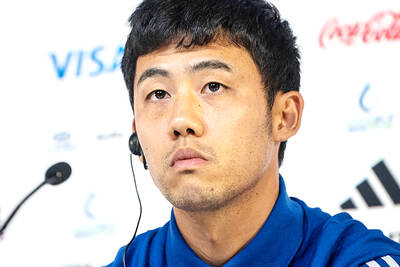
Japan captain Wataru Endo on Thursday was ruled out of the FIFA World Cup with injury and announced his international retirement, three days before his team’s opener against the Netherlands. The Liverpool midfielder pulled out of the tournament after failing to recover from a foot injury and was replaced in Japan’s squad by Shuto Machino. The 33-year-old Endo said on social media that he was “frustrated” at not being able to play, but backed his team to impress in Group F, where they face the Netherlands, Tunisia and Sweden. “There will definitely come a time in the future when Japan win the World

A rotting body was found on Friday in the trunk of a car parked near the stadium where Iran’s FIFA World Cup team is training in Mexico. The gruesome discovery came with games under way in the tournament, which is being jointly hosted by Mexico, the US and Canada. Reporters watched as police in Tijuana opened the trunk of the gray Toyota SUV, which had California plates, in the parking lot of a supermarket directly across from the Caliente Stadium, where Team Melli are training as they prepare for three games in the US. Specialists in white protective suits worked

About 100 people gathered at a bar in Taipei to watch the FIFA World Cup start in Mexico, despite the early hour of 3am yesterday. All seats had been reserved before the game started, said a clerk at the Brass Monkey, a bar in Taipei where customers can watch live sports broadcasts. The Group A clash between Mexico and South Africa drew supporters from multiple continents to the venue. For Misael Alanis, a Mexican student who has lived in Taiwan for two-and-a-half years, the atmosphere was just as important as the game itself. “There are a lot of Mexicans here and you can tell


 RSS
RSS