


The retirement of rugby union hookers Steve Thompson and Brendan Cannon on medical advice has highlighted the ongoing safety concern over front-row forwards.
But the sport's governing body, the International Rugby Board (IRB), is confident that new scrummaging laws will go some way to curtailing chronic neck injuries.
Thompson, 28, and Cannon, 34, faced each other in the 2003 World Cup final that Australia lost 20-17 to England and the latter's retirement now means that all the Australian front-row from their semi-final win against New Zealand have left the game with neck or spinal injuries.
Ben Darwin suffered a prolapsed disc after he lost feeling in his neck in a collapsed scrum, while Bill Young suffered chronic neck injuries with numbness in his left arm and hand which still returns on occasion.
Greg Thomas, head of communications for the IRB, said the new rules concerning scrummaging had been implemented in a bid to cut down on injuries.
"Rugby is a very physical game: there is a risk of injury in every aspect of the game and the scrum is obviously one area," Thomas said.
The new scrum regulations had been introduced, Thomas said, "as purely a safety issue."
"The front rows have been brought closer together to minimize impact. Our research showed that the `hit' was starting to cause long-term injuries and possible chronic injuries," he added.
Thomas argued that the number of reset scrums had not increased and "in some competitions it has gone down dramatically ... we are continuing to monitor the situation."
The new scrum laws employ a "crouch, touch, pause, engage" philosophy which sees the two opposing front rows standing closer to each other and the props within touching distance.
They are designed to lessen the full-frontal impact, with the goal of fewer collapsed scrums and resets but the truth remains that you still have up to 2,000kg worth of packs smashing into each other.

Greek swimmer Kristian Gkolomeev was the only athlete to “beat” a world record on Sunday at the Enhanced Games, winning the men’s 50m freestyle at the divisive competition where athletes were free to take performance-enhancing substances. His time of 20.81 seconds — which is not considered official — came in the final event of the night in Las Vegas, sparing the blushes of organizers who made claims that multiple world records would be surpassed due to a sophisticated doping regime. Gkolomeev, who was wearing a synthetic “supersuit” long banned at events such as the Olympics, outpaced Australia’s Cameron McEvoy’s 20.88 set in

Fred Kerley is competing unaugmented against drug-fuelled athletes at this weekend’s Enhanced Games and still hopes to race in the 2028 Olympics, the suspended former 100m world champion said on Friday. Arguably the biggest name at the divisive event in Las Vegas, where doping is permitted, the US sprinter said he had chosen not to take any of the banned substances including testosterone and steroids that his competitors have been using. “I don’t need it. God gave me fast feet for a reason. And I’m here to showcase my talent,” Kerley said. Kerley last September became the first US competitor and first track
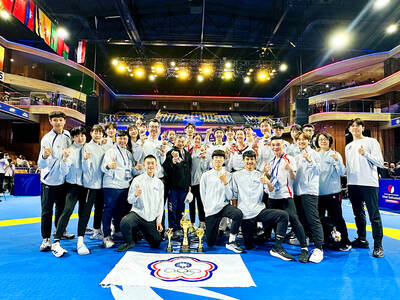
VICTORY ABROAD: The team took home a fistful of medals and secured spots for the autumn’s Asian Games, scheduled for September in Nagoya Taiwan’s women’s team captured the overall title at the Asian Taekwondo Championships in Mongolia on Sunday, finishing with two golds, one silver and one bronze medal. The strong showing, led by gold medalists Wang Chieh-ling and Chang Jui-en secured the full quota of available spots for Taiwan at the Asian Games in Nagoya, Japan, in September. Wang opened Taiwan’s medal run by winning gold in the women’s under-46kg class on Thursday, the first day of competition. Liu Yu-yun later earned a silver in the under-49kg class. On the final day on Sunday, Chang won Taiwan’s second gold medal in the under-62kg event, and

The manager of the Yomiuri Giants, one of Japan’s most popular baseball teams, resigned yesterday after he was arrested for allegedly physically attacking his teenage daughter. Shinnosuke Abe allegedly grabbed the 18-year-old and forced her to the floor at their home in central Tokyo on Monday evening, reported national broadcaster NHK and Kyodo News, citing unnamed police sources. “Leaving like this really means I’m causing you a lot of trouble, and I feel truly sorry about that,” Abe told a hastily arranged news conference, his eyes red with tears. The former star catcher, who is among baseball-obsessed Japan’s most recognized sports figures,


 RSS
RSS