


Angola won a four-way contest on Monday to host the 2010 African Nations Cup, the organizers said.
The southern African state was the unanimous choice of the Confederation of African Football (CAF) executive committee ahead of Libya, Nigeria and a joint bid by Equatorial Guinea and Gabon.
CAF president Issa Hayatou of Cameroon and the 12-man executive listened to 10-minute presentations from the four contenders before reaching the decision at their headquarters on the outskirts of the Egyptian capital.
But there was consolation for two of the losing bids with Equatorial Guinea and Gabon (2012) and Libya (2014) awarded the right to host the following two editions of the Nations Cup, won by hosts Egypt last February.
This is the first time the Cairo-based continental body have selected the hosts of three editions of the biennial showpiece of African soccer at the same time.
"We have taken the decision to name three Nations Cup hosts at the same time to ensure that our hosts have adequate time to prepare for the competitions," CAF general secretary Mustapha Fahmy told reporters. "CAF also wanted to develop the game in countries that have not had a chance to host the tournament."
"It was also important for our sponsors as they now have a clear idea what CAF is doing with its competitions over the next few years," the long-serving official added.
Angola were slight favorites ahead of the vote given their geographical proximity to 2010 World Cup hosts South Africa and a promise to invest US$140 million in four stadia.
It will be the first time that a Portuguese-speaking country stages the Nations Cup and only the second time the event comes to the south of the continent after South Africa stepped in 10 years ago when Kenya withdrew.
Although Angola is rich in oil and minerals, the national Citadela Stadium in Luanda is dilapidated with the upper tier of the main stand unused for many years due to safety concerns.
In the build-up to the vote, Angolan officials promised CAF inspectors they would revamp the Luanda stadium, and build new ones in the provinces of Benguela, Cabinda and Huila.
Hotels and communications and health facilities are also to be built in a country slowly recovering from a 27-year civil war that claimed thousands of lives and destroyed much infrastructure.
Fighting erupted between political and military rivals MPLA and Unita soon after independence from Portugal in 1975 and the rural population bore the brunt of the resultant devastation.
Angola competed at the World Cup for the first time last June, losing narrowly to eventual semi-finalists Portugal before drawing with Mexico and Iran to finish third and thus seal their first round exit.
Known as Palancas Negros (Black Antelopes), the national team caused a sensation by topping a qualifying group including star-studded Nigeria, who had reached the previous three tournaments.

Revelations of positive doping tests for nearly two dozen Chinese swimmers that went unpunished sparked an intense flurry of accusations and legal threats between the World Anti-Doping Agency (WADA) and the head of the US drug-fighting organization, who has long been one of WADA’s fiercest critics. WADA on Saturday said it was turning to legal counsel to address a statement released by US Anti-Doping Agency (USADA) CEO Travis Tygart, who said WADA and anti-doping authorities in China swept positive tests “under the carpet by failing to fairly and evenly follow the global rules that apply to everyone else in the world.” The

Taiwanese judoka Yang Yung-wei on Saturday won silver in the men’s under-60kg category at the Asian Judo Championships in Hong Kong. Nicknamed the “judo heartthrob” in Taiwan, the Olympic silver-medalist missed out on his first Asian Championships gold when he lost to Japanese judoka Taiki Nakamura in the finals. Yang defeated three opponents on Saturday to reach the final after receiving a bye through the round of 32. He first topped Laotian Soukphaxay Sithisane in the round of 16 with two seoi nage (over-the-shoulder throws), then ousted Indian Vijay Kumar Yadav in the quarter-finals with his signature ude hishigi sankaku gatame (triangular armlock). He

RALLY: It was only the second time the Taiwanese has partnered with Kudermetova, and the match seemed tight until they won seven points in a row to take the last set 10-2 Taiwan’s Chan Hao-ching and Russia’s Veronika Kudermetova on Sunday won the Porsche Tennis Grand Prix women’s doubles final in Stuttgart, Germany. The pair defeated Norway’s Ulrikke Eikeri and Estonia’s Ingrid Neel 4-6, 6-3, 10-2 in a tightly contested match at the WTA 500 tournament. Chan and Kudermetova fell 4-6 in the first set after having their serve broken three times, although they played increasingly well. They fought back in the second set and managed to break their opponents’ serve in the eighth game to triumph 6-3. In the tiebreaker, Chan and Kudermetova took a 3-0 lead before their opponents clawed back two points, but
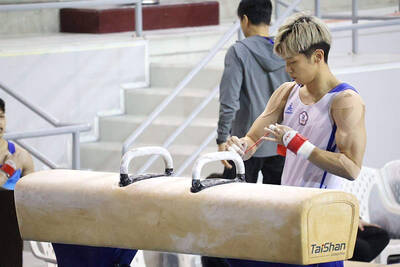
Taiwanese gymnast Lee Chih-kai failed to secure an Olympic berth in the pommel horse following a second-place finish at the last qualifier in Doha on Friday, a performance that Lee and his coach called “unconvincing.” The Tokyo Olympics silver medalist finished runner-up in the final after scoring 6.6 for degree of difficulty and 8.800 for execution for a combined score of 15.400. That was just 0.100 short of Jordan’s Ahmad Abu Al Soud, who had qualified for the event in Paris before the Apparatus World Cup series in Qatar’s capital. After missing the final rounds in the first two of four qualifier


 RSS
RSS