


At Tibet's holiest shrine, young monks are getting up at 3am -- not to pray, but to watch the World Cup.
Lights flickered in the windows of the Potala Palace, former home of Tibet's exiled ruler, the Dalai Lama, as France beat Portugal this week to set up a final showdown tomorrow against Italy.
Monks watched on a 54cm color TV, drinking Coca-Cola and eating instant noodles, said Lobsang, a 27-year-old monk with a gapped-toothed smile and a closely shorn head.
"I get very excited, very happy, when I watch the games because I get to see a lot of the famous players," said Lobsang, who like many of the 83 monks at the palace goes by only one name.
Tibet's Buddhist monks aren't encouraged to play soccer, though they are allowed to watch. But among ordinary Tibetans, the game is as wildly popular as it is in the rest of sports-mad China.
"Most Tibetans love and play football," says Bian Ba, a former defender for Tibet's official league team. He now works in the Potala Palace, helping with tourists and keeping an eye on the treasures.
At the sports bar of the Yak Hotel in Lhasa, about 20 mostly Tibetan fans watched games as they drank beer and ate meat and potatoes grilled on skewers over a trough of hot coals.
Restaurants in the Tibetan capital that stayed open until early morning were crammed with Tibetans and Chinese migrant workers watching the game.
At the Johkang Monastery, where the main hall is filled with jewel-encrusted gold religious statues, the walls of the dormitory for young monks are hung with posters of Brazil's Pele and Ronaldo and Real Madrid's Roberto Carlos. The monks call them the "soccer kings."
Other pictures show the Dalai Lama and the Karmapa, another exiled Tibetan spiritual leader.
A young monk sits on a floor cushion absorbed in a Chinese-language soccer magazine with articles about England's David Beckham and other stars.
But is it acceptable for monks to become so attached to a sport when their goal is to let go of worldly pleasures?
Lobsang, from the Potala, thinks so.
"This activity brings a kind of happiness," he said. "It doesn't harm anybody and it brings people together."

Revelations of positive doping tests for nearly two dozen Chinese swimmers that went unpunished sparked an intense flurry of accusations and legal threats between the World Anti-Doping Agency (WADA) and the head of the US drug-fighting organization, who has long been one of WADA’s fiercest critics. WADA on Saturday said it was turning to legal counsel to address a statement released by US Anti-Doping Agency (USADA) CEO Travis Tygart, who said WADA and anti-doping authorities in China swept positive tests “under the carpet by failing to fairly and evenly follow the global rules that apply to everyone else in the world.” The
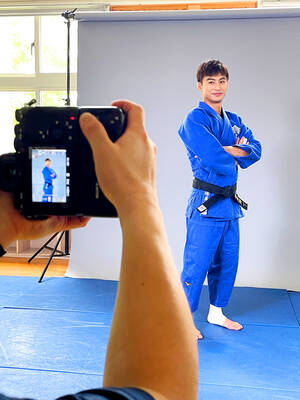
Taiwanese judoka Yang Yung-wei on Saturday won silver in the men’s under-60kg category at the Asian Judo Championships in Hong Kong. Nicknamed the “judo heartthrob” in Taiwan, the Olympic silver-medalist missed out on his first Asian Championships gold when he lost to Japanese judoka Taiki Nakamura in the finals. Yang defeated three opponents on Saturday to reach the final after receiving a bye through the round of 32. He first topped Laotian Soukphaxay Sithisane in the round of 16 with two seoi nage (over-the-shoulder throws), then ousted Indian Vijay Kumar Yadav in the quarter-finals with his signature ude hishigi sankaku gatame (triangular armlock). He

RALLY: It was only the second time the Taiwanese has partnered with Kudermetova, and the match seemed tight until they won seven points in a row to take the last set 10-2 Taiwan’s Chan Hao-ching and Russia’s Veronika Kudermetova on Sunday won the Porsche Tennis Grand Prix women’s doubles final in Stuttgart, Germany. The pair defeated Norway’s Ulrikke Eikeri and Estonia’s Ingrid Neel 4-6, 6-3, 10-2 in a tightly contested match at the WTA 500 tournament. Chan and Kudermetova fell 4-6 in the first set after having their serve broken three times, although they played increasingly well. They fought back in the second set and managed to break their opponents’ serve in the eighth game to triumph 6-3. In the tiebreaker, Chan and Kudermetova took a 3-0 lead before their opponents clawed back two points, but
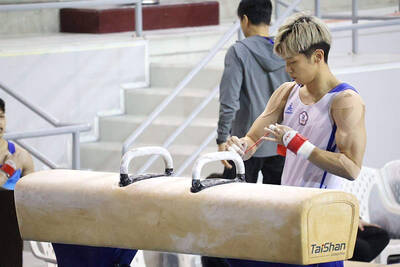
Taiwanese gymnast Lee Chih-kai failed to secure an Olympic berth in the pommel horse following a second-place finish at the last qualifier in Doha on Friday, a performance that Lee and his coach called “unconvincing.” The Tokyo Olympics silver medalist finished runner-up in the final after scoring 6.6 for degree of difficulty and 8.800 for execution for a combined score of 15.400. That was just 0.100 short of Jordan’s Ahmad Abu Al Soud, who had qualified for the event in Paris before the Apparatus World Cup series in Qatar’s capital. After missing the final rounds in the first two of four qualifier


 RSS
RSS