


"Boink, boink, Puni, Puni. Have one, Puni, Puni. It's a meeting gift, inside your mouth, Puni, Puni. QQ (chewy chewy) and sweet, sweet. Bactobacillus, various flavors. I love you, you love me, Puni, Puni, Pinky."
You may ask yourself: "What's a song about candy featuring primate-like-Teletubby creatures on helium got to do with a soccer column?"
The answer: That's what armchair World Cup fans are putting up with when advertisements for drug companies, brandy and snacks pop up during games.
Contrary to previous reports saying ads would not be broadcast on local TV during Cup matches in the knockout stages, they have not received a red card.
Though the frequency of ads during games has thankfully lessened, there is no end in sight to them, according to a source at Era TV.
The TV company holds exclusive rights to broadcast the World Cup, as it did in 2002. Games are being shown on three of the station's channels -- MUCH (38), Azio (37) and Era News (50).
The Era source, who spoke on condition of anonymity, admitted there had been widespread criticism of the company for broadcasting ads while the games are being played.
But, the source added, this was necessary to defray the NT$200 million (US$6.1 million) cost of buying exclusive rights to the Cup.
"Everyone knows that Taiwan is a football desert and it's only the World Cup that people will watch. We really should be applauded for showing these games. Nobody else is," the source said.
Though big matches in the evening have been attracting respectable viewing figures of over 1 million people (an A.C. Nielson rating of 3.2), games in the early morning have a rating of around 0.3.
The source said there was no other way of deriving revenue from broadcasting the soccer as the government has regulations against showing logos during games.
No other TV company bid for the rights to the World Cup and if Era had not done so there would be no local coverage at all, the source said.
And, because games at South Africa's World Cup in 2010 will likely be broadcast during prime time, it may not be economically feasible for Era to bid next time.
"Then people will be crying and thinking this year is not so bad. We are not making big money on this," the source said.
But there are ways around the ads. The Taipei Times suggests you switch between channels (37 and 38) when the ads play; pay for satellite; or go to a pub with satellite transmission. Otherwise, for the sake of sanity, it's best to embrace the company boss selling drugs and the colorful cartoons promoting candy.
"Puni! Puni! Give it to me."
On the pitch, meanwhile, Asia's great white hope was bounced out of the World Cup by an injury-time penalty from a substitute.
The 1-0 loss to Italy was heartbreaking for the Aussies, but the newest Asian Football Confederation (AFC) team can leave Germany with its pride intact after a great showing at only its second World Cup.
Based on its Cup exploits, the Socceroos are the AFC's top team and will add a much-needed competitive element to the continent's soccer.
Football Federation Australia chief executive John O'Neill was quoted by the Asian Football Business Review as saying: "When we went into Asia on Jan. 1, we had a FIFA ranking, but not an Asian one.
"That's why we have gone into [next year's] Asian Cup qualifiers as an unseeded team. But this result should mean we will be ranked one or two in whatever [future World Cup] pool we end up in."
According to the Melbourne-based Age newspaper, Australia's successful run at the World Cup will boost chances of a yearly three-nation tournament with Japan and South Korea, which could then be expanded to include North Korea and China.
This way the region's best teams would be able to sharpen their skills against each other. Competition is the key to improvement and thus Asian soccer will benefit from the inclusion of Australia.
In the next World Cup Diary on Saturday, we follow the money to find out why there's so much domestic interest in the World Cup when it's a "football desert" the rest of the time. Clue: It's not the beautiful game but the odds of winning a wager.

Revelations of positive doping tests for nearly two dozen Chinese swimmers that went unpunished sparked an intense flurry of accusations and legal threats between the World Anti-Doping Agency (WADA) and the head of the US drug-fighting organization, who has long been one of WADA’s fiercest critics. WADA on Saturday said it was turning to legal counsel to address a statement released by US Anti-Doping Agency (USADA) CEO Travis Tygart, who said WADA and anti-doping authorities in China swept positive tests “under the carpet by failing to fairly and evenly follow the global rules that apply to everyone else in the world.” The

Taiwanese judoka Yang Yung-wei on Saturday won silver in the men’s under-60kg category at the Asian Judo Championships in Hong Kong. Nicknamed the “judo heartthrob” in Taiwan, the Olympic silver-medalist missed out on his first Asian Championships gold when he lost to Japanese judoka Taiki Nakamura in the finals. Yang defeated three opponents on Saturday to reach the final after receiving a bye through the round of 32. He first topped Laotian Soukphaxay Sithisane in the round of 16 with two seoi nage (over-the-shoulder throws), then ousted Indian Vijay Kumar Yadav in the quarter-finals with his signature ude hishigi sankaku gatame (triangular armlock). He

RALLY: It was only the second time the Taiwanese has partnered with Kudermetova, and the match seemed tight until they won seven points in a row to take the last set 10-2 Taiwan’s Chan Hao-ching and Russia’s Veronika Kudermetova on Sunday won the Porsche Tennis Grand Prix women’s doubles final in Stuttgart, Germany. The pair defeated Norway’s Ulrikke Eikeri and Estonia’s Ingrid Neel 4-6, 6-3, 10-2 in a tightly contested match at the WTA 500 tournament. Chan and Kudermetova fell 4-6 in the first set after having their serve broken three times, although they played increasingly well. They fought back in the second set and managed to break their opponents’ serve in the eighth game to triumph 6-3. In the tiebreaker, Chan and Kudermetova took a 3-0 lead before their opponents clawed back two points, but
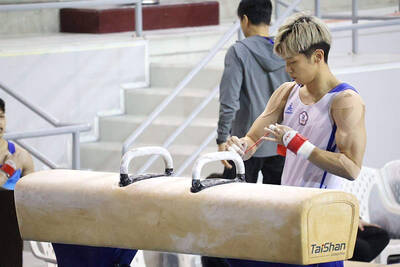
Taiwanese gymnast Lee Chih-kai failed to secure an Olympic berth in the pommel horse following a second-place finish at the last qualifier in Doha on Friday, a performance that Lee and his coach called “unconvincing.” The Tokyo Olympics silver medalist finished runner-up in the final after scoring 6.6 for degree of difficulty and 8.800 for execution for a combined score of 15.400. That was just 0.100 short of Jordan’s Ahmad Abu Al Soud, who had qualified for the event in Paris before the Apparatus World Cup series in Qatar’s capital. After missing the final rounds in the first two of four qualifier


 RSS
RSS