


Lowe's Motor Speedway featured a new surface and a different feel for the annual NASCAR Nextel All-Star Challenge Saturday night. But the result was familiar.
Jimmie Johnson, who has won the last four Cup races here and five of the past six, added the All-Star Challenge title to his collection after passing Kevin Harvick with 19 laps to go and pulling away from the field. Johnson collected more than US$1 million for the victory in a race that featured a series of wrecks that reduced the 20-car field to nine cars at the end.
"It's the Nextel All-Star crashfest," Tony Stewart said after he was knocked out in a wreck involving Matt Kenseth.
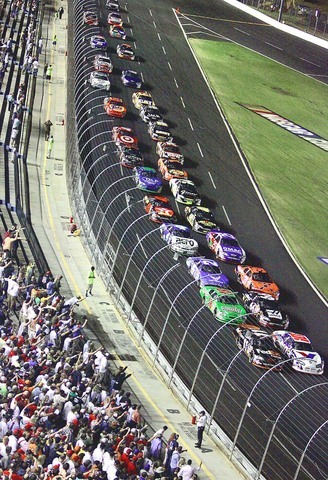
PHOTO: AP
Johnson made his way through a difficult 90 laps in the event, which is broken into a series of races -- a 40-lap segment, a 30-lap portion and a 20-lap sprint to the end. A red flag in the first segment delayed the race for several minutes because of rain.
After the first leg this year, the order of the top 10 finishers was inverted to start the second segment. Kyle Busch won the first segment but started the second part in 10th. Ryan Newman, who was 10th after the first segment, started first.
Johnson was penalized for speeding on pit road in the first segment, and he finished 11th. He was second after the second segment.
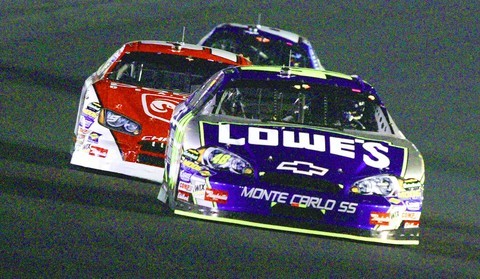
PHOTO: AP
A seven-car crash took out the leaders in the second segment. Moments after a restart on Lap 49, the race leader Kasey Kahne lost control coming off of Turn 2 and slid into Mark Martin's car on the outside, slamming him into the wall. Five more cars were collected in the wreck, including those driven by Busch, Stewart, Jamie McMurray, Jeremy Mayfield and Greg Biffle.
"Just lost grip," Kahne said. "It was all there and great and gone just like that. It's tough. There's not a lot of grip out there."
Stewart was the only driver able to return with the field down to 12 cars at that point. But it was Harvick who emerged as the leader after that second segment, with 20 laps to go. He was then passed by Johnson.
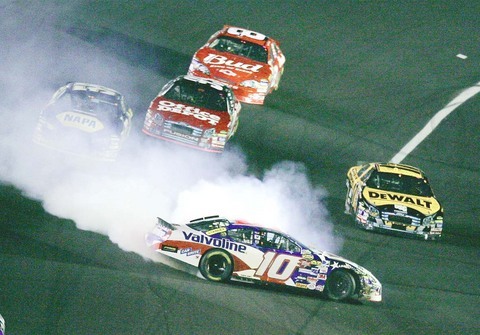
PHOTO: AP
Earlier Saturday, Scott Riggs won the Nextel Open. The event is a 30-lap race for drivers who did not win events in the Cup series in 2005 and 2006 and were not former All-Star winners or Series champions. As the winner of the Open, Riggs advanced to the Challenge.
Also advancing was Kyle Petty, who finished 22nd in the Open but was voted into the Challenge by fans. Fans can vote one driver into the Challenge, and Petty had openly campaigned for the vote. He vowed to donate all of his winnings to the Victory Junction Gang Camp for chronically ill children. Coca-Cola also promised to donate US$250,000 to the camp in Randleman, North Carolina, if Petty was voted into the field.
DRIVER RATINGs
Through nearly 25 years of racing in NASCAR's premier series, Mark Martin has competed against an all-star list of champion drivers from Dale Earnhardt to Richard Petty, Jeff Gordon, Darrell Waltrip and Cale Yarborough. But ask Martin to name the best he has ever chased, and he mentions none of them.
"Tony Stewart," Martin said Tuesday during a telephone conference call with reporters. "He's just the man, in my opinion."
Martin has no statistics to back up his choice, no numbers to quantify Stewart's talent and dominance beyond the 25 career victories and two points titles since joining NASCAR's Cup Series in 1999 after winning the Indy Racing League title.
But NASCAR has come up with a statistic that might prove Martin is right, at least among today's Cup competitors. It is the driver rating, a ranking based on eight factors from speed to finish. NASCAR officials want it to become the equivalent of the quarterback rating in football, a ranking that goes beyond victories and points to consider all of the factors that make some drivers better than others.
This season, the series has been offering driver rating with a package of new statistics from quality passes to top closers, a chart of drivers who make up the most places in the final 10 percent of races.
"Everyone knows who won the race; this helps talk about how the race was won," Ramsey Poston, NASCAR's managing director of corporate communications, said of the new statistical package during a telephone interview last week. "This sport is certainly more than just making left turns. This sport is about strategy, it's about speed, it's about performance.
"We wanted a rating that measured something more than just the number of races any driver wins, and I think we've captured that."
For years, NASCAR had no way to accurately track drivers on each lap to make those measurements. But two years ago, officials eliminated a rule allowing drivers to race back to the start-finish line when yellow flags come out during races. Instead, NASCAR froze the running order immediately.
Officials then needed a way to determine everyone's place, so scoring loops were installed at every track. Thin wires were embedded in the surface, and transponders relay data to scoring officials during races.
What resulted, beyond the placements needed during caution periods, was a mass of raw data from each race that no one knew what to do with.
"I said, `Let's get out and talk to these houses of geeks,'" Poston said.
Last summer, NASCAR approached Stats LLC and other sports statistics companies to find a way to use the data produced by the scoring loops.
Stefan Kretschmann, systems manager of commercial products for Stats LLC, had been a rabid NASCAR fan since 2003. But he was frustrated by the lack of statistics.
"I was just amazed there was so little information actually available," he said.
So Kretschmann, 34, devised his own statistics. And Stats LLC won the contract after Kretschmann showed what kinds of statistics could be based on the raw data. He developed a box score that included green-flag passes, fastest laps, consecutive laps with a pass, consecutive passes without being passed, passes on the backstretch, in turns and so on.
But the driver rating is the most crucial number. Produced through trial and error, it is derived from a formula that includes victories, finishes, top-15 finishes, average running position while on the lead lap, average speed under green, fastest lap, leader of the most laps and lead-lap finish.
The categories are weighted, and the maximum point total is 150.
By that formula, Martin is right. Stewart is No. 1 in the driver rating through the Dodge Charger 500, which was run on May 13 at Darlington, South Carolina, although Jimmie Johnson is the points leader and leads all drivers with three victories in 11 races this season.

Revelations of positive doping tests for nearly two dozen Chinese swimmers that went unpunished sparked an intense flurry of accusations and legal threats between the World Anti-Doping Agency (WADA) and the head of the US drug-fighting organization, who has long been one of WADA’s fiercest critics. WADA on Saturday said it was turning to legal counsel to address a statement released by US Anti-Doping Agency (USADA) CEO Travis Tygart, who said WADA and anti-doping authorities in China swept positive tests “under the carpet by failing to fairly and evenly follow the global rules that apply to everyone else in the world.” The

Taiwanese judoka Yang Yung-wei on Saturday won silver in the men’s under-60kg category at the Asian Judo Championships in Hong Kong. Nicknamed the “judo heartthrob” in Taiwan, the Olympic silver-medalist missed out on his first Asian Championships gold when he lost to Japanese judoka Taiki Nakamura in the finals. Yang defeated three opponents on Saturday to reach the final after receiving a bye through the round of 32. He first topped Laotian Soukphaxay Sithisane in the round of 16 with two seoi nage (over-the-shoulder throws), then ousted Indian Vijay Kumar Yadav in the quarter-finals with his signature ude hishigi sankaku gatame (triangular armlock). He

RALLY: It was only the second time the Taiwanese has partnered with Kudermetova, and the match seemed tight until they won seven points in a row to take the last set 10-2 Taiwan’s Chan Hao-ching and Russia’s Veronika Kudermetova on Sunday won the Porsche Tennis Grand Prix women’s doubles final in Stuttgart, Germany. The pair defeated Norway’s Ulrikke Eikeri and Estonia’s Ingrid Neel 4-6, 6-3, 10-2 in a tightly contested match at the WTA 500 tournament. Chan and Kudermetova fell 4-6 in the first set after having their serve broken three times, although they played increasingly well. They fought back in the second set and managed to break their opponents’ serve in the eighth game to triumph 6-3. In the tiebreaker, Chan and Kudermetova took a 3-0 lead before their opponents clawed back two points, but

Taiwanese gymnast Lee Chih-kai failed to secure an Olympic berth in the pommel horse following a second-place finish at the last qualifier in Doha on Friday, a performance that Lee and his coach called “unconvincing.” The Tokyo Olympics silver medalist finished runner-up in the final after scoring 6.6 for degree of difficulty and 8.800 for execution for a combined score of 15.400. That was just 0.100 short of Jordan’s Ahmad Abu Al Soud, who had qualified for the event in Paris before the Apparatus World Cup series in Qatar’s capital. After missing the final rounds in the first two of four qualifier


 RSS
RSS