


Seven weeks ago, as I do every Sunday morning, I shuffled through the NY Times in my kitchen in Darien, Connecticut. This time, the sports section stopped me. I was in it.
There was a photo collage on the front page showing some of the forefathers of the National Football League. George Halas, the owner and coach of the Chicago Bears, was pictured riding the shoulders of his players after the 1940 NFL championship game. There were 13 joyous faces surrounding Halas, and mine was the youngest.
I was 10 and the unofficial mascot of the Bears. I wore No. 5, and I was probably the only person in uniform who did not play in the record 73-0 rout of the Washington Redskins. My father, Hunk Anderson, coached the line for Halas and called the defensive signals.
PHOTO: EPA
He and Halas never called one for me, though, despite the urging of the players. I was there on the sideline in shoulder pads and my leather helmet. It fit like a glove. I remember some players telling Halas, "Let Billy go in for one play, George!"
I just laughed about the notion, but I thought that if I could have gone in, nobody would have bothered me. The Redskins couldn't make a block or a tackle, and the Bears looked invincible. We kicked so many extra points into the stands that we weren't allowed to kick after the final two touchdowns. The referees were down to one football.
Old-school football
It's beautiful to see the Bears winning again, and doing it with defense. My father would have loved this team, or any whose greatest strength is its toughness. After Dad died in 1978, Red Smith wrote this about him in the Times: "Hunk Anderson was the toughest nice guy or the nicest tough guy I ever knew." It was a fitting epitaph.
My father was born in 1898 near Calumet, Michigan, the copper country on the Upper Peninsula. He played football on a cobblestone road, using a pig's bladder for a ball, or so he would say. One of his high school teammates was George Gipp, who took him to Notre Dame and introduced him to coach Knute Rockne.
My father earned an engineering degree while winning all-American honors as a 165-pound guard in a career that put him in the College Football Hall of Fame. He went on to play five years for the Bears, one of three jobs he held at the time.
Every weekday at 7am, he reported to an iron works in South Bend, Ind. At 3pm, he left for campus to coach Rockne's line. On Friday night, he took a train to Chicago. He studied film and game plans on Saturday night, played for Halas on Sunday and came home that night. Rockne showed him film of the game he had missed.
It was a hectic arrangement, but the instruction got through to his players. My father's linemen formed the Seven Mules, who blocked for the fabled Four Horsemen of Notre Dame.
He knew his coaching. He invented the blitz -- the red dog, it was called then -- and from his background in engineering and his small size, he knew how to use leverage on the field. He was the first to use the reverse-body block, understanding that the bigger players' weight could bring them down.
He must have also been the only guard in football who kept all his teeth. I would ask him how he did it, with no face mask to protect him, and he said he never closed his eyes.
After Rockne died in a plane crash in 1931, Dad succeeded him as the coach at Notre Dame. In 1940, after a year as the line coach of the Detroit Lions, he joined Halas on the Bears' sideline. They won four NFL championships in the 1940s, including one while Dad was co-head coach while Halas served in the military.
Halas needed a strong assistant. His skill was recruiting and retaining great players, and running the business. On Sundays, he was emotionally hyped. Fortunately, Luke Johnsos called the offensive plays from the press box and Dad ran the players in and out. Halas just tried to contain himself.
When the Bears played in New York, Halas, my father and the sportswriters would play tackle football with Toots Shor at his restaurant after the games. Toots would kick everybody out at 10 or 11, and they would push aside all the tables and have at it. The first line of Dad's autobiography got right to the point: "Football has been my life and I enjoyed every minute of it."
The games were the rewards for me. My father would let me tag along at training camp, where I roomed with the players. The Bears had two practices a day for a month, and I joined in the workouts. I'd go to the skull sessions at night and sit for hours watching film, going through game plans.
These were serious men, with college degrees and better-paying jobs out of season, but they had fun, too.
Sid Luckman and George McAfee would take a gang of us to the local fair in Rensselaer, Indiana, and they would throw darts or knock down milk bottles and win all the prizes within 20 minutes. The carnies chased us out.
McAfee, a Hall of Fame halfback, was my hero. I wore his number and watched him with awe. I went to Duke because he had gone there. But I was worthless as a football player. I was a 156-pound halfback and they needed a defensive end, and I was run over continually. I switched to track and had four great years, and it was not an issue with Dad.
As a player, he would throw dirt, gouge eyes, bruise arms and legs. But he was a dear and loving father, and all he asked was that you loved what you did and worked hard at it.
He died of emphysema at age 79; in many of my photos of him, he has a cigarette in his hand on the sideline. But I still see him in my grandson, Austin, who has a habit of chewing his tongue when he's playing basketball at Darien High. I never did it, and neither did my four sons. But Dad did.
Another grandson, William, is 7 and plays football in Hingham, Mass. I'm told he just completed two length-of-the-field touchdown runs. He would have fit right in with the 1940 Bears.
Bill Anderson is a retired systems executive living in Darien, Connecticut

Revelations of positive doping tests for nearly two dozen Chinese swimmers that went unpunished sparked an intense flurry of accusations and legal threats between the World Anti-Doping Agency (WADA) and the head of the US drug-fighting organization, who has long been one of WADA’s fiercest critics. WADA on Saturday said it was turning to legal counsel to address a statement released by US Anti-Doping Agency (USADA) CEO Travis Tygart, who said WADA and anti-doping authorities in China swept positive tests “under the carpet by failing to fairly and evenly follow the global rules that apply to everyone else in the world.” The
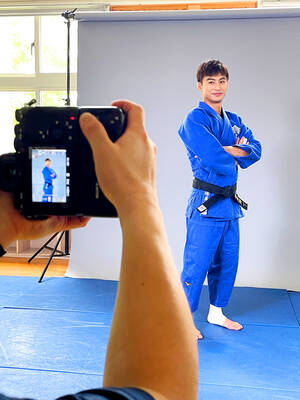
Taiwanese judoka Yang Yung-wei on Saturday won silver in the men’s under-60kg category at the Asian Judo Championships in Hong Kong. Nicknamed the “judo heartthrob” in Taiwan, the Olympic silver-medalist missed out on his first Asian Championships gold when he lost to Japanese judoka Taiki Nakamura in the finals. Yang defeated three opponents on Saturday to reach the final after receiving a bye through the round of 32. He first topped Laotian Soukphaxay Sithisane in the round of 16 with two seoi nage (over-the-shoulder throws), then ousted Indian Vijay Kumar Yadav in the quarter-finals with his signature ude hishigi sankaku gatame (triangular armlock). He

RALLY: It was only the second time the Taiwanese has partnered with Kudermetova, and the match seemed tight until they won seven points in a row to take the last set 10-2 Taiwan’s Chan Hao-ching and Russia’s Veronika Kudermetova on Sunday won the Porsche Tennis Grand Prix women’s doubles final in Stuttgart, Germany. The pair defeated Norway’s Ulrikke Eikeri and Estonia’s Ingrid Neel 4-6, 6-3, 10-2 in a tightly contested match at the WTA 500 tournament. Chan and Kudermetova fell 4-6 in the first set after having their serve broken three times, although they played increasingly well. They fought back in the second set and managed to break their opponents’ serve in the eighth game to triumph 6-3. In the tiebreaker, Chan and Kudermetova took a 3-0 lead before their opponents clawed back two points, but
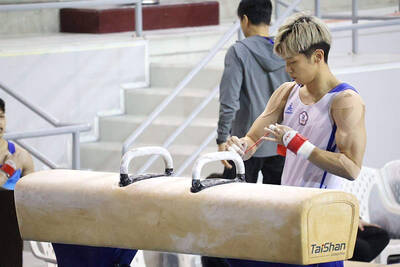
Taiwanese gymnast Lee Chih-kai failed to secure an Olympic berth in the pommel horse following a second-place finish at the last qualifier in Doha on Friday, a performance that Lee and his coach called “unconvincing.” The Tokyo Olympics silver medalist finished runner-up in the final after scoring 6.6 for degree of difficulty and 8.800 for execution for a combined score of 15.400. That was just 0.100 short of Jordan’s Ahmad Abu Al Soud, who had qualified for the event in Paris before the Apparatus World Cup series in Qatar’s capital. After missing the final rounds in the first two of four qualifier


 RSS
RSS