


The single-elimination knock-out tournament in the Pacific Curling Championships will begin tomorrow, concluding with a championship match on Wednesday at the Taipei Arena.
The event has attracted sizeable crowds and the facilities have thoroughly pleased international organizers.
"The quality of ice is 100 percent in accordance with World Curling Federation requirements, and it's the first curling competition to take place in the sub-tropics," said Hiro Saito, president of the Pacific Curling Federation and organizer of the event.
Saito, a Japanese-native, became interested in the sport while living in Hastings-On-Hudson, New York, in the late 1970s where he became a member of the St. Andrew's Curling Club. Upon returning to Japan, he helped found the nation's first curling club in 1990. There are now some 5,000 participants in Japan.
Headed to Italy
As one of 10 qualifiers, Saito will accompany the Japanese women's curling team to the Winter Olympics in February.
Although the winners of the Pacific Curling Championships won't receive an automatic Olympic bid, the top two finishers will be invited to the World Curling Championships in Victoria, Canada.
Asian teams are are making great strides in the sport, with China now ranked seventh in the world.
"They play a very defensive style, which has done them very well in competition," said Bradley Burton, coach of the South Korea's men's team. "The Chinese Taipei team, on the other hand, likes to score points whenever possible."
Burton says that rule changes, specifically the "free guard" rule in the early 1990s, were made to make the sport less of a defensive game, and one that is based on higher scoring and finesse.
"Before, we used to see some games with scores like 1-0," he said. "Now that you aren't allowed to knock out your opposition's guard position with the first four stones, the game has changed dramatically."
He adds that the high humidity in Taipei has led to slower ice, as airborne vapor condenses as a frost on the ice surface. The frost isn't much of an issue as each stone moving down the ice is accompanied by 2-3 sweepers with push brooms to either speed up or slow down the stone.
Modern equipment
The switch to push brooms occurred in the late 1970s replacing the earlier corn brooms which were more expensive and easily littered the ice with shavings and splintered stalks. Push brooms also allows the sweeper to use their weight to "polish" the path of the stone as it make's its way to the bulls-eye, or "house" as it's called in curling.
Other lingo associated with the sport is the "hammer" which is the last stone thrown by a team in one frame or end. This stone is crucial, as it can either knock-out an opponent's stone from the center or can gently glide in and become the "shot rock" or the stone that is closest to the "house."
While it may take time to learn the sport, professional players have a lengthy life-span as many members of national teams routinely rack up 10 years of international play, and the current skipper of the Australian Men's team has more than 30 years of international experience.
The Chinese Taipei Curling Association, which operates under the Chinese Taipei Skating Union, has been in operation for six years.
The single elimination tournament continues tomorrow, with matches at 8:30am, 1:30pm and 6:30pm. On Wednesday, the bronze-medal match is scheduled for 9am and the gold-medal match beginning at 1:30pm.

Revelations of positive doping tests for nearly two dozen Chinese swimmers that went unpunished sparked an intense flurry of accusations and legal threats between the World Anti-Doping Agency (WADA) and the head of the US drug-fighting organization, who has long been one of WADA’s fiercest critics. WADA on Saturday said it was turning to legal counsel to address a statement released by US Anti-Doping Agency (USADA) CEO Travis Tygart, who said WADA and anti-doping authorities in China swept positive tests “under the carpet by failing to fairly and evenly follow the global rules that apply to everyone else in the world.” The
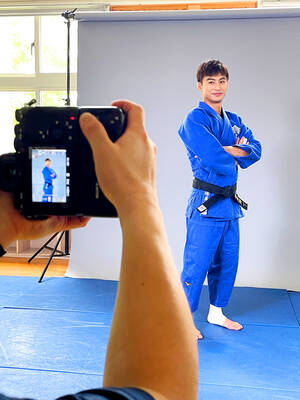
Taiwanese judoka Yang Yung-wei on Saturday won silver in the men’s under-60kg category at the Asian Judo Championships in Hong Kong. Nicknamed the “judo heartthrob” in Taiwan, the Olympic silver-medalist missed out on his first Asian Championships gold when he lost to Japanese judoka Taiki Nakamura in the finals. Yang defeated three opponents on Saturday to reach the final after receiving a bye through the round of 32. He first topped Laotian Soukphaxay Sithisane in the round of 16 with two seoi nage (over-the-shoulder throws), then ousted Indian Vijay Kumar Yadav in the quarter-finals with his signature ude hishigi sankaku gatame (triangular armlock). He

RALLY: It was only the second time the Taiwanese has partnered with Kudermetova, and the match seemed tight until they won seven points in a row to take the last set 10-2 Taiwan’s Chan Hao-ching and Russia’s Veronika Kudermetova on Sunday won the Porsche Tennis Grand Prix women’s doubles final in Stuttgart, Germany. The pair defeated Norway’s Ulrikke Eikeri and Estonia’s Ingrid Neel 4-6, 6-3, 10-2 in a tightly contested match at the WTA 500 tournament. Chan and Kudermetova fell 4-6 in the first set after having their serve broken three times, although they played increasingly well. They fought back in the second set and managed to break their opponents’ serve in the eighth game to triumph 6-3. In the tiebreaker, Chan and Kudermetova took a 3-0 lead before their opponents clawed back two points, but
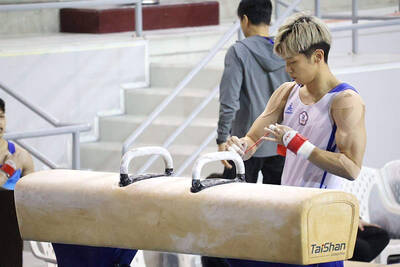
Taiwanese gymnast Lee Chih-kai failed to secure an Olympic berth in the pommel horse following a second-place finish at the last qualifier in Doha on Friday, a performance that Lee and his coach called “unconvincing.” The Tokyo Olympics silver medalist finished runner-up in the final after scoring 6.6 for degree of difficulty and 8.800 for execution for a combined score of 15.400. That was just 0.100 short of Jordan’s Ahmad Abu Al Soud, who had qualified for the event in Paris before the Apparatus World Cup series in Qatar’s capital. After missing the final rounds in the first two of four qualifier


 RSS
RSS