


In July 2003, Chris Carpenter returned to Bedford, New Hampshire, a broken man. He had not seen his infant son in a month. He had not made it out of the fourth inning in a minor league start in Knoxville, Tennessee. His surgically repaired throwing shoulder was not repaired at all.
"I told my wife I didn't want to do it anymore," Carpenter said Thursday. "I wanted to come home."
Carpenter and his wife, Alyson, stayed up until 3am talking. Carpenter was only 28, with six years of major league experience. His wife told him he would regret it if he did not give it one last shot.
PHOTO: AP
Carpenter, a right-hander, listened. He had another shoulder operation, worked his way into the St. Louis Cardinals' rotation and blossomed from a 15-game winner in 2004, when he was named the National League's Comeback Player of the Year, to the NL's Cy Young award winner this season.
"A few years ago, I never thought I was going to play again," Carpenter said. "And I go from coming back and winning the comeback player to winning the Cy Young the year after that. It's a crazy feeling."
Carpenter won the Cy Young in a close race with Dontrelle Willis of the Florida Marlins.
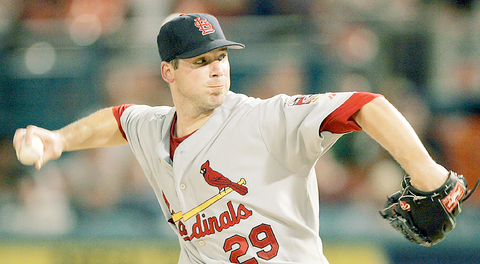
PHOTO: AP
All 32 voters from the Baseball Writers' Association of America listed Carpenter and Willis on their ballots. Carpenter had 19 votes for first place, 12 for second place and one for third. Willis had 11 votes for first place, 18 for second and three for third. Based on the 5-3-1 scoring system, Carpenter defeated Willis, 132-112.
Roger Clemens of Houston -- who had two votes for first, two for second and 24 for third -- was third with 40 points.
It was a tricky year for the voters, who had two candidates -- Carpenter and Willis -- with strikingly similar numbers and a third, Clemens, who probably pitched the best.
Clemens had a 1.87 earned run average, the best of his 22-year career. But his record was just 13-8, largely because the Astros were shut out in nine of his starts, including five losses by 1-0.
Clemens, 43, has not decided whether he will retire, according to his agent, Randy Hendricks. "It is clear he needs time off to get better physically," Hendricks said in an e-mail message, adding that pitching in September and October "took a lot out of him because of the physical problems he endured."
Carpenter won despite having fewer victories and a higher ERA than Willis. Carpenter was 21-5 with a 2.83 ERA, and Willis was 22-10 with a 2.63 ERA. But Carpenter had more innings (241 2/3 to 236 1/3) and strikeouts (213 to 170) than Willis.
In one stretch this season, the Cardinals won 17 consecutive games that Carpenter started. He seemed to seize the momentum in the Cy Young race by midseason, receiving the start in the All-Star Game from his manager, Tony La Russa.
His numbers were superior to Willis' until the final month. Entering September, Carpenter was 19-4 with a 2.29 ERA, and Willis was 18-8 with a 2.61 ERA.
Carpenter became the first Cardinals pitcher to win the Cy Young Award since Bob Gibson in 1970, and the first native of New Hampshire to win it since Mike Flanagan of the Baltimore Orioles in 1979.
"There's not a lot of people that come from this area or this state and play in the big leagues, never mind win a Cy Young award," Carpenter said. "To be a part of this whole situation is unbelievable. I can't believe I won."
MANAGER AWARDS
Ozzie Guillen of the World Series champion Chicago White Sox was voted AL Manager of the Year, and Atlanta's Bobby Cox won the NL award for the second straight year Wednesday after leading the rookie-laden Braves to yet another division title.
Guillen received 17 first-place votes, five seconds and five thirds for 105 points in balloting by the Baseball Writers' Association of America. Eric Wedge of the Cleveland Indians was the runner-up with six first-place votes and 71 points, while Joe Torre of the New York Yankees finished third with 43 points.
Cox became the first manager to win two years in a row, listed first on 28 ballots and second on the other four to win by a whopping 100 points. He beat out St. Louis' Tony La Russa, who also finished second last year.
Voting for all BBWAA awards takes place after the regular season and excludes the postseason.
In his second season as manager, the outspoken Guillen guided the White Sox to the best record in the AL (99-63) and a World Series sweep of Houston for their first title since 1917. His small-ball approach was a big hit in Chicago -- he loved to bunt and hit-and-run all season.
Cox, whose Braves have won a record 14 straight division titles, was honored for the fourth time, tying La Russa for the most ever.
Houston's Phil Garner came in third with 38 points, 14 behind La Russa. Washington Nationals manager Frank Robinson received a pair of first-place votes and finished fourth.
The banged-up Braves were forced to use 18 rookies this year but still extended their streak of division titles. They were eliminated in the first round of the playoffs by Houston again.
Cox also won Manager of the Year with Atlanta in 1991, the start of its incredible streak of division titles, and 1985 with the Toronto Blue Jays.
Notebook:
Major League Baseball star Rafael Palmeiro will not be prosecuted on perjury charges after lawmakers said Thursday there isn't enough evidence to prove he lied when he told a congressional panel under oath that he had "never used steroids" -- six weeks before failing a steroid test.
"The committee will not make a perjury referral to the Department of Justice," the House Government Reform Committee said in a 44-page report on the Palmeiro case released Thursday. "A referral for perjury is a serious step. In this case, the evidence before the committee is insufficient to merit a perjury referral."
The report said the panel "did not make further determinations about the accuracy or inaccuracy of assertions by Mr. Palmeiro or others."
At issue was Palmeiro's statement at a House Government Reform Committee hearing March 17: "I have never used steroids. Period." On May 4, he failed a Major League Baseball doping test, coming up positive for an anabolic steroid. In August, shortly after baseball suspended Palmeiro for 10 days, the committee's chairman, Representative Tom Davis, said Congress would look into whether the player committed perjury.
"We have a responsibility, an obligation, to investigate it, and that's what we've done," Davis told a news conference Thursday in the same hearing room where Palmeiro had testified in March.
"We were not concerned with why he tested positive or how he tested positive except for how that related to his testimony," Davis added.
Palmeiro issued his first detailed public comments on the case Wednesday, including a possible explanation for why he might have failed a steroid test even though he says he never knowingly took steroids: a tainted vitamin shot given to him by a teammate.
When he testified before the House Government Reform Committee on March 17, alongside Mark McGwire, Jose Canseco and others, Palmeiro jabbed a finger in the air for emphasis and denied he had used steroids.
In May, Palmeiro failed a doping test, and on Aug. 1, he became the highest-profile player suspended for 10 days by Major League Baseball under its new steroids policy. Two days later, Davis said the panel would open an investigation into whether Palmeiro committed perjury.
Palmeiro agreed to have baseball give Congress documents about his steroid tests, and investigators interviewed some of his current and former teammates and training partners.
On Wednesday, two hours after Davis' committee announced he would release the results of the investigation Thursday, Palmeiro's lawyers issued the player's first detailed public comments on the case.
Palmeiro acknowledged several facts that already had been reported, including that he had raised the possibility that a shot of vitamin B-12 he was given by a teammate ``might have been the cause'' of the positive doping test.
"Everything I have been working for all my life -- to play the game that I love with dignity and earn the respect and admiration of my colleagues and fans -- has been changed by my suspension. For this, I alone take full responsibility," Palmeiro said. "I have never intentionally taken steroids. But I must also acknowledge that stanozolol, a banned substance, was found in my system in May."
He's one of four players in baseball history with 500 homers and 3,000 hits -- and the timing of his positive test means Palmeiro knew he faced a suspension as he approached the hit milestone this summer.
"Nobody is more frustrated and disappointed in me than I am. ... All my accomplishments are now tainted," Palmeiro said.
His case has been cited as one of the reasons that lawmakers have continued to pursue legislation to require tougher rules for steroid testing and harsher penalties for positive tests in baseball and other major professional sports leagues.
A bill calling for a half-season ban for a first steroid offense, a full-season ban for a second offense, and a lifetime ban for a third reached the floor of the Senate. But a spokesman for one of the bill's sponsors, Sen. Jim Bunning, a former major league pitcher, said Wednesday that an unidentified senator placed a hold on the bill, meaning it's stalled indefinitely.
According to Palmeiro's lawyers, he tested negative for steroids in 2003 and 2004; after he was informed he failed a test in May, he took a second test that month, which was negative.
Palmeiro, 41, had just two hits in 26 at-bats after returning from his suspension and was booed by spectators at Baltimore and on the road. He was sent home to Texas to rehabilitate injuries; the Orioles eventually told him not to return to the team.
On the Net:
Palmeiro documents:
www.rptranscripts.com
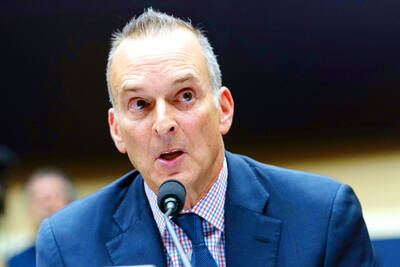
Revelations of positive doping tests for nearly two dozen Chinese swimmers that went unpunished sparked an intense flurry of accusations and legal threats between the World Anti-Doping Agency (WADA) and the head of the US drug-fighting organization, who has long been one of WADA’s fiercest critics. WADA on Saturday said it was turning to legal counsel to address a statement released by US Anti-Doping Agency (USADA) CEO Travis Tygart, who said WADA and anti-doping authorities in China swept positive tests “under the carpet by failing to fairly and evenly follow the global rules that apply to everyone else in the world.” The

Taiwanese judoka Yang Yung-wei on Saturday won silver in the men’s under-60kg category at the Asian Judo Championships in Hong Kong. Nicknamed the “judo heartthrob” in Taiwan, the Olympic silver-medalist missed out on his first Asian Championships gold when he lost to Japanese judoka Taiki Nakamura in the finals. Yang defeated three opponents on Saturday to reach the final after receiving a bye through the round of 32. He first topped Laotian Soukphaxay Sithisane in the round of 16 with two seoi nage (over-the-shoulder throws), then ousted Indian Vijay Kumar Yadav in the quarter-finals with his signature ude hishigi sankaku gatame (triangular armlock). He

RALLY: It was only the second time the Taiwanese has partnered with Kudermetova, and the match seemed tight until they won seven points in a row to take the last set 10-2 Taiwan’s Chan Hao-ching and Russia’s Veronika Kudermetova on Sunday won the Porsche Tennis Grand Prix women’s doubles final in Stuttgart, Germany. The pair defeated Norway’s Ulrikke Eikeri and Estonia’s Ingrid Neel 4-6, 6-3, 10-2 in a tightly contested match at the WTA 500 tournament. Chan and Kudermetova fell 4-6 in the first set after having their serve broken three times, although they played increasingly well. They fought back in the second set and managed to break their opponents’ serve in the eighth game to triumph 6-3. In the tiebreaker, Chan and Kudermetova took a 3-0 lead before their opponents clawed back two points, but

Taiwanese gymnast Lee Chih-kai failed to secure an Olympic berth in the pommel horse following a second-place finish at the last qualifier in Doha on Friday, a performance that Lee and his coach called “unconvincing.” The Tokyo Olympics silver medalist finished runner-up in the final after scoring 6.6 for degree of difficulty and 8.800 for execution for a combined score of 15.400. That was just 0.100 short of Jordan’s Ahmad Abu Al Soud, who had qualified for the event in Paris before the Apparatus World Cup series in Qatar’s capital. After missing the final rounds in the first two of four qualifier


 RSS
RSS