


By all that is reasonable and rational, the Phoenix Suns should have no chance to win the Western Conference finals, despite an inspired victory Monday night in San Antonio.
They still trail three games to one, and no NBA team has ever won a series after losing the first three games. So why are the Suns smiling, upbeat -- even optimistic -- heading into Game 5 here on Wednesday?
For that answer, flash back exactly three weeks ago to May 11 and the horrifying sight of Joe Johnson slamming face first to the floor of America West Arena. The fall left Johnson, the gifted Suns swingman, with a displaced orbital fracture.
In plain English, he had broken his face. Specifically, part of his left eye socket.
Yet there was Johnson on Monday, protected by only a thin plastic shield, slicing up the Spurs' vaunted defense, muscling for rebounds and going chest to chest with Tim Duncan. Johnson scored 26 points, made 10 of 15 shots and supplied the double-teaming that helped limit Duncan to 15 points.
Phoenix defied convention and expectations all season with its small lineup and high-octane style. Now Johnson is doing the same, inspiring the Suns to think big.
"It's amazing. It's a blessing," said Suns forward Shawn Marion. "He sees we've got something special going on here, and we've got a good chance to do something."
Should the Suns win Game 5 at home, the pressure will shift to the Spurs. A Suns victory in the series remains improbable, but no more so than the fact Johnson is playing like an All-Star when, by all that is reasonable and rational, he probably should not be playing at all.
Johnson needed reconstructive surgery. He has four plates holding his face together. If he were anything but a world-class pro athlete whose team is in the playoffs, Johnson probably would not even be near the court.
"There's definitely risk," said Dr. Eli Chang, the chief of Ophthalmic, Plastic, Orbital and Reconstructive Surgery for the Doheny Eye Institute at the University of Southern California.
Chang has no involvement with Johnson's case, but he is a self-described "huge basketball fan" who has followed the story with keen professional interest.
He said Johnson's recovery window of two to three weeks is reasonable. But that assessment is for the average person, not for one whose profession involves constant motion, wayward elbows and collisions with 280-pound basketball players. Chang said that the need for four plates indicates Johnson had a large fracture.
"If it was a college athlete and there was nothing on the line, I probably would have said six weeks," Chang said.
"The biggest risk obviously is if he gets hit again, he's going to undo the whole thing, probably bend all the plates out of position. Anytime you have a second surgery, it's a lot harder to fix than the first surgery."
In the worst cases, a fractured orbital can lead to deformity, permanent double-vision or even blindness.
"Oh, man, everybody told me to take my time," Johnson said. "A lot of people told me don't come back. "It was a tough decision. But I seen my guys out there playing hard, and I just wanted to come out and put forth the effort."
"But I love the game of basketball," Johnson said, "so if I would have sat out, I would have felt like I was cheating myself. I came back with a lot of confidence, no doubts."

Revelations of positive doping tests for nearly two dozen Chinese swimmers that went unpunished sparked an intense flurry of accusations and legal threats between the World Anti-Doping Agency (WADA) and the head of the US drug-fighting organization, who has long been one of WADA’s fiercest critics. WADA on Saturday said it was turning to legal counsel to address a statement released by US Anti-Doping Agency (USADA) CEO Travis Tygart, who said WADA and anti-doping authorities in China swept positive tests “under the carpet by failing to fairly and evenly follow the global rules that apply to everyone else in the world.” The
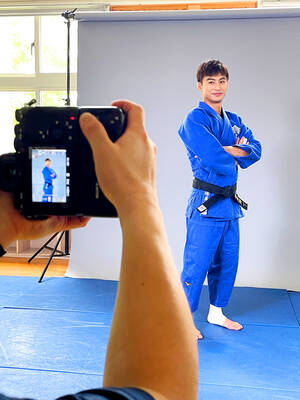
Taiwanese judoka Yang Yung-wei on Saturday won silver in the men’s under-60kg category at the Asian Judo Championships in Hong Kong. Nicknamed the “judo heartthrob” in Taiwan, the Olympic silver-medalist missed out on his first Asian Championships gold when he lost to Japanese judoka Taiki Nakamura in the finals. Yang defeated three opponents on Saturday to reach the final after receiving a bye through the round of 32. He first topped Laotian Soukphaxay Sithisane in the round of 16 with two seoi nage (over-the-shoulder throws), then ousted Indian Vijay Kumar Yadav in the quarter-finals with his signature ude hishigi sankaku gatame (triangular armlock). He

RALLY: It was only the second time the Taiwanese has partnered with Kudermetova, and the match seemed tight until they won seven points in a row to take the last set 10-2 Taiwan’s Chan Hao-ching and Russia’s Veronika Kudermetova on Sunday won the Porsche Tennis Grand Prix women’s doubles final in Stuttgart, Germany. The pair defeated Norway’s Ulrikke Eikeri and Estonia’s Ingrid Neel 4-6, 6-3, 10-2 in a tightly contested match at the WTA 500 tournament. Chan and Kudermetova fell 4-6 in the first set after having their serve broken three times, although they played increasingly well. They fought back in the second set and managed to break their opponents’ serve in the eighth game to triumph 6-3. In the tiebreaker, Chan and Kudermetova took a 3-0 lead before their opponents clawed back two points, but
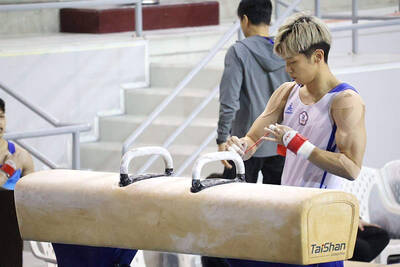
Taiwanese gymnast Lee Chih-kai failed to secure an Olympic berth in the pommel horse following a second-place finish at the last qualifier in Doha on Friday, a performance that Lee and his coach called “unconvincing.” The Tokyo Olympics silver medalist finished runner-up in the final after scoring 6.6 for degree of difficulty and 8.800 for execution for a combined score of 15.400. That was just 0.100 short of Jordan’s Ahmad Abu Al Soud, who had qualified for the event in Paris before the Apparatus World Cup series in Qatar’s capital. After missing the final rounds in the first two of four qualifier


 RSS
RSS