


The garish marble palace surrounded by manicured lawns, country club and a pro golf course is the last thing you'd expect in the dirt-poor countryside near Beijing.
While peasants trundle along in horse-drawn carts and scratch a living nearby, golf stars whirr around in electric buggies and the rich and famous arrive in chauffeur-driven Rolls Royces and Bentleys.
Welcome to China's golfing revolution.
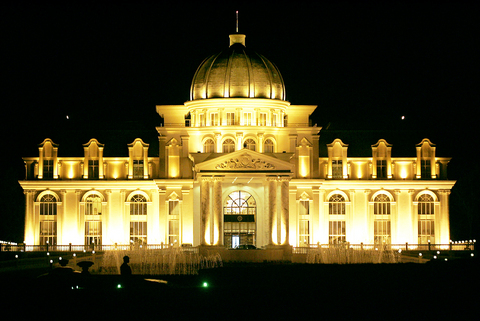
PHOTO: AFP
For while the sport is booming here, attracting big names and big money, it remains a distant dream for the vast majority of people in the world's most populous nation.
"At the moment membership is very expensive over here so it's not possible for everybody to become a member and play golf," US Open champion Retief Goosen said during the Johnnie Walker Classic, held at this opulent Pine Valley resort outside Beijing.
"It's still a very elite sport. But it's nice to see the game grow in China and we look forward to seeing it grow," he said.
Membership at Pine Valley, billed as China's most exclusive golf resort, costs US$150,000, plus US$1,200 a year in fees.
That puts its Jack Nicklaus-designed course, spa and equestrian center, with distant views of the Great Wall, way out of reach for the average Beijinger and his US$2,900 annual salary.
"It puts it in a different class. This is the very, very top, the pinnacle. At Pine Valley we've created and maintain the most exclusive golf club in China for bankers and the elite," general manager Bob Guthrie said.
The resort, complete with fountains, statues and saluting, red-uniformed guards, is one of about 170 courses in China, whose association with golf only goes back about 20 years.
The 180-hole Mission Hills complex in Shenzhen, southern China, is the world's biggest golf resort with courses designed by top women's player Annika Sorenstam, Nick Faldo, Vijay Singh and Ernie Els.
But with clubs' average fees at about US$40,000 to US$50,000, only a tiny fraction of China's 1.3 billion population can afford to play.
"Some kids are quite well off and they get into it hopefully through the country club, but what if you're not well off?" Guthrie asks.
World No. 6 Adam Scott walked off with US$400,000 in prize money for winning the Johnnie Walker Classic, the richest tournament ever staged in China and with arguably the best field seen in Asia.
Many of the world-class players then headed to the BMW Asian Open in Shanghai. No less than 10 Asian Tour events are being held in China this year, including four joint-sanctioned by the European Tour, offering US$7.1 million in prize money.
But with greens fees so high, it may be a while before China can produce a player who attracts as much interest as the high-profile tournaments.
At the Johnnie Walker Classic, locals who could afford the entrance fee were disappointed to see home-grown star Zhang Lian-wei, 39, finish 19 shots off the lead.
"He's a wonderful player, no doubt about it. He's been doing very well in a couple of big tournaments," world No. 9 Sergio Garcia said. "It's probably a shame he's not a bit younger."
Guthrie says China needs public courses to develop the sport. However, he says it will not take long before Chinese players are challenging for the top honors.

Revelations of positive doping tests for nearly two dozen Chinese swimmers that went unpunished sparked an intense flurry of accusations and legal threats between the World Anti-Doping Agency (WADA) and the head of the US drug-fighting organization, who has long been one of WADA’s fiercest critics. WADA on Saturday said it was turning to legal counsel to address a statement released by US Anti-Doping Agency (USADA) CEO Travis Tygart, who said WADA and anti-doping authorities in China swept positive tests “under the carpet by failing to fairly and evenly follow the global rules that apply to everyone else in the world.” The
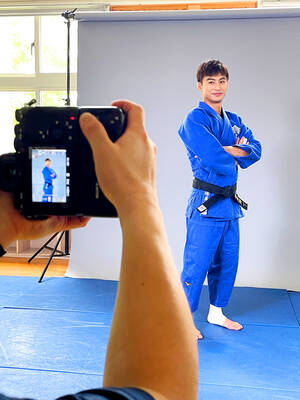
Taiwanese judoka Yang Yung-wei on Saturday won silver in the men’s under-60kg category at the Asian Judo Championships in Hong Kong. Nicknamed the “judo heartthrob” in Taiwan, the Olympic silver-medalist missed out on his first Asian Championships gold when he lost to Japanese judoka Taiki Nakamura in the finals. Yang defeated three opponents on Saturday to reach the final after receiving a bye through the round of 32. He first topped Laotian Soukphaxay Sithisane in the round of 16 with two seoi nage (over-the-shoulder throws), then ousted Indian Vijay Kumar Yadav in the quarter-finals with his signature ude hishigi sankaku gatame (triangular armlock). He

RALLY: It was only the second time the Taiwanese has partnered with Kudermetova, and the match seemed tight until they won seven points in a row to take the last set 10-2 Taiwan’s Chan Hao-ching and Russia’s Veronika Kudermetova on Sunday won the Porsche Tennis Grand Prix women’s doubles final in Stuttgart, Germany. The pair defeated Norway’s Ulrikke Eikeri and Estonia’s Ingrid Neel 4-6, 6-3, 10-2 in a tightly contested match at the WTA 500 tournament. Chan and Kudermetova fell 4-6 in the first set after having their serve broken three times, although they played increasingly well. They fought back in the second set and managed to break their opponents’ serve in the eighth game to triumph 6-3. In the tiebreaker, Chan and Kudermetova took a 3-0 lead before their opponents clawed back two points, but
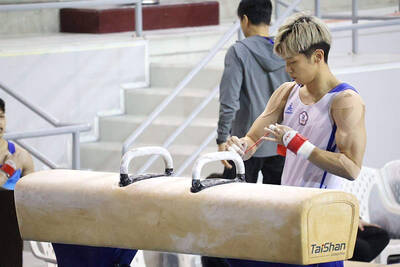
Taiwanese gymnast Lee Chih-kai failed to secure an Olympic berth in the pommel horse following a second-place finish at the last qualifier in Doha on Friday, a performance that Lee and his coach called “unconvincing.” The Tokyo Olympics silver medalist finished runner-up in the final after scoring 6.6 for degree of difficulty and 8.800 for execution for a combined score of 15.400. That was just 0.100 short of Jordan’s Ahmad Abu Al Soud, who had qualified for the event in Paris before the Apparatus World Cup series in Qatar’s capital. After missing the final rounds in the first two of four qualifier


 RSS
RSS