


They are the quaintest of sports which, despite boasting few players, only a handful of fans and no stars, help to give the Olympic Games their unique appeal.
But the days of taekwondo, modern pentathlon and equestrianism being part of the world's biggest sporting festival are numbered.
They are set to be punished for their lack of popularity by being dropped from the Games
Olympic chiefs are planning to axe minority specialist sports and replace them with guaranteed crowd-pullers, such as golf and rugby, in a move which will outrage sporting traditionalists.
Alarmed that the Olympics are increasingly seen as too staid, too out-of-touch and too dominated by the world's biggest countries, the International Olympic Committee is preparing a radical overhaul of the event intended to make it sexier, more global and better reflect sports which young people like.
Baseball, softball and Greco-Roman wrestling are among the sports which may be axed, while golf, rugby sevens, karate, squash and even roller-skating are being lined up as replacements.
The IOC president, Jacques Rogge, is keen to boost the image of the four-yearly summer Olympics, which he and other senior IOC figures fear is too staid and unattractive to younger people who are into newer, more demanding pursuits, such as dirt-biking and extreme sports.
An IOC working group is drawing up plans to modernize the sporting programme for the summer Olympics. Whatever changes are agreed will be introduced at the 2012 Games.
Last week, the IOC confirmed that it was writing to the world governing bodies of five sports that could potentially add to the quality and popularity of the Games: golf, rugby, squash, karate and roller sports. All five are desperate to join the Olympics.
The IOC says that the popularity of the Games largely depends on the content of the sports programme, which must be "exciting, attractive, action-packed and athlete-focused. It must also reflect the constant evolution of public expectations."
Rogge tried to axe modern pentathlon, baseball and softball in 2002, but those sports fought successful campaigns to thwart him. But the experience of the 2004 Olympics in Athens in August has convinced IOC members that a revamping of the schedule is needed.
The IOC has decided that for every sport which comes in, one will have to go, as it intends to keep the maximum number of sports contested at 28.
Golf and rugby are highly likely to be included, karate is tipped to replace taekwondo, but squash is unlikely to supplant any of the three existing racquet sports of tennis, badminton and table tennis.
Roller-skating is seen as an outside bet for inclusion in 2012. Although a popular pastime, few people realize that it is also a competitive sport.
However, the IOC has already agreed other changes intended to modernize the Games, such as substituting two BMX cycling events for two track cycling contests at the 2008 Olympics in Beijing.
The IOC will decide which sports are in and which will go in July next year.

Greek swimmer Kristian Gkolomeev was the only athlete to “beat” a world record on Sunday at the Enhanced Games, winning the men’s 50m freestyle at the divisive competition where athletes were free to take performance-enhancing substances. His time of 20.81 seconds — which is not considered official — came in the final event of the night in Las Vegas, sparing the blushes of organizers who made claims that multiple world records would be surpassed due to a sophisticated doping regime. Gkolomeev, who was wearing a synthetic “supersuit” long banned at events such as the Olympics, outpaced Australia’s Cameron McEvoy’s 20.88 set in
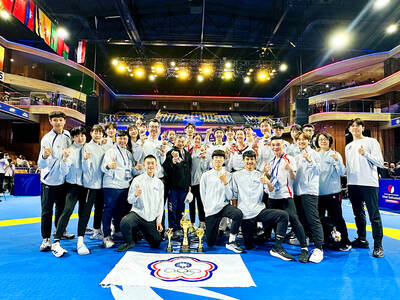
VICTORY ABROAD: The team took home a fistful of medals and secured spots for the autumn’s Asian Games, scheduled for September in Nagoya Taiwan’s women’s team captured the overall title at the Asian Taekwondo Championships in Mongolia on Sunday, finishing with two golds, one silver and one bronze medal. The strong showing, led by gold medalists Wang Chieh-ling and Chang Jui-en secured the full quota of available spots for Taiwan at the Asian Games in Nagoya, Japan, in September. Wang opened Taiwan’s medal run by winning gold in the women’s under-46kg class on Thursday, the first day of competition. Liu Yu-yun later earned a silver in the under-49kg class. On the final day on Sunday, Chang won Taiwan’s second gold medal in the under-62kg event, and

The manager of the Yomiuri Giants, one of Japan’s most popular baseball teams, resigned yesterday after he was arrested for allegedly physically attacking his teenage daughter. Shinnosuke Abe allegedly grabbed the 18-year-old and forced her to the floor at their home in central Tokyo on Monday evening, reported national broadcaster NHK and Kyodo News, citing unnamed police sources. “Leaving like this really means I’m causing you a lot of trouble, and I feel truly sorry about that,” Abe told a hastily arranged news conference, his eyes red with tears. The former star catcher, who is among baseball-obsessed Japan’s most recognized sports figures,

Taiwanese tennis star Hsieh Su-wei on Wednesday advanced to the second round of the mixed doubles at the French Open, after she and German partner Mark Wallner defeated Slovenian Andreja Klepac and Briton Lloyd Glasspool in straight sets, despite temperatures exceeding 32°C in Paris, while Taiwan’s top men’s doubles player Ray Ho also reached the second round. Hsieh, who made it to the semi-finals in the mixed doubles at Roland Garros in 2024, and Wallner defeated Klepac and Glasspool 6-3, 7-5 in just more than an hour, converting three of five break points, while holding their opponents to just one conversion


 RSS
RSS