


The National Hockey League locked out its players yesterday, threatening to keep the sport off the ice for the entire 2004-2005 season, and perhaps beyond, in an effort by management to gain massive economic change.
After the long-expected decision was approved unanimously on Wednesday by NHL owners, commissioner Gary Bettman repeatedly belittled the union's bargaining position, talked about the possibility the confrontation could extend into the 2005-2006 season and said the conflict has jeopardized the NHL's participation in the 2006 Winter Olympics.
"If there's enough time to play some games, we'll do it," he said of this season, "and if there's not, we won't."
Bettman called it a "bleak day," claimed teams had combined to lose more than US$1.8 billion over 10 years and cited bankruptcy filings by teams in Buffalo, Los Angeles, Ottawa and Pittsburgh. He said management will not agree to a labor deal that doesn't include a defined relationship between revenue and salaries.
"Until he gets off the salary-cap issue, there's not a chance for us to get an agreement," union head Bob Goodenow said in Toronto, adding that players "are not prepared to entertain a salary cap in any way, shape, measure or form."
Far apart on both philosophy and finances, the sides haven't bargained since last Thursday and say they are entrenched for the long run, echoing words of baseball players and owners at the start of their disastrous seven-and-a-half-month labor war of 1994-1995.
There is almost no chance the season will start as scheduled on Oct. 13, and Bettman told teams to release their arenas for other events for the next 30 days. Bettman said the season can't extend past June, and the lockout threatens to wipe out the Stanley Cup final for the first time since 1919, when the series between Montreal and Seattle was stopped after five games due to a Spanish influenza epidemic.
"The union is trying to win a fight, hoping that the owners will give up. That will turn out to be a terrible error in judgment," Bettman said. "They are apparently convinced that come some point in the season, the owners' resolve will waver, and I'm telling you that is wrong, wrong, wrong."
NHL management claims teams combined to lose US$273 million in 2002-2003 and US$224 million last season. Bettman said the union's proposals would do little for owners, and said the six offers rejected by the union would lower the average player salary from US$1.8 million to US$1.3 million.
Goodenow said players had offered more than US$100 million in annual concessions.
"The notion that we don't have competitive balance is absurd," said Vancouver center Trevor Linden, the union's president.
Bettman made clear that declaring an impasse under US labor law and imposing new work rules unilaterally was an option, but said it had not yet been considered.
"I think it's pretty fair to say that we're at an impasse right now, and my guess is that we've probably been at impasse for months, if not a year," he said. "At some point when we're at impasse, we could simply say, `We're going to open and here are the terms and conditions. Let's go.' It's that simple."
Goodenow said attempting to impose terms would be a "very, very ill-advised strategy" and predicted "the results of it could be catastrophic." Bettman said the use of replacement players is not under consideration.
Owners have contributed US$300 million to a league fund to help get them through a lockout.
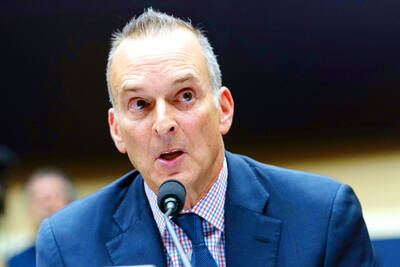
Revelations of positive doping tests for nearly two dozen Chinese swimmers that went unpunished sparked an intense flurry of accusations and legal threats between the World Anti-Doping Agency (WADA) and the head of the US drug-fighting organization, who has long been one of WADA’s fiercest critics. WADA on Saturday said it was turning to legal counsel to address a statement released by US Anti-Doping Agency (USADA) CEO Travis Tygart, who said WADA and anti-doping authorities in China swept positive tests “under the carpet by failing to fairly and evenly follow the global rules that apply to everyone else in the world.” The

Taiwanese judoka Yang Yung-wei on Saturday won silver in the men’s under-60kg category at the Asian Judo Championships in Hong Kong. Nicknamed the “judo heartthrob” in Taiwan, the Olympic silver-medalist missed out on his first Asian Championships gold when he lost to Japanese judoka Taiki Nakamura in the finals. Yang defeated three opponents on Saturday to reach the final after receiving a bye through the round of 32. He first topped Laotian Soukphaxay Sithisane in the round of 16 with two seoi nage (over-the-shoulder throws), then ousted Indian Vijay Kumar Yadav in the quarter-finals with his signature ude hishigi sankaku gatame (triangular armlock). He

RALLY: It was only the second time the Taiwanese has partnered with Kudermetova, and the match seemed tight until they won seven points in a row to take the last set 10-2 Taiwan’s Chan Hao-ching and Russia’s Veronika Kudermetova on Sunday won the Porsche Tennis Grand Prix women’s doubles final in Stuttgart, Germany. The pair defeated Norway’s Ulrikke Eikeri and Estonia’s Ingrid Neel 4-6, 6-3, 10-2 in a tightly contested match at the WTA 500 tournament. Chan and Kudermetova fell 4-6 in the first set after having their serve broken three times, although they played increasingly well. They fought back in the second set and managed to break their opponents’ serve in the eighth game to triumph 6-3. In the tiebreaker, Chan and Kudermetova took a 3-0 lead before their opponents clawed back two points, but
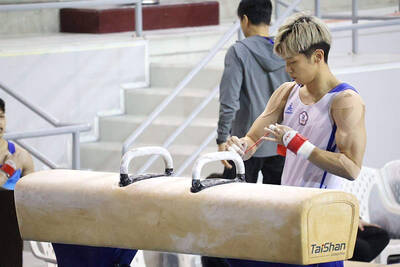
Taiwanese gymnast Lee Chih-kai failed to secure an Olympic berth in the pommel horse following a second-place finish at the last qualifier in Doha on Friday, a performance that Lee and his coach called “unconvincing.” The Tokyo Olympics silver medalist finished runner-up in the final after scoring 6.6 for degree of difficulty and 8.800 for execution for a combined score of 15.400. That was just 0.100 short of Jordan’s Ahmad Abu Al Soud, who had qualified for the event in Paris before the Apparatus World Cup series in Qatar’s capital. After missing the final rounds in the first two of four qualifier


 RSS
RSS