


Within the last two days in Athens, three archers in succession handed victory to their opponents with their final shots, making the Panathinaiko Stadium the most painful of venues for Taiwanese athletes, the place where they have shed the most tears.
All contests in individual sports are lonely journeys without teammates from whom to draw support. But it is the essence of archery that victory always seems to be within the athlete's own grasp, so each arrow, before it is fired, is replete with hope, as though victory can be attained in the split second that it takes for the arrow to carve the line of its flight in thin air.
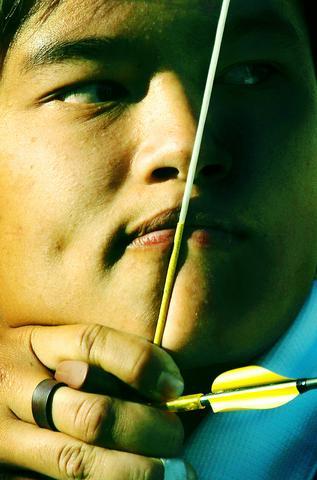
PHOTO: AP
"The most attractive aspect of archery competitions is their capacity for drama. At the final shot, the athlete always experiences an unprecedented sensation of pressure," said Hung Tsung-min (洪聰敏), professor and director of the Graduate Institute of Exercise and Sport Science at Taipei Physical Education College.
"There are athletes who have led all the way who fire their career-worst shots at the final shot. There are others who think they've already lost and won't live to fight another day, who, because their opponent makes a mistake, suddenly find that victory is within their grasp, as though they've just traveled from hell to heaven," said Hung, who is also a psychological consultant to Taiwan's archery team.
"I think we can describe the `individual' contests as the cruelest of sports for the archers involved," Hung said.
Indeed, one of those covering her face and weeping at this venue where the modern Olympics began 108 years ago, was 19-year old Yuan Shu-chi (袁叔琪), who had described herself as unafraid of any pressure whatsoever. Another who lost with her final shot and wept a flood of heart-wrenching tears was Wu Hui-ju (吳蕙如).
On Aug. 18, the 25-year old Wu faced South Korea's Lee Sung-jin in the quarterfinal competition. In the twelve-arrow contest, she led by three points after the first nine shots, but in the final round (the 10th to 12th shots), overcome by nerves, she made her worst shot of seven points allowing her opponent to draw level.
The tide to began to turn; with the pressure apparently seizing her entire person after Lee secured ten points with her final shot, Wu shot a nine, throwing away Taiwan's hopes with a deficit of one point.
If Wu had won that shoot, she might have faced her compatriot and teammate, Yuan, guaranteeing Taiwan at least a silver medal with an opportunity for a bronze. But Wu's defeat signaled the beginning of a series of tragedies.
The next to go was Yuan.
Having worked hard to defeat reigning Olympic champion Yun Mi-jun of South Korea, in the semifinal Yuan faced Wu's conqueror, Lee Sung-jin. Apparently having made inadequate preparations, she shot four seven-points arrows, and was comfortably defeated by Lee 98-104.
But Yuan still had the consolation prize of a bronze medal to shoot for and all observers felt that she had the ability and the opportunity to secure Taiwan's first medal of the Athens Olympics.
To their surprise, however, having led all the way, with her ninth arrow Yuan shot the worst seven points seen in this stadium, allowing her opponent, England archer Allison Williamson, to draw level.
Then, with the two athletes neck and neck at the final shot, Williamson meekly shot an eight points. She herself clearly thought she had thrown away the contest; all we could see was her shaking her head remorsefully towards her coach. To everyone's surprise, however, Yuan then shot an even worse seven points, handing the bronze medal to Williamson.
"Everybody said Yuan Shu-chi was the most naturally gifted athlete and the one least capable of being defeated by pressure. But after this defeat, I believe that she has learned the lesson that a good athlete knows how to harness pressure appropriately to keep themselves in optimum condition, uneasily distracted by the external situation," said Tang Wen-tzu (
But the drama wasn't over. On the afternoon of Aug. 19, Taiwan's male archer Chen Szu-yuan (
To the surprise, once more, of spectators and a global television audience, with his three arrows of the final round, Chen completely lost his rhythm, raised his bow up and down nervously several times and took deep breaths continuously in a bid to steady himself. But he couldn't conquer the pressure and shot a meager seven points with his tenth arrow. His next was an eight, allowing Godfrey to draw level. Once more, it came down to the final shot. Godfrey shot a nine. Chen raised his bow, got ready, then nervously put his bow down again, raised it a second time and finally shot, only to score another inadequate seven.
That was the arrow that broke the hearts of the Taiwanese spectators who were present or watching on television.
"At the Olympic Games, this Mecca of top-level competition, the essence of victory is not whether the athlete's technique is good or not, but whether his mind is strong enough," said Tang Chin-lan (
Tang believes that coaches have in the past explained this to the athletes concerned and he urges them to prepare their minds for the next contest as soon as they suffer any defeat in a major competition.
"After all," he says," Yuan Shu-chi is too young, a child of 19. Her experience at this Olympics is the best possible lesson for the athletes that victory always seems to be in front of one's eyes but wriggling out of reach; you can only enjoy it when you have conquered yourself."

Fred Kerley is competing unaugmented against drug-fuelled athletes at this weekend’s Enhanced Games and still hopes to race in the 2028 Olympics, the suspended former 100m world champion said on Friday. Arguably the biggest name at the divisive event in Las Vegas, where doping is permitted, the US sprinter said he had chosen not to take any of the banned substances including testosterone and steroids that his competitors have been using. “I don’t need it. God gave me fast feet for a reason. And I’m here to showcase my talent,” Kerley said. Kerley last September became the first US competitor and first track

MLB is experiencing an epidemic of guys being dudes. At ballparks all across the US, groups consisting of mostly young men are joining in on the “Tarps Off” trend that is loud, goofy, infectious and new to the baseball world. Joining in on the fun is simple: Go to the section where the party is happening, take off your shirt and start twirling it above your head. Soccer-like chants or singing usually follow — injecting a jolt of energy for a sport that is occasionally chided for its lack of energy inside the stadium. After getting its start in St Louis, Missouri, on

Hull City AFC are to play Middlesbrough for a place in the Premier League after Southampton on Wednesday failed in their appeal against expulsion from the Championship playoff final for spying on opponents. Southampton were thrown out of the final on Tuesday and handed a four-point deduction for next season after they had beaten semi-final opponents Middlesbrough. “The original sanction of expulsion ... remains in place, as does the four-point deduction to be applied to the 2026/27 Championship table and the reprimand in respect of all charges,” the English Football League said in a statement. The final is to be played at Wembley

INTERNATIONAL TRAVEL: Officials, players and fans winging across all of North America are likely to make this the most polluting World Cup ever, say scientists The largest and likely most lucrative ever World Cup this summer could set a record for the most-polluting sporting event in history, environmental experts say. “Unlike the case of the Olympic Games, where the carbon footprints have been reducing over the last several editions, this is totally opposite in the case of FIFA men’s World Cup,” said David Gogishvili, a geographer at the University of Lausanne (Unil). The summer’s World Cup has been expanded to 48 teams for the first time. It is being played in three countries — Mexico, Canada and the US — for the first time. It is going to


 RSS
RSS