


The mighty home runs of Barry Bonds, Mark McGwire, Hank Aaron and Roger Maris can all be linked to an unassuming building near the railroad tracks in this small town.
Since 1961, workers at the Tennessee Tanning Co have produced the leather that becomes the pristine white surface of an American icon, the major league baseball.
"We do our jobs day in and day out, but it really gives you a neat feeling when you go to a ballpark and watch them hit a ball out of the park and know where that cover came from," general manager Mike Cunningham said.
The city of Tullahoma, halfway between Chattanooga and Nashville, is perhaps more famous for whiskey than baseballs. Tourists regularly visit the George A. Dickel distillery or the nearby Jack Daniel's plant in Lynchburg.
But there aren't any tourists at Tennessee Tanning; making baseballs is a rougher business.
Inside the tannery, which smells like a chemistry lab and a butcher's shop, workers take Holstein cowhides and run them through a five-week process.
The hides typically come from Ohio and Pennsylvania. When they come off the truck in Tullahoma, they are first sliced down the backbone with a boning knife.
Chemicals in rotating wooden drums remove the hair and preserving salts, and then the hides are ``fleshed,'' a process that takes away fat and muscle tissue.
The hides are then treated with tanning agents to create the perfectly white leather of a baseball.
Finally, the leather is dried for several days before being shaved to the correct specification for a major league baseball -- between 0.011cm and 0.014cm. Each hide yields about 16 baseballs.
"It's a very hands-on process that requires a lot of knowledge and skill on the part of all employees to make sure it's done right," Cunningham said.
The 48 employees at Tennessee Tanning handle about 31,000 cowhides each year for Rawlings Sporting Goods. The balls are later stitched together in a plant in Turrialba, Costa Rica.
It is a deceptively simple looking object, but every detail has to be perfect.
"For the integrity of the game, the product needs to be consistent year in and year out," said Matthew Gould, an MLB spokesman. "The end result is the most important thing for us, that every ball meets our exact specifications.
"You can't have one ball being one way in one park, and a different one in another."
The product has an intimate connection with the American people, said Christopher Kimball, dean of Augsburg College, which sits a 1.5km away from the Metrodome in Minneapolis, home of the Twins.
"You can grip it in your hand," Kimball said. "It's a natural thing to pick up a ball and hold it."

Revelations of positive doping tests for nearly two dozen Chinese swimmers that went unpunished sparked an intense flurry of accusations and legal threats between the World Anti-Doping Agency (WADA) and the head of the US drug-fighting organization, who has long been one of WADA’s fiercest critics. WADA on Saturday said it was turning to legal counsel to address a statement released by US Anti-Doping Agency (USADA) CEO Travis Tygart, who said WADA and anti-doping authorities in China swept positive tests “under the carpet by failing to fairly and evenly follow the global rules that apply to everyone else in the world.” The
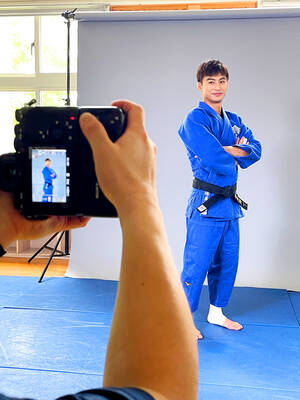
Taiwanese judoka Yang Yung-wei on Saturday won silver in the men’s under-60kg category at the Asian Judo Championships in Hong Kong. Nicknamed the “judo heartthrob” in Taiwan, the Olympic silver-medalist missed out on his first Asian Championships gold when he lost to Japanese judoka Taiki Nakamura in the finals. Yang defeated three opponents on Saturday to reach the final after receiving a bye through the round of 32. He first topped Laotian Soukphaxay Sithisane in the round of 16 with two seoi nage (over-the-shoulder throws), then ousted Indian Vijay Kumar Yadav in the quarter-finals with his signature ude hishigi sankaku gatame (triangular armlock). He

RALLY: It was only the second time the Taiwanese has partnered with Kudermetova, and the match seemed tight until they won seven points in a row to take the last set 10-2 Taiwan’s Chan Hao-ching and Russia’s Veronika Kudermetova on Sunday won the Porsche Tennis Grand Prix women’s doubles final in Stuttgart, Germany. The pair defeated Norway’s Ulrikke Eikeri and Estonia’s Ingrid Neel 4-6, 6-3, 10-2 in a tightly contested match at the WTA 500 tournament. Chan and Kudermetova fell 4-6 in the first set after having their serve broken three times, although they played increasingly well. They fought back in the second set and managed to break their opponents’ serve in the eighth game to triumph 6-3. In the tiebreaker, Chan and Kudermetova took a 3-0 lead before their opponents clawed back two points, but

Taiwanese gymnast Lee Chih-kai failed to secure an Olympic berth in the pommel horse following a second-place finish at the last qualifier in Doha on Friday, a performance that Lee and his coach called “unconvincing.” The Tokyo Olympics silver medalist finished runner-up in the final after scoring 6.6 for degree of difficulty and 8.800 for execution for a combined score of 15.400. That was just 0.100 short of Jordan’s Ahmad Abu Al Soud, who had qualified for the event in Paris before the Apparatus World Cup series in Qatar’s capital. After missing the final rounds in the first two of four qualifier


 RSS
RSS