


When it comes to questions whether Portugal's security forces will be ready for the 2004 European Championship, the answer depends on who you speak to -- the authorities or cops on the beat.
The government, bracing for possible violent clashes between the expected 1.2 million fans at the biggest sports event ever held in Portugal, insists the preparations are on track.
Representatives of the security forces aren't so sure.
Jose Luis Arnaut, the government minister overseeing the three-week event, won't go into detail about security arrangements but says he's not worried.
"We're sure everything will go smoothly. All necessary precautions will be taken," Arnaut said at a recent meeting with foreign reporters.
But in telephone interviews, police representatives said they were understaffed and under-equipped.
They also have long-standing contract grievances with the government which may translate into labor disruptions around the championships.
Soccer-related violence is rare in Portugal.
Europe's entrenched problem of soccer hooliganism stained the last championships in 2000, jointly held in Belgium and the Netherlands, where hundreds were arrested after clashing in city streets and trashing bars and shops. Violence marred the World Cup in Spain in 1982, in Italy in 1990 and in France in 1998.
The trouble may well seep into Portugal.
Yet less than five months before Portugal and Greece kick off in the opening game, police are voicing concern about what they claim is a shortage of manpower and delays in deploying promised modern equipment, worth US$20 million and including water cannon and new riot gear, to counter hooliganism.
"We haven't enough men for patrols now, never mind at Euro 2004," said Antonio Ramos, president of the Police Union and a beat officer. "We haven't been properly equipped for years."
Ramos lists a worrying number of broken-down patrol cars, outdated computers and defective radios among the shortcomings.
"We often have to use our own cellphones to call the station when we're out on duty," he said.
New riot gear hasn't arrived yet, though the government says it will be in place by March.
Crucially, an integrated communications system which for the first time will allow Portugal's emergency services -- police, the fire service and the ambulance service -- to talk to each other directly over the same frequency will not be ready in time for Euro 2004.
The government recently pledged to hire another 1,200 officers to beef up the police force.
But that won't be much help -- the police training course lasts one year.
"We're pretty gloomy," Ramos said.
Portugal is patrolled by two police forces -- an urban force known by its acronym PSP, and, outside major towns and cities, the Guarda Nacional Republicana, or GNR, a semi-military force like Italy's carabinieri.
This force will be in charge of shadowing foreign fans traveling to games, providing security at the 16 participating teams' training camps, and will be on duty at three rural stadiums where some games are to be held.
Jose Manageiro, a policeman for the past 20 years who also heads the GNR Association, a representative body, says the police wanted to begin training and using new riot equipment from the start of the Portuguese league soccer season last September.
But halfway through the season, that training is still very patchy, he said.
An economic recession last year and a cash shortage due to previous spend-happy administrations has forced the government to enact severe spending cuts. All public services are feeling the pinch.
The government is now scrambling to make up lost time.
The Portuguese have a sometimes infuriating but often endearing habit of leaving things till the last minute and then cheerfully muddling their way through. Euro 2004 could well be another manifestation of that national trait.

Revelations of positive doping tests for nearly two dozen Chinese swimmers that went unpunished sparked an intense flurry of accusations and legal threats between the World Anti-Doping Agency (WADA) and the head of the US drug-fighting organization, who has long been one of WADA’s fiercest critics. WADA on Saturday said it was turning to legal counsel to address a statement released by US Anti-Doping Agency (USADA) CEO Travis Tygart, who said WADA and anti-doping authorities in China swept positive tests “under the carpet by failing to fairly and evenly follow the global rules that apply to everyone else in the world.” The

Taiwanese judoka Yang Yung-wei on Saturday won silver in the men’s under-60kg category at the Asian Judo Championships in Hong Kong. Nicknamed the “judo heartthrob” in Taiwan, the Olympic silver-medalist missed out on his first Asian Championships gold when he lost to Japanese judoka Taiki Nakamura in the finals. Yang defeated three opponents on Saturday to reach the final after receiving a bye through the round of 32. He first topped Laotian Soukphaxay Sithisane in the round of 16 with two seoi nage (over-the-shoulder throws), then ousted Indian Vijay Kumar Yadav in the quarter-finals with his signature ude hishigi sankaku gatame (triangular armlock). He

RALLY: It was only the second time the Taiwanese has partnered with Kudermetova, and the match seemed tight until they won seven points in a row to take the last set 10-2 Taiwan’s Chan Hao-ching and Russia’s Veronika Kudermetova on Sunday won the Porsche Tennis Grand Prix women’s doubles final in Stuttgart, Germany. The pair defeated Norway’s Ulrikke Eikeri and Estonia’s Ingrid Neel 4-6, 6-3, 10-2 in a tightly contested match at the WTA 500 tournament. Chan and Kudermetova fell 4-6 in the first set after having their serve broken three times, although they played increasingly well. They fought back in the second set and managed to break their opponents’ serve in the eighth game to triumph 6-3. In the tiebreaker, Chan and Kudermetova took a 3-0 lead before their opponents clawed back two points, but
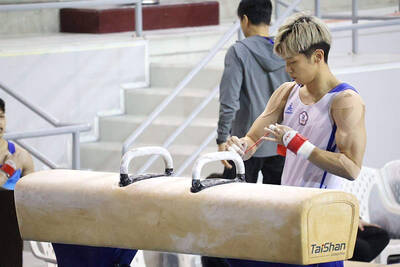
Taiwanese gymnast Lee Chih-kai failed to secure an Olympic berth in the pommel horse following a second-place finish at the last qualifier in Doha on Friday, a performance that Lee and his coach called “unconvincing.” The Tokyo Olympics silver medalist finished runner-up in the final after scoring 6.6 for degree of difficulty and 8.800 for execution for a combined score of 15.400. That was just 0.100 short of Jordan’s Ahmad Abu Al Soud, who had qualified for the event in Paris before the Apparatus World Cup series in Qatar’s capital. After missing the final rounds in the first two of four qualifier


 RSS
RSS