


Ask former All-Pro New York Giants linebacker Harry Carson what's wrong with him and he laughs. "How much time do you have?" he says. Carson, who played 13 seasons in the NFL, has a laundry list of health problems.
"Anyone who plays the game leaves with something. You learn how to deal with it," he said. "I have a disk problem that affects my sciatic nerve, back pain, numbness down my leg into my foot, spasms in my back, an atrophied posterior deltoid muscle in my right shoulder, knee pain ..."
Then there's the headaches, memory loss, and blurry vision associated with being diagnosed with post-concussion syndrome two years after he retired in 1988.
"I really don't know how many concussions I had, something like 15 to 18," he said. "We were trained to be warriors, who never wanted to sit. We played hurt. We all had that macho, John Wayne mentality. Most people get knocked around, [but] I was never unconscious. I was stunned and saw stars, and it faded to black. A lot of players don't even know they had one."
Carson, who was a Hall of Fame finalist last year, said his memory loss cost him a television broadcasting job. But he'll never forget a 1985 collision in a game against the Washington Redskins at RFK Stadium.
"The Redskins had John Riggins, who liked to use his power. He tried to run over you," Carson said. "I was a linebacker who didn't have a lot of speed. It was power vs. power. I remember hitting John solid and getting back up into the huddle. We're holding hands in the huddle. I'm the signal-caller on defense. I look over at [assistant coach] Bill Belichick and everything fades to black and comes back. He's flashing the sign -- Stack cover two -- or whatever and I can't distinguish what he's saying. So if I don't understand, my sign is to tap my helmet. He flashes again and I fade again to black and then it comes back. Then I tap my helmet."
This happens yet again.
"At this time the Redskins are already at the line of scrimmage. [Linebacker] Gary Reasons calls the play. I knew I was in trouble. Physically I was fine, neurologically I was not there. In the heat of battle, you learned to play. I stayed in the game, I probably should not have. Under those conditions, players are gonna play. It's hard for a player to come out. You suck it up and play."
Carson says he completely supports the Center for the Study of Retired Athletes. "It's extremely important, you have to have a neutral body out there to conduct credible studies, with no bias. It's tremendously helpful. We've sort of been in the dark in our own sphere. You can't often get the truth from management in the NFL."
Carson, who promised himself he never would get overweight after he retired, likes to walk the city streets. People still recognize him, even the homeless in Central Park. A thoughtful man, he still visits regularly with teammates who admire his speaking out about the dangers of concussions. But couldn't part of the depression he suffers be from not hearing the roar of the crowd and being catered to? After winning the Super Bowl, what do you do for the next 50 years?
Carson smiles. He always could take a hit.
"When I was depressed, I was still playing. It wasn't like I was not playing well. I was a captain, All-Pro, and I was depressed and I couldn't put my finger on why. I can remember going to [the Giants' medical staff] and they said, `Anything wrong?' I said, `I'm depressed and I want you to put it down.' Physically I was fine."
Carson saw a specialist in 1990, but still suffers the effects of his playing days.
"I like to think the results are due to the concussions I suffered," he said. "I have good days where I'm up and witty and other days where I'm very sluggish. I learned to deal with it. It's a trade-off."
But Carson would not trade in his Super Bowl ring or blame anyone for his medical problems.
"What you do is so special you pay the price. I can't think of many players that would say it wasn't worth it," he said. "It's not the trainers' or the coaches' fault ... concussions are the bad guy."
Carson said his playing days (1976-1988) were still the dark ages of understanding concussions. "They'd ask you what day it was," he said. "That's no true measure of what damage had been done.
"For the most part, it was my decision to go back in the game. It was a different era, there was not a whole lot of research. I don't think anybody knew how serious it was at the time.
"When Steve Young and Troy Aikman, high-profile players, got dinged, then people started to take notice. I can't talk about brain damage down the road."
Carson attended the funeral of Pittsburgh Hall of Fame center Mike Webster last September. Webster was diagnosed in 1999 with brain damage caused by multiple concussions, which set off a myriad of problems leading to his death from congestive heart failure.
"What can be done? Nothing," Carson said. "It's the nature of the game. It's a contact sport. How is technology going to stop that?
"It could be the sudden stopping of the body and the brain continues to go. Especially around the head. I don't care how much equipment you have.
"It's frustrating. But you see more and more players keeling over, and not of Alzheimer's. You can't really worry about it. The best thing you can do is live."

Revelations of positive doping tests for nearly two dozen Chinese swimmers that went unpunished sparked an intense flurry of accusations and legal threats between the World Anti-Doping Agency (WADA) and the head of the US drug-fighting organization, who has long been one of WADA’s fiercest critics. WADA on Saturday said it was turning to legal counsel to address a statement released by US Anti-Doping Agency (USADA) CEO Travis Tygart, who said WADA and anti-doping authorities in China swept positive tests “under the carpet by failing to fairly and evenly follow the global rules that apply to everyone else in the world.” The
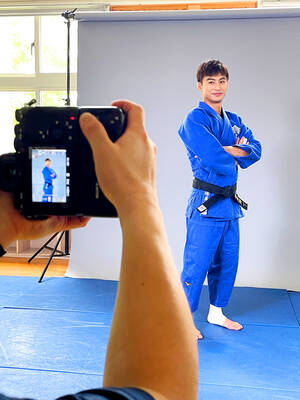
Taiwanese judoka Yang Yung-wei on Saturday won silver in the men’s under-60kg category at the Asian Judo Championships in Hong Kong. Nicknamed the “judo heartthrob” in Taiwan, the Olympic silver-medalist missed out on his first Asian Championships gold when he lost to Japanese judoka Taiki Nakamura in the finals. Yang defeated three opponents on Saturday to reach the final after receiving a bye through the round of 32. He first topped Laotian Soukphaxay Sithisane in the round of 16 with two seoi nage (over-the-shoulder throws), then ousted Indian Vijay Kumar Yadav in the quarter-finals with his signature ude hishigi sankaku gatame (triangular armlock). He

RALLY: It was only the second time the Taiwanese has partnered with Kudermetova, and the match seemed tight until they won seven points in a row to take the last set 10-2 Taiwan’s Chan Hao-ching and Russia’s Veronika Kudermetova on Sunday won the Porsche Tennis Grand Prix women’s doubles final in Stuttgart, Germany. The pair defeated Norway’s Ulrikke Eikeri and Estonia’s Ingrid Neel 4-6, 6-3, 10-2 in a tightly contested match at the WTA 500 tournament. Chan and Kudermetova fell 4-6 in the first set after having their serve broken three times, although they played increasingly well. They fought back in the second set and managed to break their opponents’ serve in the eighth game to triumph 6-3. In the tiebreaker, Chan and Kudermetova took a 3-0 lead before their opponents clawed back two points, but
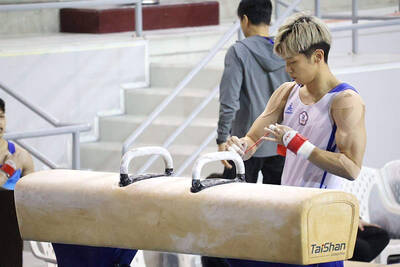
Taiwanese gymnast Lee Chih-kai failed to secure an Olympic berth in the pommel horse following a second-place finish at the last qualifier in Doha on Friday, a performance that Lee and his coach called “unconvincing.” The Tokyo Olympics silver medalist finished runner-up in the final after scoring 6.6 for degree of difficulty and 8.800 for execution for a combined score of 15.400. That was just 0.100 short of Jordan’s Ahmad Abu Al Soud, who had qualified for the event in Paris before the Apparatus World Cup series in Qatar’s capital. After missing the final rounds in the first two of four qualifier


 RSS
RSS