


Asia's tight-knit community of rugby-playing expats still bears the scars of their group holiday when a break from the stress of professional life ended in tragedy on the sun-kissed island of Bali.
Teams from across the region had converged on the Indonesian island last year for an annual highlight to their sporting calendar; a chance to play rugby, meet old friends and let off steam at an international tournament.
But the fun stopped on Oct. 12 when bombs planted by Islamic extremists tore through two nightclubs. Of the 202 people who died that night, 27 were rugby players or supporters.
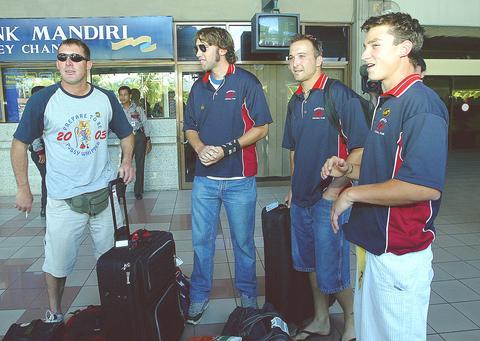
PHOTO: REUTERS
"It is going to take a long time for the wounds to heal from Bali," said Donough Foley, a member of the Hong Kong Football Club (HKFC), which lost nine players in the blasts. "The first anniversary is going to be hard."
Few who play rugby in the former British colony went untouched by the tragedy. Young victims like Britons Nathaniel Miller, Peter Record, Edward Waller, Stephen Spiers and American Jake Young were popular club figures.
"Those guys were there one minute and they were gone the next. They had a lot of years' combined experience in playing rugby and they were great characters both on and off the field," Foley said.
For those who survived the attack, the events of Oct. 12 will be even harder to forget.
Peter Chworowsky, president of the Taipei Baboons rugby club, which lost five players and one fan, still recalls the deafening explosion, the thick smoke and the panic to escape Bali's Sari club after the bombs detonated.
"I was sitting down for a drink after dinner, when the bombs went off. It was chaos. I was trapped under debris with people trampling over me to get out of the club," Chworowsky said.
"Eventually, I got out, I was stunned but OK, but then we had to figure out who was missing and begin trying to find them," he said.
The task would take weeks, with dazed survivors airlifted to hospitals in other parts of Indonesia and Australia. Chworowsky was among those who stayed on in Bali to help relatives track down loved ones, many of them already dead.
One year on from the attacks, for which 34 suspects have been arrested and three men sentenced to death, many of the surviving players last week returned to Bali to once again play rugby, remember the dead and to tackle the future.
"It was a terrible event, but we can take some postivity from it," said Chworowsky, who led the toast to absent friends and teammates following Sunday's tournament final.
"It brought those of us who survived it closer together and it made the club much stronger."
Added Foley: "A week after the attacks, we pushed forward and played on. That's what the boys would have wanted.
"Today, although those who lost their lives in Bali can never be replaced, we still have a strong club."

Revelations of positive doping tests for nearly two dozen Chinese swimmers that went unpunished sparked an intense flurry of accusations and legal threats between the World Anti-Doping Agency (WADA) and the head of the US drug-fighting organization, who has long been one of WADA’s fiercest critics. WADA on Saturday said it was turning to legal counsel to address a statement released by US Anti-Doping Agency (USADA) CEO Travis Tygart, who said WADA and anti-doping authorities in China swept positive tests “under the carpet by failing to fairly and evenly follow the global rules that apply to everyone else in the world.” The

Taiwanese judoka Yang Yung-wei on Saturday won silver in the men’s under-60kg category at the Asian Judo Championships in Hong Kong. Nicknamed the “judo heartthrob” in Taiwan, the Olympic silver-medalist missed out on his first Asian Championships gold when he lost to Japanese judoka Taiki Nakamura in the finals. Yang defeated three opponents on Saturday to reach the final after receiving a bye through the round of 32. He first topped Laotian Soukphaxay Sithisane in the round of 16 with two seoi nage (over-the-shoulder throws), then ousted Indian Vijay Kumar Yadav in the quarter-finals with his signature ude hishigi sankaku gatame (triangular armlock). He

RALLY: It was only the second time the Taiwanese has partnered with Kudermetova, and the match seemed tight until they won seven points in a row to take the last set 10-2 Taiwan’s Chan Hao-ching and Russia’s Veronika Kudermetova on Sunday won the Porsche Tennis Grand Prix women’s doubles final in Stuttgart, Germany. The pair defeated Norway’s Ulrikke Eikeri and Estonia’s Ingrid Neel 4-6, 6-3, 10-2 in a tightly contested match at the WTA 500 tournament. Chan and Kudermetova fell 4-6 in the first set after having their serve broken three times, although they played increasingly well. They fought back in the second set and managed to break their opponents’ serve in the eighth game to triumph 6-3. In the tiebreaker, Chan and Kudermetova took a 3-0 lead before their opponents clawed back two points, but

Taiwanese gymnast Lee Chih-kai failed to secure an Olympic berth in the pommel horse following a second-place finish at the last qualifier in Doha on Friday, a performance that Lee and his coach called “unconvincing.” The Tokyo Olympics silver medalist finished runner-up in the final after scoring 6.6 for degree of difficulty and 8.800 for execution for a combined score of 15.400. That was just 0.100 short of Jordan’s Ahmad Abu Al Soud, who had qualified for the event in Paris before the Apparatus World Cup series in Qatar’s capital. After missing the final rounds in the first two of four qualifier


 RSS
RSS