


It was 6-4, 5-3 for the Spaniard, Juan Carlos Ferrero, with Andre Agassi about to drop another set, fall into that place where the mind begins telling a 33-year-old pair of legs that it just might be time to pack and go home.
"Too big of a hill to climb," Agassi would say later, an interesting choice of words for a man whose midtennis life crisis was exterminated with a training regimen not for the vertically challenged.
But now he was out there against a player shedding his clay-court skin in his first appearance on the Arthur Ashe Stadium court during this provincially plotted US Open. Ferrero, the French Open champion, was morphing before Agassi's eyes into the world's No. 1 ranked player, into a legitimate threat on the American hard courts, the surface that has always suited Agassi's baseline brilliance best.
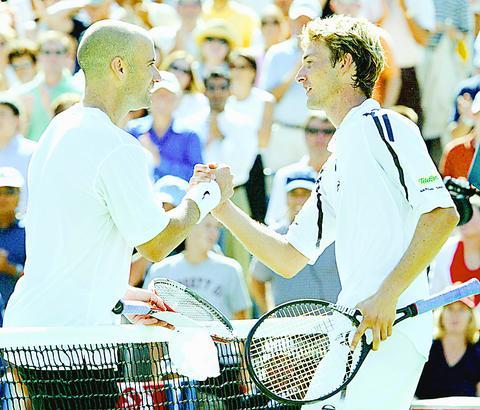
PHOTO: AFP
Ferrero was raising his game, his profile and ultimately a cosmic question Agassi will undoubtedly soon have to ask of himself.
"See, that's the problem," someone who knew what it was like to be where Agassi was said inside a posh office at the National Tennis Center. "It's not the tennis so much at this stage of your career; it's your comfort zone. You're down two sets to love and you're asking: `Do I really want to stay out here and do what it takes or do I really need this?"'
On the television screen, Agassi was hitting a forehand long and that person, Jimmy Connors, added: "In my case, I was ready to stay out there however long it took, 15 minutes or five hours. I never felt like I had anywhere else to go, anything else to do. And that's why you've got to love a guy like Agassi. He's out there pushing, trying to hold these younger guys off."
Agassi would lean on Ferrero on Saturday, winning the third set, making the fourth a struggle but he wound up losing his semifinal 6-4, 6-3, 3-6, 6-4. The home country scheduling during the rainy second week of the Open didn't help Agassi. He couldn't make it up the hill the way Andy Roddick did after dropping the first two sets to David Nalbandian, the Argentine backboard. Roddick pulled himself together in time, otherwise this afternoon's only patriot act would have been a ceremony honoring Chris Evert and Connors as members of the new US Open Court of Champions.
Two Spanish-speaking finalists would not have made the network's day, with the forecast calling for no opportunities to rewind Connors and Krickstein, the match that has come to stand as the timeless Open classic. "Those eleven days," Connors said of his memorable 1991 run to the semifinals at the ancient tennis age of 39, "were the best of my career."
He was speaking figuratively when he said he never had anywhere else to go outside the tennis court. At 33, Connors, had a wife, a child, another on the way, just as Agassi does now. He continued to play, all the way to 40, then disappeared from the National Tennis Center until last summer, when he stopped by one day for a couple of hours.
"I wasn't here or anywhere," Connors said before going out to watch Roddick resurrect himself, along with the masses who late in Connors' career loved howling for him. "I never wanted to be here, just to be here."
He had to make himself scarce, he said, in order to kick his competition habit. He wanted to go forward with his life, and build a seniors tour from the ground up. In recent years, he stayed home in Santa Barbara, reconnecting on a full-time basis with his wife and children.
His son, Brett, is 24 and his 18-year-old daughter, Aubree, who was with him Saturday, is now his regular hitting partner. "I was a stranger in my house for a long time," Connors said. "We're making up for lost time."
The all-time champion of blue-collar tennis played years past his prime, long after he was a serious Grand Slam threat. Agassi, conversely, won his eighth Grand Slam title last January in Australia but the summer was full of what had to feel like last chances, slipping away.
"You know, I got outplayed today," Agassi said. "The same thing happened at Wimbledon. The same thing happened in Paris."
Here, Agassi was defeated by a man who had played nine sets combined the previous two days and whose aching leg needed to be wrapped during the fourth set. Ferrero, a decade younger, had more energy, more to prove to the American crowd that expected Agassi to wipe him away like clay-court dust off the bottom of his shoes. Ferrero was not only the survivor, he was the showman, running down a lob, swatting it back between his legs and then catching up with Agassi's mediocre volley for a crosscourt winner.
Fifteen years ago, Agassi was the brash shot-maker when he beat Connors in straight sets at the Open, then bragged that he knew a rout was inevitable. "He made a mistake, which I'll remember," Connors said at the time. When they played again in the Open quarters the following year, Connors pushed Agassi hard but lost again, 6-4, in the fifth.
Is scaring the young ones -- the Ferreros and the Federers -- enough of a reward to continue putting in the work, running all those hills? "Something would have to change dramatically for me not to be back," Agassi said at the end of his 18th US Open, which began with his contemporary and career-long rival, Pete Sampras, saying goodbye.

Revelations of positive doping tests for nearly two dozen Chinese swimmers that went unpunished sparked an intense flurry of accusations and legal threats between the World Anti-Doping Agency (WADA) and the head of the US drug-fighting organization, who has long been one of WADA’s fiercest critics. WADA on Saturday said it was turning to legal counsel to address a statement released by US Anti-Doping Agency (USADA) CEO Travis Tygart, who said WADA and anti-doping authorities in China swept positive tests “under the carpet by failing to fairly and evenly follow the global rules that apply to everyone else in the world.” The
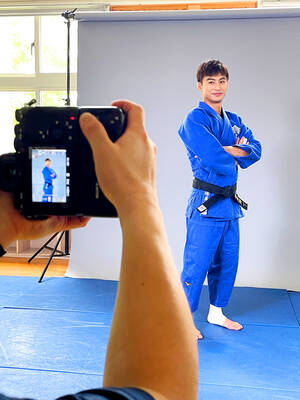
Taiwanese judoka Yang Yung-wei on Saturday won silver in the men’s under-60kg category at the Asian Judo Championships in Hong Kong. Nicknamed the “judo heartthrob” in Taiwan, the Olympic silver-medalist missed out on his first Asian Championships gold when he lost to Japanese judoka Taiki Nakamura in the finals. Yang defeated three opponents on Saturday to reach the final after receiving a bye through the round of 32. He first topped Laotian Soukphaxay Sithisane in the round of 16 with two seoi nage (over-the-shoulder throws), then ousted Indian Vijay Kumar Yadav in the quarter-finals with his signature ude hishigi sankaku gatame (triangular armlock). He

RALLY: It was only the second time the Taiwanese has partnered with Kudermetova, and the match seemed tight until they won seven points in a row to take the last set 10-2 Taiwan’s Chan Hao-ching and Russia’s Veronika Kudermetova on Sunday won the Porsche Tennis Grand Prix women’s doubles final in Stuttgart, Germany. The pair defeated Norway’s Ulrikke Eikeri and Estonia’s Ingrid Neel 4-6, 6-3, 10-2 in a tightly contested match at the WTA 500 tournament. Chan and Kudermetova fell 4-6 in the first set after having their serve broken three times, although they played increasingly well. They fought back in the second set and managed to break their opponents’ serve in the eighth game to triumph 6-3. In the tiebreaker, Chan and Kudermetova took a 3-0 lead before their opponents clawed back two points, but
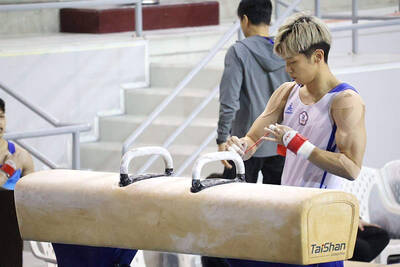
Taiwanese gymnast Lee Chih-kai failed to secure an Olympic berth in the pommel horse following a second-place finish at the last qualifier in Doha on Friday, a performance that Lee and his coach called “unconvincing.” The Tokyo Olympics silver medalist finished runner-up in the final after scoring 6.6 for degree of difficulty and 8.800 for execution for a combined score of 15.400. That was just 0.100 short of Jordan’s Ahmad Abu Al Soud, who had qualified for the event in Paris before the Apparatus World Cup series in Qatar’s capital. After missing the final rounds in the first two of four qualifier


 RSS
RSS