


Members of a secret society yesterday held a ceremony at the Taipei Armed Forces Hero House (國軍英雄館) to honor its fifth president and other of the society's members.
Around 250 members, including several high-ranking retired generals such as General O Yen-wei (
"It's a great honor to serve as the society's president," said Tu Yi-fei (杜一飛), the new head of the group. "And it's my goal to strengthen the sense of community among society members and lead the Hung Men Society to engage in more work for the welfare and benefit of the public."
As a private organization, the society has long been mysterious due to its low profile, yet it boasts a remarkable membership.
According to Huang Chao-sheng (
Founded more than 300 years ago, "Hung Men members have contributed much to the writing of Chinese history since national father Sun Yat-sen (
Like the Green Gang, another well-known secret society, the Chinese Hung Men Society was involved in Sun's efforts to subvert the Qing dynasty at the turn of the century and was later involved in Chiang Kai-shek's (
"And after the nationalists came to Taiwan, Hung Men members continued to contribute and support the government's work in developing Taiwan," Huang said.
The society's goals have also changed with the times.
"Anti-communism had been Hung Men's mission," Huang said. "And now the ultimate mission of the society is to work on a unified China.
"Hung Men members will continue to uphold the spirit of righteousness and loyalty, the spirits valued most by Hung Men."
According to a society magazine published last December, many high-profile politicians act as advisers to the group. These figures include former New Party lawmaker Elmer Fung (馮滬祥), PFP legislators Lee Ching-an (李慶安), Chou Hsi-wei (周錫瑋), and Lin Yu-fang (林郁芳) and KMT legislators Hung Hsiu-chu (洪秀柱), Huang Chao-shun (黃昭順), Chu Fong-chi (朱鳳芝), Apollo Chen (陳學聖), Chin Huei-chu (秦慧珠), Mu Min-chu (穆閩珠) and James Chen (陳健治).

The National Chungshan Institute of Science and Technology yesterday showcased its locally developed variants of the Vision 60 robotic patrol dog, which it plans to deploy on the nation’s outlying territories in the South China Sea. The variants were produced under the Joint Lab project — created by the institute and domestic companies — and assembled with domestically produced motors, lenses and artificial intelligence (AI) systems alongside licensed tech from the US, Missile and Rocket Systems Research Division deputy director Jen Kuo-kang (任國光) told the media event at a military base in Taipei’s Dazhi (大直) area. Taiwan has built up its strengths

RIGHT DIRECTION: Taiwan’s efforts to prevent forced labor include a proposal to ‘fully prohibit’ employers from withholding workers’ documents, an official said Taiwan is to establish a mechanism to restrict imports of goods linked to forced labor, the Executive Yuan said yesterday, after the US proposed imposing additional tariffs on Taiwanese goods over labor concerns. “The Ministry of Labor and the Ministry of Economic Affairs are to establish an interministerial review procedure,” Executive Yuan spokesperson Michelle Lee (李慧芝) said at a news briefing in Taipei. “The government is to use the Foreign Trade Act [貿易法] as the legal basis to restrict imports of goods produced with forced labor” and bring its supply chain governance more in line with international standards on human rights, resilience

NOT IMMEDIATE: Taiwan has a chance to appeal the proposed 10 percent tariff before it starts, while other countries face a 12.5 percent tariff from the trade office Taiwan is among 60 economies determined by the US to have failed to impose or enforce a ban on the importation of goods produced with forced labor, according to a notice released on Tuesday by the Office of the US Trade Representative (USTR), which proposed imposing an additional 10 percent or more tariff on them. The USTR in a statement said that following an investigation, it had determined under Section 301 of the Trade Act of 1974 that the failure of the 60 economies to impose and effectively enforce a prohibition on the importation of goods produced with forced labor is
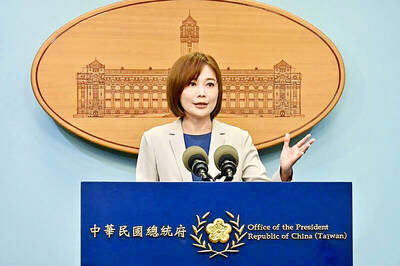
TIT-FOR-TAT: The US allegedly revoked the visa of a Chinese national working at Xinhua News Agency in the US in response to Beijing’s expulsion of Vivian Wang The Presidential Office yesterday condemned China for expelling a New York Times correspondent from Beijing following the newspaper’s interview with President William Lai (賴清德), saying the move highlighted Beijing’s suppression of press freedom and its threat to international news media. Taiwan has noted a series of recent incidents in which Beijing used similar tactics to “threaten and pressure international media outlets and journalists,” Presidential Office spokeswoman Karen Kuo (郭雅慧) said in a statement. “This concerns not only press freedom and freedom of expression, but also the safety of journalists, and Taiwan and relevant partners are paying close attention to the situation,” she


 RSS
RSS