


Lawmakers yesterday criticized accusations made by DPP lawmaker Chang Chin-fang (張清芳) that up to 20 of his colleagues had taken bribes in return for supporting a bill to amend the Electronic Game Regulation Act (電子遊戲場業管理條例).
The KMT has also told its lawmakers to withdraw their endorsement of the amendment, which would legalize video-game arcades, yet continue to ban video games for gambling.
Chang and another DPP lawmaker, Yeh Yi-jin (葉宜津), held a press conference on Thursday during which they accused colleagues from various parties of accepting bribes, ranging between NT$500,000 and NT$3 million, from operators of video-game arcades to endorse the amendment.
Yesterday morning, KMT Secretary-General Lin Fong-cheng (林豐正) contacted the KMT's legislative caucus whip, Lee Cheng-chong (李正宗), asking him to find out if any KMT legislator was involved in the alleged corruption.
Lin told Lee: "Before we clear things up, our policy is to drop our endorsement of the amendment. We cannot allow any one of our legislators to accept bribes. We need to figure out who those people are, if there are any."
New Party lawmaker Elmer Fung (馮滬祥) said that the accusation was ridiculous since Yeh and Chang failed to provide any evidence.
"I have endorsed the amendment," Fung said. "However, it is an insult for them to say that lawmakers who endorsed the bill have accepted bribes since it's not the truth. I will commit suicide if I am found guilty."
DPP lawmaker Lin Kuo-hua (林國華) said that the Ministry of Justice (法務部) should begin its investigation of the case and find out who actually accepted the bribes.
"Yeh and Chang accused those who have endorsed the amendment without presenting any evidence," the DPP's Lin said.
"It's actually not fair to those who did not accept the money but still endorsed the bill. If you want to point the finger at somebody, you need to back it up with evidence. Now, more and more lawmakers will drop their endorsement because nobody wants to be misunderstood."
KMT lawmaker Hsu Shu-po (許舒博), who proposed the amendment, said he would stand by it.
"We need the amendment to regulate these video-game arcades so they can be legalized," Hsu said.
"By doing so, we can create more job opportunities. ... So I'll keep up the fight."
In response to lawmakers' requests for an investigation, the Ministry of Justice's Bureau of Investigation said that Yeh and Chang's accusation had not been verified but would investigate if necessary.
"We do not have a list of those lawmakers who allegedly accepted bribes," said an anonymous senior officer at the bureau.
"However, investigators will do what they must do when the time comes."

‘NO SECURITY RISK’: The Railway Bureau reassured the public that the technicians’ activities were limited to technical guidance and did not involve sensitive systems The Railway Bureau yesterday said it had invited eight Chinese technicians to assist with an airport MRT construction project. The bureau issued the confirmation after an Internet user said Chinese nationals had entered the construction zone of Taiwan Taoyuan International Airport’s Terminal 3 project. They asked why “individuals from an enemy state” were allowed access to such a major national infrastructure project, which raised serious concerns over Taiwan’s industrial safety, sensitive systems and information security. The bureau’s Northern Region Engineering Branch Office said subcontractor Taiwan Handle Industrial Co (台灣手把工業) of the Taoyuan airport MRT’s “Contract No. CU05 Project A14 Station Civil, MEP &

A US uncrewed surface vessel (USV) encountered multiple Chinese warships during an autonomous transit of the Taiwan Strait, US defense company Seasats said in a statement on Wednesday. Seasats announced that a Lightfish USV had completed the first autonomous transit of the Taiwan Strait. Over five days, the USV traversed the entire length of the Strait while constantly monitoring surface vessel traffic, the company said. The Lightfish encountered multiple Chinese warships, one of which was a Chinese People’s Liberation Army Navy (PLAN) Type 056 corvette, it said. The Chinese vessels were operating “well within Taiwan’s exclusive economic zone without transmitting their identity via the
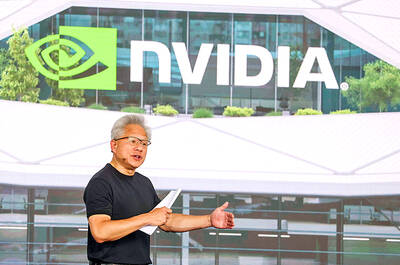
‘BOOMING’: ’ The number of partners we have here is incredible. You can see from their stock prices. They’re doing so well, they’re so happy,’ Jensen Huang said Nvidia Corp’s spending in Taiwan has ballooned to about US$150 billion a year, 10 times the US$10 billion to US$15 billion the company spent five years ago, Nvidia chief executive officer Jensen Huang (黃仁勳) said yesterday, suggesting Taiwan’s strategic importance in the global artificial intelligence (AI) supply chain. “Taiwan is the epicenter of the AI revolution. This is where the chips come, packaging comes. This is where the systems are made. This is where AI supercomputers were created,” Huang said at a meeting for the company’s employees in Beitou-Shilin Technology Park (北投士林科技園區) in Taipei, the planned site of Nvidia’s Taipei headquarters. “Taiwan
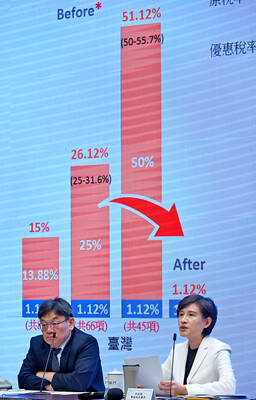
GREATER REACH? Auto parts and wood products would face tariffs of up to 15%, matching those targeting the EU, Japan and South Korea, Vice Premier said The US has announced that preferential tariff treatment for Taiwan’s non-semiconductor Section 232 goods would take effect retroactively from May 1, the Executive Yuan said yesterday. The US government yesterday posted a notice on the Federal Register’s public inspection Web site previewing tariff concessions for Taiwan under a memorandum of understanding (MOU) on Taiwan-US investment after two months of negotiations. The MOU signed on Jan. 15 stipulated three major preferential tariff arrangements: a 15 percent “reciprocal” tariff rate for Taiwan without stacking most-favored nation (MFN) rates; preferential Section 232 treatment for semiconductors and related products; and preferential Section 232 treatment for non-semiconductor


 RSS
RSS