


Former Hsinchu mayor Tsai Jen-chien (蔡仁堅), erstwhile boyfriend of the one-time Hsinchu City Bureau of Cultural Affairs chief Chu Mei-feng (璩美鳳), was yesterday issued with a summons to go to the Taipei District Prosecutors' Office.
Meanwhile, in the Legislative Yuan yesterday, Minister of Justice Chen Ding-nan (陳定南) vehemently asserted his innocence on charges made by some lawmakers that he, because he is a friend of Tsai's, may have interfered in the investigation into the secret filming of a sex VCD.
The summons requires that Tsai report to prosecutors as a potential witness in that investigation.
"The reason why we are summoning him as a `potential witness' instead of as a `witness' is that other than Kuo Yu-ling (
Kuo, a "spiritual growth" instructor at a religious-healing center called Avatar, has admitted to prosecutors that she installed the equipment that made the VCD possible, but said that she acted on the orders of somebody else whom she has refused to name.
Chen said the task force's current focus is on identifying the primary culprit in the case and to establish the whereabouts of the original tape. Investigators have obtained Kuo's telephone records and notebooks and found the name and telephone number of Tsai among them.
"On the basis of what we have established," Chen said, "prosecutors believe there is more than a good chance that there might be more than one original tape and that the main culprit still possesses them. Tsai might know this person or be able to provide more clues to help us figure out who it is.
"But don't get me wrong," he continued. "Tsai's summons does not mean that he will be treated as a witness or suspect. Prosecutors need him to clear up certain questions to which, obviously, current evidence suggests he could be key."
He said that the summons would notify Tsai to attend the prosecutors' office at an appointed time, which he was not at liberty to divulge, before this week comes to an end.
Meanwhile, answering questions at the Judicial Committee of the Legislative Yuan yesterday morning, Minister Chen said that in the investigation of cases prosecutors are no longer influenced by politics.
"Unconfirmed information and rumors, on the other hand, can affect an investigation," he said.
"Many people have suspected me of interfering due to my friendship with Tsai," Chen said. "Actually, that was a malicious rumor and the truth is that I have never been involved in the investigation. That is our prosecutors' job and, at the moment, I think they're doing quite well."
Continuing to state his innocence, he said, "Moreover, this is just an ordinary criminal case. I don't believe that any politician would interfere in a case like this."
"What makes you believe that any government official would speak for a former city mayor and get involved in a case like this?" he said.

National Taiwan University (NTU) yesterday said it disqualified a person from an entrance examination for using AI smart glasses to cheat, along with two others for making untruthful statements in their curriculum vitae. The three applicants were given null scores, Taiwan’s highest-ranked university said, calling on prospective students to be honest in the admissions process. NTU registrar Lee Hung-sen (李宏森) said that the cheating applicant wore a hat and thick-rimmed glasses to the second written exam for medical school, claiming that they felt cold. Suspicions were aroused when the applicant stared oddly at the test for long stretches while steadily bringing the paper
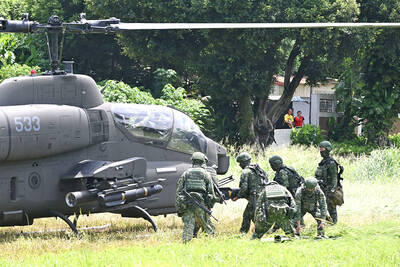
MILITARY ISSUES: A partisan divide between the Cabinet and the legislature ‘raised questions about Taiwan’s ability to adequately fund its defense,’ the report said Taiwan’s defense budget, military personnel numbers and resilience are challenges to its ability to meet national defense goals, the US Naval Institute said in a report published on Tuesday. In response to the perception of a growing military threat posed by China, Taiwan has embarked on an effort to enhance the capabilities needed to deter an attempt by Beijing to annex the nation by force, the institute said in the US Congressional Research Service report, titled Taiwan: Defense and Military Issues, which was filed on Thursday last week. Taiwan’s defense budget increased by about 7.5 percent from 2024 to last year, it
NOT JUST NUMBERS: What matters to intelligence work is crucial, reliable information, so even a few credible leads can be highly valuable to national security, a legislator said The National Security Bureau (NSB) yesterday said it has finished the establishment of an information-reporting channel for Chinese nationals, the aim of which is to broaden intelligence gathering on China’s political, military, economic and social developments. Chinese nationals can submit information on the Web page, https://report.nsb.gov.tw, the NSB said in a statement. The move aims to expand the bureau’s diverse intelligence sources and is pursuant to the National Intelligence Services Act (國家情報工作法), it said, adding that it referenced practices adopted by intelligence agencies in the US, the UK and Israel. An increasing number of people are approaching Taiwanese agencies to provide information, as

66 FIGHTER JETS: The aircraft is likely undergoing preparations for its transfer to Taiwan — a significant step forward in the nation’s modernization program, a lawmaker said The first of Taiwan’s order of F-16V Block 70 aircraft has been sighted in Texas ahead of delivery, Democratic Progressive Party (DPP) Legislator Wang Ting-yu (王定宇) said. Taiwan’s first F-16V Block 70 two-seat aircraft, tail number 6831, was seen flying from Lockheed Martin’s production facility in Greenville, South Carolina, to Naval Air Station Joint Reserve Base Fort Worth in Texas, Wang wrote on Facebook yesterday. The plane is likely undergoing preparations for its transfer to Taiwan, marking a significant step forward in the Republic of China Air Force’s modernization program, Wang said, citing military analysts. The F-16V Block 70 is a new-build version


 RSS
RSS