

Former DPP heavyweight, Wei Yao-chieh (魏耀乾) is challenging DPP candidate Su Huan-chih (蘇煥智) by running as an independent in a bid to be Tainan County's next county commissioner.
Born into a conservative Tainan family that had close links to the KMT, Wei was an unlikely political dissident. But an influential friendship with then Taipei City Councilor Frank Hsieh (
Originally trained as a dentist, Wei said his political awakening came after the 1979 murders of former DPP chairman Lin I-hsiung's (
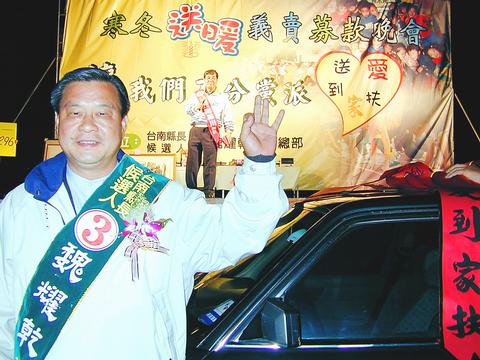
PHOTO: YANG CHIN-CHENG, TAIPEI TIMES
Later, in his six years as a DPP legislator, Wei frequently resorted to fist fights to make his point, often referring to his time as a dentist by saying he was going to "pull the tiger's teeth."
Noting that his time as a hardliner is over, Wei said that he now just wants to get his ideas on social welfare out into the open, regardless of whether he wins or loses the race.
"The county should integrate with [nearby] Tainan City and Chiayi County and develop into a Singapore-style economic hub for contract manufacturers' packing and marketing," Wei said.
Reiterating his pledge to take care of the elderly, Wei said that he has been greatly moved by those people over 70 years old who have attended his recent campaign rallies. He said that most of the county's older population is looking to the future commissioner to ensure that they are taken care of in their old age.
"My perspectives on social welfare differ from those of the DPP," Wei said, adding that he is fighting for the interests of the middle and lower classes.
Wei said that the ideal leader for the county would speak for disadvantaged farmers and workers and ensure that a sound social security system be put in place for them.
"Also, he should assist small and medium-sized enterprises to create new business opportunities, which will then bring in employment opportunities and income for local families," Wei said.
Placing a distant third in opinion polls, Wei has stayed in the race despite pleas from the DPP to bow out.
Denying arguments that his candidacy threatens Su's chances of winning, Wei said he might actually help Su take the county.
"I can win the votes of DPP members that turn against Su so that they don't all go to the KMT's Wu Ching-chi (

‘GLOBAL WARNING’: The infiltration is not just a local problem, as Beijing has been deploying the same tactics worldwide against Western democracies, a report said Between 50,000 and 100,000 Chinese spies are operating in Taiwan, far more than the National Security Bureau’s previous estimate of 5,000, German journalist and author Jurgen Kremb said on Monday. Kremb presented his research, titled “The War of Spies: How China’s Intelligence Services Are Infiltrating Taiwan — and What Europe Must Learn from It,” at a joint event held by the Taiwan offices of the Friedrich Naumann Foundation and the European Values Center for Security Policy. The report was published in June in the Ministry of Justice Investigation Bureau’s Prospect & Exploration Monthly (展望與探索月刊). By spies, he said he was referring to informants,

PRICE STABILIZATION: The Ministry of Economic Affairs has urged the legislature to support the Cabinet’s supplementary budget for state-owned energy companies State-owned oil supplier CPC Corp, Taiwan (CPC, 台灣中油) on Saturday announced that it would raise domestic gasoline prices by NT$0.7 (US$0.02) per liter and diesel prices by NT$0.6 per liter this week after international crude oil prices rose above US$100 per barrel last week. Formosa Petrochemical Corp (台塑石化) yesterday said that it matched CPC’s price adjustments for this week. The decisions end a six-week period during which CPC and Formosa kept fuel prices in Taiwan unchanged. Retail gasoline prices this week would rise to NT$31.2, NT$32.7 and NT$34.7 per liter for 92, 95 and 98-octane unleaded gasoline respectively at CPC
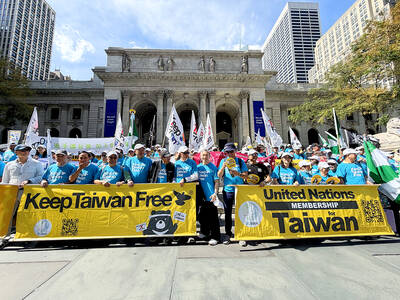
More than 100 Taiwanese-Americans, Taiwanese lawmakers and members of civic groups on Saturday marched through New York City to call for Taiwan’s participation in the UN, with Marshall Island Permanent Representative to the UN John Silk joining the event to show support. Participants chanted: “UN for Taiwan” and “Keep Taiwan Free” as they marched through central Manhattan, passing Times Square and Bryant Park before ending near the New York Public Library. The annual march brought together Taiwanese community groups from across the US East Coast. Silk expressed hope that Taiwan would one day be able to participate in UN meetings

Two aides at independent Legislator May Chin’s (高金素梅) office were ordered detained incommunicado yesterday in a broadening probe into alleged Chinese espionage by Chin’s former chief of staff, Chang Chun-chieh (張俊傑). The move to hold Lin I-chun (林怡君) and current chief of staff Chen Chih-huang (陳智葟) in custody came four days after Chang, indicted on corruption charges, cut off his electronic monitoring wristband and jumped bail. The High Prosecutors’ Office said that it believes Chang had developed a Chinese spy ring, which might have operated for more than a decade, with funding from China, and that Lin and Chen were suspected of


 RSS
RSS