


Taipei prosecutors indicted a KMT lawmaker yesterday on check fraud charges and alleged he used his position to cover up the crime.
Prosecutors yesterday asked that Liao Hwu-peng (
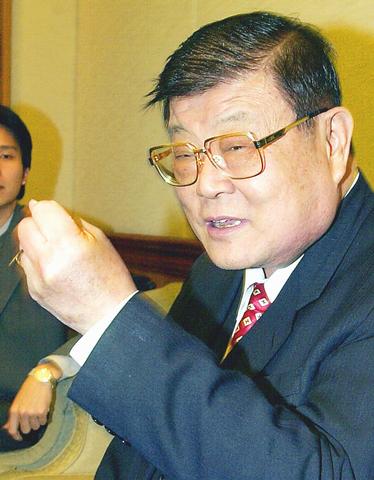
PHOTO: CHU YU-PIN, TAIPEI TIMESN
Investigators say Liao wrote checks after being barred from doing so, and then told banking officials to alter the documents so the checks would be cleared.
On Aug. 11 last year, the Taipei Clearing House declared Liao's account to be "dishonored" after three of his checks had bounced.
The designation meant that Liao was barred from writing new checks and any items dated after Aug. 11 wouldn't be cleared.
But prosecutors say the lawmaker kept on writing checks after that date.
They say he threatened Pai Hui-hsiung (
In all, 81 checks worth more than NT$19.5 million were involved.
Liao yesterday said he was innocent of the charges and said the Bank of Taiwan should shoulder the blame.
The lawmaker said the bank on Sept. 14 of last year had informed him that his account had been declared a "dishonored" one. He said the bank had asked him to change the dates on items written after Aug. 11 so they would be cleared.
"So I gave them my stamp to do it," Liao said.
The lawmaker said he didn't understand what all the fuss was about, as the checks he wrote after Aug. 11 were paid.
"The checks I wrote after Aug. 11 were all cashed. I don't understand why the prosecutors want to indict me," he said.
Prosecutor Liu Cheng-wu (
Liu also said that Liao had asked his assistant, Soong Chun-lien (宋春蓮), to help.
"But he did it by himself as well," the prosecutor said. "Among the 81 checks, two of them were altered by Liao himself. It's quite ridiculous for him to do this as a lawmaker, especially when the bank is located inside the Legislative Yuan [building]."
In addition to Liao, prosecutors have also asked that Soong be sentenced to three-and-a-half years in prison, Pai to three years and Chao to two years.
Prosecutors have also asked that Hsu Man-tzu (
Last February, Liao was indicted for allegedly counterfeiting the stock certificates of Chimei Electronics and selling them to a man for NT$106 million. The case is still pending.
Liao has served six terms in the legislature, but he decided not to run in the Dec. 1 election after the KMT implemented more stringent rules on who could run under the party's banner.

‘NO SECURITY RISK’: The Railway Bureau reassured the public that the technicians’ activities were limited to technical guidance and did not involve sensitive systems The Railway Bureau yesterday said it had invited eight Chinese technicians to assist with an airport MRT construction project. The bureau issued the confirmation after an Internet user said Chinese nationals had entered the construction zone of Taiwan Taoyuan International Airport’s Terminal 3 project. They asked why “individuals from an enemy state” were allowed access to such a major national infrastructure project, which raised serious concerns over Taiwan’s industrial safety, sensitive systems and information security. The bureau’s Northern Region Engineering Branch Office said subcontractor Taiwan Handle Industrial Co (台灣手把工業) of the Taoyuan airport MRT’s “Contract No. CU05 Project A14 Station Civil, MEP &

A US uncrewed surface vessel (USV) encountered multiple Chinese warships during an autonomous transit of the Taiwan Strait, US defense company Seasats said in a statement on Wednesday. Seasats announced that a Lightfish USV had completed the first autonomous transit of the Taiwan Strait. Over five days, the USV traversed the entire length of the Strait while constantly monitoring surface vessel traffic, the company said. The Lightfish encountered multiple Chinese warships, one of which was a Chinese People’s Liberation Army Navy (PLAN) Type 056 corvette, it said. The Chinese vessels were operating “well within Taiwan’s exclusive economic zone without transmitting their identity via the
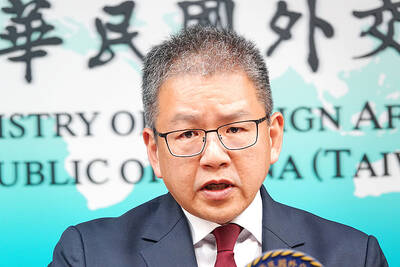
Taiwan is still in the process of assessing the possibility of recruiting workers from Eswatini, the Ministry of Foreign Affairs said yesterday, adding that its goal is to help Eswatini upgrade its vocational training centers. If there are plans to recruit workers from Eswatini, safeguarding national security, protecting public health and ensuring the employment rights of Taiwanese would be prerequisites, Department of West Asian and African Affairs Director-General Yen Chia-liang (顏嘉良) told a news conference. Key considerations would also include filling labor shortages in specific industries, and fostering bilateral professional and technical exchanges, he said. Yen was asked about the progress of labor
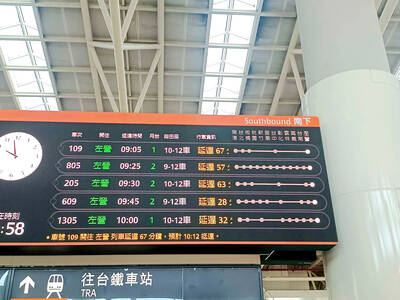
The nation’s usually punctual high-speed rail system yesterday was hit by major disruptions after all scheduled services were canceled and replaced with three hourly trains offering only non-reserved seating, affecting more than 200,000 passengers. Preliminary findings indicate the disruption was caused by a faulty power module in a track switch control cabinet, Taiwan High-Speed Rail Corp (THSRC) said, adding that as a full system inspection could only be conducted after operations end for the day, a decision on whether normal service would resume today would be announced before the first train departs. During a routine inspection early yesterday, a switch signal abnormality


 RSS
RSS