


Boeing Co of the US is negotiating the sale of 60 to 100 AV-8B Harrier vertical/short takeoff and landing (VSTOL) fighter planes with Taiwan, according to the latest issue of a local defense magazine.
If the deal succeeds, Taiwan is expected to start taking delivery of the AV-8Bs in 2005, the Defense Technology Monthly magazine said in its October issue.
To sweeten the deal, Boeing has promised to offer terms beneficial to Taiwan, including transferring relevant technology and upgrading the radar system of the AV-8Bs to match that of the F-16 series fighter jets, the magazine said.
Boeing sent a team to Taiwan early this year to brief the military on the AV-8B package it plans to offer Taiwan, according to the magazine. It reported that the total package will include between 60 and 100 AV-8Bs.
The English-language Flight International magazine had an article on the same topic in its Aug. 21 issue.
The Taipei Times printed an exclusive report on Aug. 21 last year on the military's plans to purchase AV-8Bs from the US.
The US initially did not accept the Taiwanese military's request for the AV-8Bs, according to defense sources. It urged Taiwan instead to buy AV-8As, an older version of the British-designed VSTOL aircraft. The military turned down the arrangement saying that the AV-8As could not meet the combat requirements of Taiwan in the 21st century, sources said.
Now the situation seems to have changed in Taiwan's favor, with the US agreeing not only to sell the AV-8Bs to Taiwan but also to provide some lucrative terms as part of the deal.
The Aerospace Industry Development Corporation, a private company and developer of the IDF fighter plane, is expected to win a contract from Boeing to produce the wing parts of the AV-8Bs, according to the magazine.
The contract will give a boost to the struggling firm, which has been awarded very few big contracts since completing the production of 130 IDFs for the air force two years ago.
The purchase of the AV-8Bs is part of the military's effort to build a force of third-generation fighters, according to an air force official.
F-16s, IDFs and Mirage 2000-5s are referred to as second-generation fighters to differentiate them from older fighter jets such as F-5Es and F-104s.
The air force's main demands for third-generation fighters are those with short or vertical takeoff and landing capabilities, the air force official said.
The Joint Strike Fighter currently being developed in the US is also being considered for purchase because of its VSTOL capabilities, the official said, but the chances of Taiwan acquiring the jet are very slim.

A signaling system malfunction disrupted high-speed rail (HSR) services beginning at 8am today, with trains temporarily reduced to three northbound and three southbound trains per hour as authorities conduct inspections. The malfunction occurred on a section of track in Miaoli County during pre-operation checks early this morning, forcing northbound and southbound trains to use a single track, the HSR operator said. The regular schedule has been replaced with three hourly trains offering only nonreserved seating in each direction, stopping at every station, it said, adding that business class cars would still have reserved seating. Departures from terminal stations are scheduled at the top
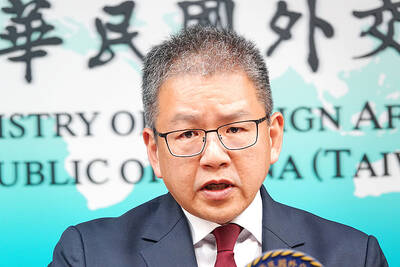
Taiwan is still in the process of assessing the possibility of recruiting workers from Eswatini, the Ministry of Foreign Affairs said yesterday, adding that its goal is to help Eswatini upgrade its vocational training centers. If there are plans to recruit workers from Eswatini, safeguarding national security, protecting public health and ensuring the employment rights of Taiwanese would be prerequisites, Department of West Asian and African Affairs Director-General Yen Chia-liang (顏嘉良) told a news conference. Key considerations would also include filling labor shortages in specific industries, and fostering bilateral professional and technical exchanges, he said. Yen was asked about the progress of labor
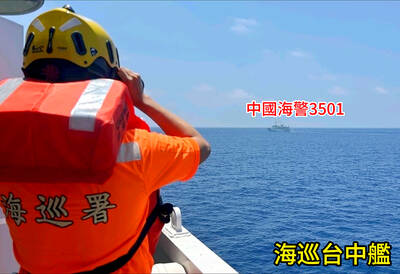
VERBOSE VESSELS: A CGA cutter and a China Coast Guard exchanged verbal barbs for more than a day in Taiwanese-controlled waters before the Chinese vessel left The Taiwanese and Chinese coast guards had a standoff near the strategically located Pratas Islands (Dongsha Islands, 東沙群島) in the north of the South China Sea, the Coast Guard Administration (CGA) said yesterday. The two sides engaged in intense radio exchanges over sovereignty claims during the 33-hour standoff. China Coast Guard vessel 3501 eventually left the restricted waters, 26.6 nautical miles (49.2km) west of the Pratas Islands, at 5pm yesterday, the CGA said. Lying approximately between southern Taiwan and Hong Kong, the Taiwan-controlled Pratas are seen by some security experts as vulnerable to Chinese attack due to their distance — more than

A US uncrewed surface vessel (USV) encountered multiple Chinese warships during an autonomous transit of the Taiwan Strait, US defense company Seasats said in a statement on Wednesday. Seasats announced that a Lightfish USV had completed the first autonomous transit of the Taiwan Strait. Over five days, the USV traversed the entire length of the Strait while constantly monitoring surface vessel traffic, the company said. The Lightfish encountered multiple Chinese warships, one of which was a Chinese People’s Liberation Army Navy (PLAN) Type 056 corvette, it said. The Chinese vessels were operating “well within Taiwan’s exclusive economic zone without transmitting their identity via the


 RSS
RSS