


Taipei Times: Previously, much of your work focused on promoting Taiwan in the international arena, but now you are running for the post of a local government head. What are the major differences for you?
Jason Hu: Actually both are the same -- they are about dealing with public affairs. Although in the diplomatic arena you pay great attention to protocol and the rules of the game, to present yourself successfully either in a formal diplomatic activity or in a local meeting with the general public, it is the human touch that you need to master.
TT: Your opponents criticize you as being "unfamiliar with local affairs." How do you respond to that criticism?

Hu: I was [Taiwan's] representative to the US and later foreign minister. I did these jobs not for my own benefit, but to safeguard Taiwan's security and dignity. Wouldn't it be strange if my efforts in Taiwan's foreign affairs win nationwide recognition but fail to gain the approval of Taichung City residents?
TT: If you are elected but then have opportunities to join the Cabinet or return to the central government, say, if the KMT wins in the next presidential election, what would your choices be?
Hu: I would stay [in Taichung] for at least four years and surely hope to win re-election. This is a contract with voters and also my commitment. I hope when I look back on my life, I will be able to say that I was once a good mayor, and not just a good minister.
TT: In the last Taichung mayoral election, one of the major factors of Chang Wen-ying's (
Hu: Basically, I still doubt whether factional defections were really the key factor in the KMT's loss. More importantly, Taichung City has evolved with an urban constituency structure, in which local factions do not control most votes.
These voters don't identify themselves with factions and don't affiliate themselves with political parties. Even the influence of political parties is declining remarkably. Most voters base their choice on individual candidates' qualifications instead of their party affiliation. I will not adopt traditional campaigning methods. But basically, the KMT is united this time.
TT: How about the effect of the People First Party's attitude toward the election?
Hu: While James Soong (宋楚瑜) got the most votes, 220,000, in Taichung City, outshining other candidates in last year's presidential election, the PFP should not indulge in the myth that all those votes will automatically transfer to the PFP in the year-end elections.
I think that the PFP's best strategy is to maintain an ambiguous attitude. If they insist on coarsely nominating some heavyweight to join the election, it will only tarnish Mr. Soong's image, instead of drawing more supporters [for his party].
TT: You've put forth plans for the city to have an international dimension and you advocate "integrating Taichung City into the Asia Pacific economic market." How do you present this to Taichung City residents in plain language?
Hu: Residents in central Taiwan have always criticized the government for "tilting toward the north, ignoring the south and forgetting Taichung."
Now the people want Jason Hu for Taichung City because only with Jason Hu can the people of Taichung tell other people with pride that they also have a top mayor and that Taichung is on a par with Taipei and Kaohsiung.
That's why my campaign has a new slogan. It's "North Taiwan has Ma, the South has Hsieh, and central Taiwan needs Hu."
Besides, I have many international friends, who will all ask, "Where is Jason Hu?"
When they learn that minister Hu has become Mayor Hu, they will surely ask, "Where is Taichung City?" and they will want to visit and get to know Taichung.
Wouldn't this be the best way for Taichung to get on track with international society?

CREDIT-GRABBER: China said its coast guard rescued the crew of a fishing vessel that caught fire, who were actually rescued by a nearby Taiwanese boat and the CGA Maritime search and rescue operations do not have borders, and China should not use a shipwreck to infringe upon Taiwanese sovereignty, the Coast Guard Administration (CGA) said yesterday. The coast guard made the statement in response to the China Coast Guard (CCG) saying it saved a Taiwanese fishing boat. The Chuan Yu No. 6 (全漁6號), a fishing vessel registered in Keelung, on Thursday caught fire and sank in waters northeast of Diaoyutai Islands (釣魚台). The vessel left Keelung’s Badouzih Fishing Harbor (八斗子漁港) at 3:35pm on Sunday last week, with seven people on board — a 62-year-old Taiwanese captain surnamed Chang (張) and six

The Legislative Yuan’s Finance Committee yesterday approved proposed amendments to the Amusement Tax Act (娛樂稅法) that would abolish taxes on films, cultural activities and competitive sporting events, retaining the fee only for dance halls and golf courses. The proposed changes would set the maximum tax rate for dance halls and golf courses at 50 and 20 percent respectively, with local governments authorized to suspend the levies. Article 2 of the act says that “amusement tax shall be levied on tickets sold or fees charged by amusement places, facilities or activities” in six categories: “Cinema; professional singing, story-telling, dancing, circus, magic show, acrobatics
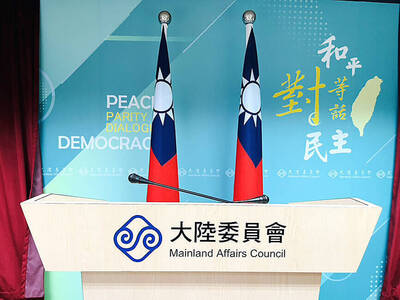
RISKY BUSINESS: The ‘incentives’ include initiatives that get suspended for no reason, creating uncertainty and resulting in considerable losses for Taiwanese, the MAC said China’s “incentives” failed to sway sentiment in Taiwan, as willingness to work in China hit a record low of 1.6 percent, a Ministry of Labor survey showed. The Directorate-General of Budget, Accounting and Statistics (DGBAS) also reported that the number of Taiwanese workers in China has nearly halved from a peak of 430,000 in 2012 to an estimated 231,000 in 2024. That marked a new low in the proportion of Taiwanese going abroad to work. The ministry’s annual survey on “Labor Life and Employment Status” includes questions respondents’ willingness to seek employment overseas. Willingness to work in China has steadily declined from

Tainan, Taipei and New Taipei City recorded the highest fines nationwide for illegal accommodations in the first quarter of this year, with fines issued in the three cities each exceeding NT$7 million (US$220,639), Tourism Administration data showed. Among them, Taipei had the highest number of illegal short-term rental units, with 410. There were 3,280 legally registered hotels nationwide in the first quarter, down by 14 properties, or 0.43 percent, from a year earlier, likely indicating operators exiting the market, the agency said. However, the number of unregistered properties rose to 1,174, including 314 illegal hotels and 860 illegal short-term rental


 RSS
RSS