


Aboriginals from Hsinchu County yesterday expressed strong opposition to a proposal to build a waste incinerator in their township, saying that garbage left by visitors to the Shei-Pa National Park (
At a public meeting called at the Legislative Yuan by Walis Pelin (
A thriving tourism industry brings the peaceful Aboriginal township much more garbage than it produces itself. It also brings traffic accidents, which residents fear might increase with the installation of the incinerator and the large trucks that will travel in and out of Wufeng to supply it.
At the meeting yesterday, the Aboriginals sang high-spirited songs to demonstrate their determination to resist dioxin pollution from which, they say, they would suffer if the incinerator were installed.
The residents believe it unreasonable to build a waste incinerator to process garbage left by visitors to the national park.
"It violates the principles of environmental justice if local Aboriginal tribes have to be responsible for managing waste generated by visitors to Shei-Pa National Park," they said in a news release.
In addition, the residents argued that dioxin emitted from the incinerator might pollute rivers running through the township, which were the main sources of water for the Pao-er Reservoir (保二水庫).
Officials from the Environmental Protection Administration promised to investigate whether the local government or local township office had properly communicated with residents on the project.
According to officials from the administration's Bureau of Solid Waste Management, a project to establish small-scale waste incinerators in remote areas has been underway since 1994. According to the law, a project to establish a waste incinerator to treat less than 15 tonnes of waste a day need not be preceded by an environmental impact assessment.
Walis Pelin, however, asked administration officials to consider whether there was another alternative to building the incinerator in Wufeng township.

‘NO SECURITY RISK’: The Railway Bureau reassured the public that the technicians’ activities were limited to technical guidance and did not involve sensitive systems The Railway Bureau yesterday said it had invited eight Chinese technicians to assist with an airport MRT construction project. The bureau issued the confirmation after an Internet user said Chinese nationals had entered the construction zone of Taiwan Taoyuan International Airport’s Terminal 3 project. They asked why “individuals from an enemy state” were allowed access to such a major national infrastructure project, which raised serious concerns over Taiwan’s industrial safety, sensitive systems and information security. The bureau’s Northern Region Engineering Branch Office said subcontractor Taiwan Handle Industrial Co (台灣手把工業) of the Taoyuan airport MRT’s “Contract No. CU05 Project A14 Station Civil, MEP &

A US uncrewed surface vessel (USV) encountered multiple Chinese warships during an autonomous transit of the Taiwan Strait, US defense company Seasats said in a statement on Wednesday. Seasats announced that a Lightfish USV had completed the first autonomous transit of the Taiwan Strait. Over five days, the USV traversed the entire length of the Strait while constantly monitoring surface vessel traffic, the company said. The Lightfish encountered multiple Chinese warships, one of which was a Chinese People’s Liberation Army Navy (PLAN) Type 056 corvette, it said. The Chinese vessels were operating “well within Taiwan’s exclusive economic zone without transmitting their identity via the
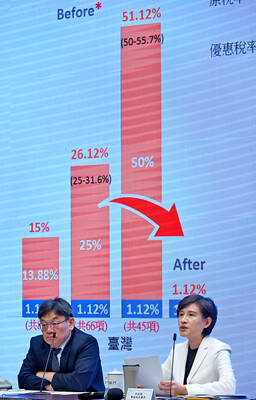
GREATER REACH? Auto parts and wood products would face tariffs of up to 15%, matching those targeting the EU, Japan and South Korea, Vice Premier said The US has announced that preferential tariff treatment for Taiwan’s non-semiconductor Section 232 goods would take effect retroactively from May 1, the Executive Yuan said yesterday. The US government yesterday posted a notice on the Federal Register’s public inspection Web site previewing tariff concessions for Taiwan under a memorandum of understanding (MOU) on Taiwan-US investment after two months of negotiations. The MOU signed on Jan. 15 stipulated three major preferential tariff arrangements: a 15 percent “reciprocal” tariff rate for Taiwan without stacking most-favored nation (MFN) rates; preferential Section 232 treatment for semiconductors and related products; and preferential Section 232 treatment for non-semiconductor

The National Chungshan Institute of Science and Technology yesterday showcased its locally developed variants of the Vision 60 robotic patrol dog, which it plans to deploy on the nation’s outlying territories in the South China Sea. The variants were produced under the Joint Lab project — created by the institute and domestic companies — and assembled with domestically produced motors, lenses and artificial intelligence (AI) systems alongside licensed tech from the US, Missile and Rocket Systems Research Division deputy director Jen Kuo-kang (任國光) told the media event at a military base in Taipei’s Dazhi (大直) area. Taiwan has built up its strengths


 RSS
RSS