

A pro-Taiwan alliance has begun its drive to recruit politicians loyal to former president Lee Teng-hui (
"The alliance's goal is electoral victory," said Huang Chu-wen (黃主文), a Lee loyalist and former minister of the interior. Huang added that a list of the group's members would be made public in July.
Chen Chien-ming (
Liu and Ho said they were still thinking over wether to join the group, adding that their decision would be based on the "DPP's understanding or unspoken consent." Both Liu and Ho had plans to run for public office, but failed to win their party's support in the DPP's primary in April. Liu said the alliance's prospects looked bright, and that "a total of some five or six million votes could be secured if Lee and Chen join forces."
Liu made the estimate based on the 5.5 million votes Lee won in the 1996 presidential election and the 2.2 million votes that went to the DPP's candidate, Peng Min-min (
Liu also said yesterday that the alliance's electoral strategy would be to nominate just one candidate in each constituency and to focus on winning 35 seats, including legislator-at-large.
Ho, meanwhile, said that joining an alliance close to Lee would allow him to attract former DPP supporters and would provide him a second chance to run for public office.
"The alliance has made it very clear that they will support A-bian and forge a strong political force, with some 35 legislative seats to assist the DPP government. That explains my leaving the DPP," Ho said. Echoing Ho's view, DPP legislative whip Lin Feng-hsi (林豐喜) said yesterday that "the alliance was likely to join hand in hand with the DPP after the elections." Lin added that an inter-party reorganization would likely occur after the elections, and that the DPP would form a coalition government with the alliance.
"It is also possible that these two will merge as a new political party," he said.
Independent legislator Jao yesterday flatly declined the alliance's invitation to join the group, saying that "he has no intentions of joining any alliance which was likely to provoke ideological and ethnic confrontation."
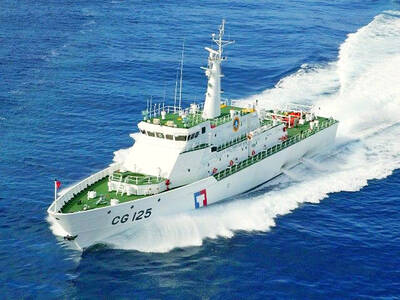
GEOPOLITICAL SIGNIFICANCE: The CGA’s nonmilitary role makes it a tool to avert diplomatic issues, an official said, while confirming the donation of a ship to Manila Coast Guard Administration (CGA) ships are scheduled to sail to the Philippines bearing the words “Taiwan Coast Guard” in a high-profile visit in October next year, the first such visit by a Taiwanese maritime law enforcement vessel to the Southeast Asian nation, the agency said yesterday. The CGA also confirmed that it had donated one of its decommissioned patrol vessels to the Philippines in a rare transfer of a retired ship to a nondiplomatic ally. The Republic of China (ROC) Navy last made such a visit in 1974, shortly before the Philippines switched diplomatic recognition to the People’s Republic of China in

CALL FOR CHANGE: They urged the UN to facilitate Taiwan’s involvement in the body, recognize its peace efforts and to work with members in preventing military conflict Representatives to the UN from five of Taiwan’s diplomatic allies sent a joint letter to UN Secretary-General Antonio Guterres on Friday, calling for the country’s inclusion in the body. Allies in the letter sent ahead of the 81st session of the UN General Assembly General Debate made three demands in support of Taiwan: inclusion, recognition and camaraderie. They implored the UN to seek an appropriate way to facilitate Taiwan’s meaningful involvement in the world governing body, saying that UN Resolution 2758, which accepted the People’s Republic of China (PRC) as a member of the UN, does not exclude Taiwan. Beijing claims that the

‘GLOBAL WARNING’: The infiltration is not just a local problem, as Beijing has been deploying the same tactics worldwide against Western democracies, a report said Between 50,000 and 100,000 Chinese spies are operating in Taiwan, far more than the National Security Bureau’s previous estimate of 5,000, German journalist and author Jurgen Kremb said on Monday. Kremb presented his research, titled “The War of Spies: How China’s Intelligence Services Are Infiltrating Taiwan — and What Europe Must Learn from It,” at a joint event held by the Taiwan offices of the Friedrich Naumann Foundation and the European Values Center for Security Policy. The report was published in June in the Ministry of Justice Investigation Bureau’s Prospect & Exploration Monthly (展望與探索月刊). By spies, he said he was referring to informants,
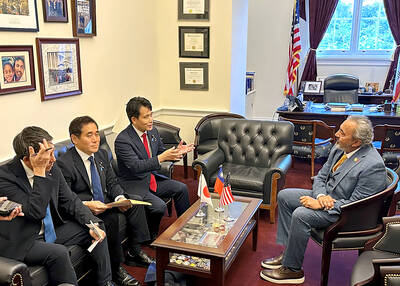
WASHINGTON MEETING: Japan’s Hirofumi Takinami said participants rejected the idea that the US should limit its defensive perimeter to the Second Island Chain US and Japanese lawmakers agree that the US must defend the First Island Chain, including Taiwan, and should not fall back to the Second Island Chain, while “a Taiwan contingency is a Japan contingency and therefore a US-Japan alliance contingency,” media reported after a meeting between officials of the two nations in Washington on Tuesday. A delegation of Japanese lawmakers from the Liberal Democratic Party met with US Senator Thom Tillis, co-chair of the Senate Taiwan Caucus, and US Representative Ami Bera, co-chair of the US Congressional Taiwan caucus, to discuss issues concerning East Asia and the Taiwan Strait. The Japanese and


 RSS
RSS