


Business tycoon and KMT legislator Gary Wang (
It had previously been widely reported that, following his disqualification to run for the KMT because of pending fraud charges, Wang was to be a key member of a new political group that plans to play a high-profile role in the year-end legislative elections.
In a written statement, the three-term legislator admitted that a lot of his friends, including those from the political arena, have tried to persuade him to seek re-election.
"However, these contacts were limited to private chats and exchanges of opinion. I have not asked for any position or made any commitment, and I have not made any decision to run in the elections," Wang said.
Wang said recent speculation concerning his political career planning have been troubling him, which prompted him to make the public announcement yesterday.
"I won't run in any geographic legislative constituency at year end, and I decline, with thanks, arrangements offered from any sides to nominate me as a legislator at large," Wang said.
"I will invest more time and effort in -- and concentrate myself on -- running the media business, and do the best I can to do my part in the bid to revive Taiwan's commercial and industrial sectors," he added.
Wang is chairman of the General Chamber of Commerce of the ROC (中華民國全國商業總會) and vice chairman of the Rebar Group (力霸東森企業集團), a major investor in the real estate, cable TV and fixed-line telecommunication industries.
Wang, currently a legislator at-large representing the KMT, has been disqualified by the party from nomination as an at-large legislator for the next term, because of his alleged involvement in a series of land fraud deals concerning the state-run Taiwan Development and Trust Corp (TDTC,
Wang was indicted by the Taipei District Prosecutors' Office in January over the case.
Over the past few months, there have been reports claiming Wang was organizing a new political group together with some sitting independent lawmakers. It was also rumored that Wang was going to be nominated for an at-large seat representing the group because of his financial backing of the group.
The at-large seats are allocated to political parties or groups that are able to garner at least 5 percent of the vote in the legislative elections. Their vote shares decide how many at-large seats they qualify for.
The political group in question is expected to be founded in July and may be named the "Taiwan Justice Alliance," with members including Tsai Hau (蔡豪), Lo Fu-chu (羅福助), Chen Chin-ting (陳進丁) and Wu Tze-yuan (伍澤元). Chen yesterday said Wang's decision to quit will not affect their plan to form the group.

‘NO SECURITY RISK’: The Railway Bureau reassured the public that the technicians’ activities were limited to technical guidance and did not involve sensitive systems The Railway Bureau yesterday said it had invited eight Chinese technicians to assist with an airport MRT construction project. The bureau issued the confirmation after an Internet user said Chinese nationals had entered the construction zone of Taiwan Taoyuan International Airport’s Terminal 3 project. They asked why “individuals from an enemy state” were allowed access to such a major national infrastructure project, which raised serious concerns over Taiwan’s industrial safety, sensitive systems and information security. The bureau’s Northern Region Engineering Branch Office said subcontractor Taiwan Handle Industrial Co (台灣手把工業) of the Taoyuan airport MRT’s “Contract No. CU05 Project A14 Station Civil, MEP &

A US uncrewed surface vessel (USV) encountered multiple Chinese warships during an autonomous transit of the Taiwan Strait, US defense company Seasats said in a statement on Wednesday. Seasats announced that a Lightfish USV had completed the first autonomous transit of the Taiwan Strait. Over five days, the USV traversed the entire length of the Strait while constantly monitoring surface vessel traffic, the company said. The Lightfish encountered multiple Chinese warships, one of which was a Chinese People’s Liberation Army Navy (PLAN) Type 056 corvette, it said. The Chinese vessels were operating “well within Taiwan’s exclusive economic zone without transmitting their identity via the
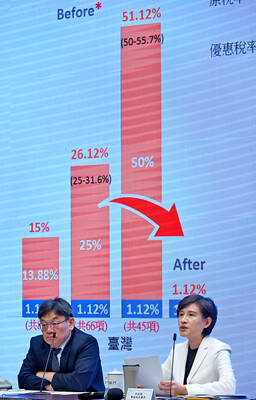
GREATER REACH? Auto parts and wood products would face tariffs of up to 15%, matching those targeting the EU, Japan and South Korea, Vice Premier said The US has announced that preferential tariff treatment for Taiwan’s non-semiconductor Section 232 goods would take effect retroactively from May 1, the Executive Yuan said yesterday. The US government yesterday posted a notice on the Federal Register’s public inspection Web site previewing tariff concessions for Taiwan under a memorandum of understanding (MOU) on Taiwan-US investment after two months of negotiations. The MOU signed on Jan. 15 stipulated three major preferential tariff arrangements: a 15 percent “reciprocal” tariff rate for Taiwan without stacking most-favored nation (MFN) rates; preferential Section 232 treatment for semiconductors and related products; and preferential Section 232 treatment for non-semiconductor
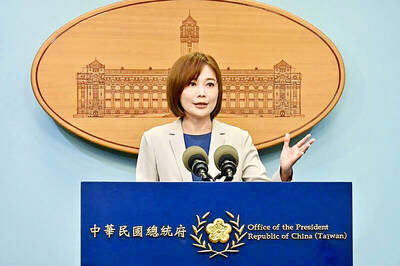
TIT-FOR-TAT: The US allegedly revoked the visa of a Chinese national working at Xinhua News Agency in the US in response to Beijing’s expulsion of Vivian Wang The Presidential Office yesterday condemned China for expelling a New York Times correspondent from Beijing following the newspaper’s interview with President William Lai (賴清德), saying the move highlighted Beijing’s suppression of press freedom and its threat to international news media. Taiwan has noted a series of recent incidents in which Beijing used similar tactics to “threaten and pressure international media outlets and journalists,” Presidential Office spokeswoman Karen Kuo (郭雅慧) said in a statement. “This concerns not only press freedom and freedom of expression, but also the safety of journalists, and Taiwan and relevant partners are paying close attention to the situation,” she


 RSS
RSS