


A five-year study of the incidence of disease among residents of radiation-contaminated buildings was recently completed, showing that the possibility of chromosome aberration -- damage to DNA -- was proportional to long-term exposure to low-dose radiation.
From November 1995 to June 2000, a research team at National Yang Ming University (陽明大學) kept track of more than 4,100 sample people who once lived in buildings that had been constructed in Taipei City between 1982 and 1983 using radioactive steel reinforcing bars.
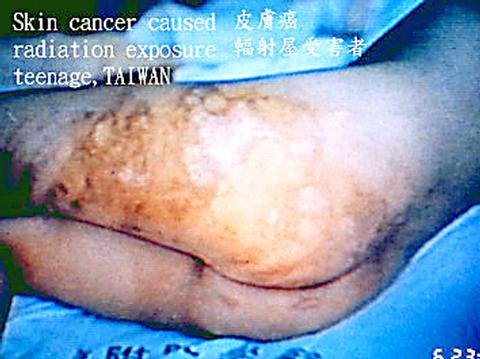
FILE PHOTO: RADIATION SAFETY AND PROTECTION ASSOCIATION TAIWAN
A high incidence of diverse cancers was discovered among samples taken from the group.
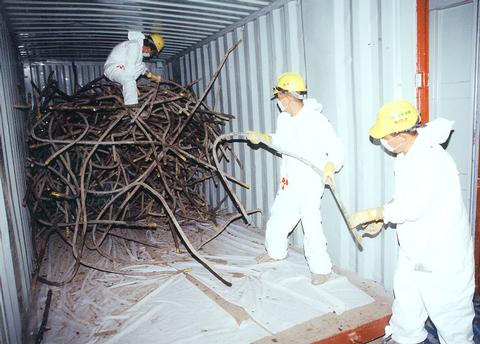
PHOTO: LIN WEN-HUANG, TAIPEI TIMES
The researchers said that cancer could be induced by various factors, including personal lifestyle and environmental and occupational conditions. Exposure to radiation exceeding safety limits is also a factor that deserves close attention, they said.
"We found that DNA damage and chromosome aberration was closely related to samples' long-term exposure to low-dose radiation," Chang Wu-shou (
The 4,100 sample patients, who have been receiving treatment at Taipei Municipal Jen-ai Hospital, are among some 7,800 residents recorded by the Taipei City Government as victims of radiation contamination.
Eighty-nine of the 4,100 samples were diagnosed with cancer, including cervical cancer, breast cancer, liver cancer, leukemia and thyroid cancer. Researchers said that high incidence of the disease might be attributed to chronic low-dose radiation exposure.
Over the course of the research period, 39 of the 89 cancer sufferers died.
Researchers said that the situation did not mean that the mortality from cancer in the group was higher than that in other population groups because there was no direct link between cancer and the patients' exposure to low-dose radiation.
Researchers, however, concluded that excessive radiation did have a negative impact on humans.
"For example, we discovered that the height of children who had been exposed to radiation [exceeding the safety limits] was generally below average," said Chang, an environmental health sciences professor. He also said that the incidence of cataracts (白內障) among children who lived in radiation-contaminated buildings was higher than the national level.
"We also concluded that radiation causes damage to white blood cells, weakening people's immune systems," Chang said.
Unpleasant reminder
Chang's study, supported by the National Health Research Institute (
Officials from the council contacted Chang several times, asserting that his research on low-level radiation would not result in any new scientific discoveries. They told him that a low dose of radiation has been demonstrated to be beneficial to humans.
Chang, however, said the council should be ashamed of itself for discouraging him from conducting his research because Taiwan was the only country which could provide such samples for medical research.
"Contaminated buildings in other countries would be dismantled immediately after radiation pollution was confirmed," Chang told the Taipei Times.
In the early 1980s, rebar contaminated with Colbalt-60 was used in the construction of more than 100 buildings in several counties in Taiwan. The situation was not publicly known until a 1992. One day that summer a Taiwan Power Company (Taipower,
High amounts of radiation had actually been detected years earlier. In 1985 a dentist had an x-ray machine set up in his apartment in Minsheng Villas (民生別墅) in Taipei and dangerous amounts of radiation had been detected. The dentist was banned from operating the machine. However, AEC officials did not mention to residents that high levels of radioactivity came from the walls of the building rather than the x-ray machine.
The truth was exposed later. Because of a dispute over promotions at the council, high-ranking officials revealed in 1992 that AEC officials had been involved in a cover-up of the radiation-contaminated buildings.
After a reporter from the Liberty Times discovered that radiation levels at the villa exceeded safety limits by hundreds of times, a comprehensive check was carried out on thousands of buildings constructed between 1982 and 1984 in Taipei City. More than 100 buildings, including office buildings, schools and kindergartens in the city were confirmed to be contaminated by radiation.
At the time, thousands of residents, young and old, were identified as having been exposed to more than 1 milli-Sievert per year (mSv/y), a safety limit set by the International Radiation Protection Association (IRPA), for up to 12 years. Following the investigation in Taipei, buildings with radioactive reinforced steel bars were discovered elsewhere in the country, including Taipei, Changhua, and Taoyuan counties and also Keelung City.
Hsu Ssu-ming (許思明), secretary-general of the Radiation Safety and Protection Association Taiwan (RSPAT), told the Taipei Times that the radiation-contaminated reinforced steel bars discovered to date only account for a small portion of the radioactive bars.
Hsu said that an ironworks produced 20,000 tonnes of contaminated rebar but so far the government has discovered only 7,000 tonnes of the product.
The 7,000 tonnes of contaminated rebar was used in more than 2,000 homes and 30 schools, affecting more than 10,000 residents.
Hsu said that potential dangers from undiscovered radiation contamination continue to threaten the public because the ironworks lost all records of the steel bars.
"Where are undiscovered radiation-contaminated buildings? They could be all over the island," Hsu said.
Health check
"We strongly encourage victims to have free medical examinations to take care of their health," Hsu said.
He pointed out that many victims relocated from the radiation-contaminated buildings ignore the potential threats to their health after they have moved away.
A teenage boy, who relocated to Kaohsiung County after going to a primary school contaminated by radiation in Taipei for two years, ignored the notification from the Taipei City Government and missed chances to receive treatment. He later discovered he had leukemia. By the time the Tzu Chi Foundation (
The boy, however, was not one of the subjects in Chang's research.
"The government has lost contact with too many victims and are therefore no longer getting any help," Hsu told the Taipei Times.
A group of residents led by Minsheng Villas residents established the Radiation Victims' Association Taiwan to fight for compensation from the government and to raise public awareness that being exposed to radiation was dangerous.
Many of the victims had spent their life savings on the apartments they saw as their dream homes, but which later became the source of their nightmares.
In 1993, three officials were censured for neglect of duty after having learned in 1985 that Minsheng Villas was seriously contaminated by radiation. In 1994, the Taipei District Court accepted lawsuits for state compensation from 65 residents of Minsheng Villas.
But it was not until 1997 that the court made a judgment in favor of 57 of the residents and told the government to compensate them for physical, property, and psychological losses resulting from the intentional negligence of government officials who had concealed information.
That was the only successful case for victims who asked for state compensation.
The AEC's role
Fewer than 20 of the almost 200 buildings discovered to be contaminated by radiation were properly dealt with. Some residents continued to live in the radiation-contaminated buildings because the selling price offered by the AEC was far less than what the homeowners had originally paid.
The AEC also carries out studies relating to radiation-contaminated buildings. Researchers from the medical school of National Taiwan University confirmed only that the rate of death of thyroid-related diseases among the victims was higher than that of other population groups.
Another research paper by the AEC published in the British medical journal the Lancet in February last year shows that the incidence of chromosomes being affected in people who lived in radiation-contaminated buildings was substantially higher than that of control groups.
Taiwan has arranged for about 8 million barrels of crude oil, or about one-third of its monthly needs, to be shipped from the Red Sea this month to bypass the Strait of Hormuz and ease domestic supply pressures, CPC Corp, Taiwan (CPC, 台灣中油) said yesterday. The state-run oil company has worked with Middle Eastern suppliers to secure routes other than the Strait of Hormuz, through which about 20 percent of the world’s oil and liquefied natural gas typically passes, CPC chairman Fang Jeng-zen (方振仁) said at a meeting of the legislature’s Economics Committee in Taipei. Suppliers in Saudi Arabia have indicated they
South Korea has adjusted its electronic arrival card system to no longer list Taiwan as a part of China, a move that the Ministry of Foreign Affairs said would help facilitate exchanges between the two sides. South Korea previously listed “Taiwan” as “Taiwan (China)” in the drop-down menus of its online arrival card system, where people had to fill out where they came from and their next destination. The ministry had requested South Korea make a revision and said it would change South Korea’s name on Taiwan’s online immigration system from “Republic of Korea” to “Korea (South),” should the issue not be

CCP ‘PAWN’? Beijing could use the KMT chairwoman’s visit to signal to the world that many people in Taiwan support the ‘one China’ principle, an academic said Chinese Nationalist Party (KMT) Chairwoman Cheng Li-wun (鄭麗文) yesterday arrived in China for a “peace” mission and potential meeting with Chinese President Xi Jinping (習近平), while a Taiwanese minister detailed the number of Chinese warships currently deployed around the nation. Cheng is visiting at a time of increased Chinese military pressure on Taiwan, as the opposition-dominated Legislative Yuan stalls a government plan for US$40 billion in extra defense spending. Speaking to reporters before going to the airport, Cheng said she was going on a “historic journey for peace,” but added that some people felt uneasy about her trip. “If you truly love Taiwan,
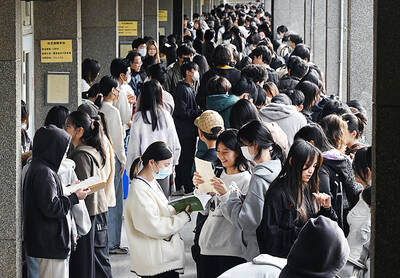
A global survey showed that 60 percent of Taiwanese had attained higher education, second only to Canada, the Ministry of the Interior said. Taiwan easily surpassed the global average of 43 percent and ranked ahead of major economies, including Japan, South Korea and the US, data from the Organisation for Economic Co-operation and Development (OECD) for 2024 showed. Taiwan has a high literacy rate, data released by the ministry showed. As of the end of last year, Taiwan had 20.617 million people aged 15 or older, accounting for 88.5 percent of the total population, with a literacy rate of 99.4 percent, the data


 RSS
RSS