


When ecological conservationists and officials in Taiwan campaigned for the 31st anniversary of Earth Day yesterday, some environmentalists called on citizens to live simple and economical lives.
Activists from the Homemakers' Union and Foundation (主婦聯盟) yesterday sold cloth lunch bags in Taipei to promote reusing recyclable materials rather than plastic bags.
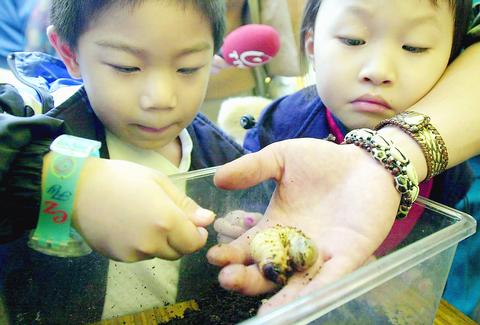
PHOTO: CHIANG YING-YING, TAIPEI TIMES
The lunch bags are made by housewives living in central Taiwan in areas heavily affected by the 921 earthquake.
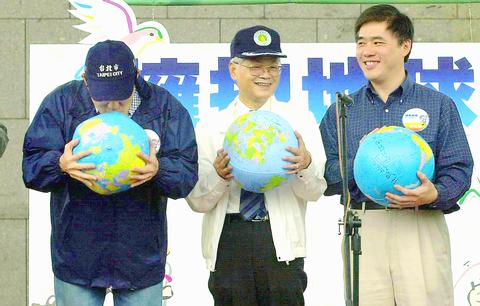
PHOTO: CHIANG YING-YING, TAIPEI TIMES
Activists from the foundation said that selling the bags promotes a more environmentally and economically conscious lifestyle and helps victims of the earthquake.
Chan Man-li (陳曼麗), board chairwoman of the foundation, told the Taipei Times that Earth Day was not the only chance for people to treasure natural resources.
"If people's environmental awareness is raised, they can fulfill their ideas of environmental protection every day," Chan said.
In Taipei's Ta-an Forest Park (大安森林公園) yesterday, officials and conservationists held an activity called the "2001 Earth Day, Embracing the Earth" (二OO一世界地球日,擁抱地球), to encourage members of the public to experience nature.
At the opening ceremony environment, agriculture and education officials held a forum to where they called on people to treasure the planet.
Environmental Protection Administration head Hau Lung-bin (
Chang Hung-lin (張宏林), an activist with the Taiwan-based Society of Wilderness (荒野保護協會), said that the diverse activities designed for the Earth Day event were intended to help participants experience nature and learn to treasure it.
The society displayed rock samples collected by its members from remote mountain areas in Taiwan to offer children living in cities a chance to observe geologic textures.
With the assistance of record companies, they also played music accompanied by calls of diverse animals in Taiwan and the sound of waves and tides recorded on the eastern coast to illustrate the beauty of Taiwan.
The idea for Earth Day evolved over a period of seven years starting in 1962 in the US. At that time, a group of concerned senators felt that the state of the environment was simply a non-issue in the country's politics.
On April 22, 1970, a nationwide grassroots demonstration was held on behalf of the environment. Demonstrators lobbied senators to draft laws pertaining to clean air, clean water and endangered animals.
Since then, concepts that emerged from the first Earth Day have influenced environmentalists, conservationists, politicians and businessmen all over the world, including Taiwan.
In the industrial sector, Applied Materials Taiwan yesterday took children to visit the Taipei Astronomy Museum.
Applied Material said that its environmentally friendly machines for producing semi-conductor materials efficiently reduce the emission of perfluorocarbons (PFCs), into the atmosphere. Semiconductor manufacturing is a large source of PFC emission.

‘NO SECURITY RISK’: The Railway Bureau reassured the public that the technicians’ activities were limited to technical guidance and did not involve sensitive systems The Railway Bureau yesterday said it had invited eight Chinese technicians to assist with an airport MRT construction project. The bureau issued the confirmation after an Internet user said Chinese nationals had entered the construction zone of Taiwan Taoyuan International Airport’s Terminal 3 project. They asked why “individuals from an enemy state” were allowed access to such a major national infrastructure project, which raised serious concerns over Taiwan’s industrial safety, sensitive systems and information security. The bureau’s Northern Region Engineering Branch Office said subcontractor Taiwan Handle Industrial Co (台灣手把工業) of the Taoyuan airport MRT’s “Contract No. CU05 Project A14 Station Civil, MEP &

A US uncrewed surface vessel (USV) encountered multiple Chinese warships during an autonomous transit of the Taiwan Strait, US defense company Seasats said in a statement on Wednesday. Seasats announced that a Lightfish USV had completed the first autonomous transit of the Taiwan Strait. Over five days, the USV traversed the entire length of the Strait while constantly monitoring surface vessel traffic, the company said. The Lightfish encountered multiple Chinese warships, one of which was a Chinese People’s Liberation Army Navy (PLAN) Type 056 corvette, it said. The Chinese vessels were operating “well within Taiwan’s exclusive economic zone without transmitting their identity via the
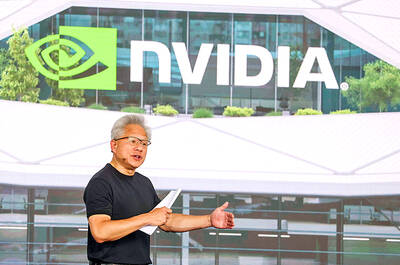
‘BOOMING’: ’ The number of partners we have here is incredible. You can see from their stock prices. They’re doing so well, they’re so happy,’ Jensen Huang said Nvidia Corp’s spending in Taiwan has ballooned to about US$150 billion a year, 10 times the US$10 billion to US$15 billion the company spent five years ago, Nvidia chief executive officer Jensen Huang (黃仁勳) said yesterday, suggesting Taiwan’s strategic importance in the global artificial intelligence (AI) supply chain. “Taiwan is the epicenter of the AI revolution. This is where the chips come, packaging comes. This is where the systems are made. This is where AI supercomputers were created,” Huang said at a meeting for the company’s employees in Beitou-Shilin Technology Park (北投士林科技園區) in Taipei, the planned site of Nvidia’s Taipei headquarters. “Taiwan
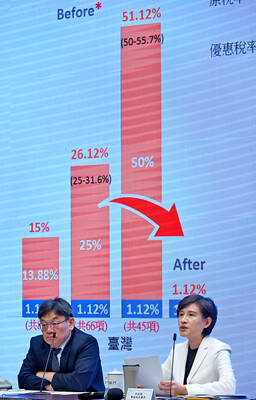
GREATER REACH? Auto parts and wood products would face tariffs of up to 15%, matching those targeting the EU, Japan and South Korea, Vice Premier said The US has announced that preferential tariff treatment for Taiwan’s non-semiconductor Section 232 goods would take effect retroactively from May 1, the Executive Yuan said yesterday. The US government yesterday posted a notice on the Federal Register’s public inspection Web site previewing tariff concessions for Taiwan under a memorandum of understanding (MOU) on Taiwan-US investment after two months of negotiations. The MOU signed on Jan. 15 stipulated three major preferential tariff arrangements: a 15 percent “reciprocal” tariff rate for Taiwan without stacking most-favored nation (MFN) rates; preferential Section 232 treatment for semiconductors and related products; and preferential Section 232 treatment for non-semiconductor


 RSS
RSS