


New Party leaders yesterday continued to lash out at the People First Party (PFP), accusing the party of being two-faced (
The New Party has accused the PFP of poaching its members since the announcement on Thursday that New Party Taichung County legislator Feng Ting-kuo (馮定國) would join the PFP.
New Party legislator and spokesperson Lai Shyh-bao (賴士葆) yesterday said, "The PFP and the New Party are just like the two characters from the cartoon Tom and Jerry. While the two might appear to be pals, the cat, Tom, actually wants to swallow the mouse, Jerry."
After Lai's meeting with New Party Convener Hsieh Chi-ta (謝啟大) on Friday night, the two decided to continue to voice their anger with the PFP in order to reduce any negative impact Feng's defection might have on the party.
According to Lai, if PFP Chairman James Soong (
Lai also accused the PFP of being two-faced. Lai said that the PFP initially strongly supported New Party calls to suspend independent legislator Lo Fu chu (羅福助) for assaulting PFP legislator Diane Lee (李慶安), but that few PFP heavyweights actually showed up to vote on Lo's case.
Lai said the incident was an example of how the PFP only supports the opposition in public but then behind the scenes acts according to its best interests.
Rumor has it that Soong had suggested inviting New Party heavyweights -- such as the party's former convener Wang Chien-shien (王建火宣), former legislator Chou Yang-shang (周陽山) and senior member Kao Shin-wu (高新武) -- to represent the PFP in the legislative election. Lai, however, stressed yesterday that the three would never join the PFP.
Wang, who returned from a visit to China last night, held a press conference about the rumors upon his return. He told reporters he considers Soong's invitation an insult and that he would not stray from his party.
"I want to be the New Party's loyal dog," he said.
Wang earlier reportedly wrote a private letter to Feng which said that "Feng's behavior was worse than that of a dog."
In response to the criticism, a PFP spokesperson, Hsieh Kung-ping (
Meanwhile, New Party heavyweight Hsu Li-nung (許歷農) yesterday suggested that both his party and the PFP should work together closely in order to win mutual interests.
Hsu said he believes that the PFP would not try to poach the New Party's elite into its ranks intentionally.
He said he also has confidence that his party would not become a bubble (泡沫) party.
In August 1993, a group of young elite KMT members broke away from the party and established the New Party.
With only nine seats in the legislature, however, the party now faces the prospect of a PFP merger or takeover.

The Tourism Administration yesterday announced that it would reward repeat international visitors with incentives of up to NT$8,000 to boost inbound tourism. The incentives are available to all international tourists, it said, adding that repeat visitors would be rewarded with NT$5,000 and would receive an additional NT$3,000 if they bring travel companions. The nation received 2,990,657 inbound visitors during the first quarter, marking a 3.8 percent increase from the same period last year, agency data showed. Japanese nationals are among groups visiting Taiwan the most. About 1.48 million Japanese tourists arrived last year, a year-on-year increase of more than 12

66 FIGHTER JETS: The aircraft is likely undergoing preparations for its transfer to Taiwan — a significant step forward in the nation’s modernization program, a lawmaker said The first of Taiwan’s order of F-16V Block 70 aircraft has been sighted in Texas ahead of delivery, Democratic Progressive Party (DPP) Legislator Wang Ting-yu (王定宇) said. Taiwan’s first F-16V Block 70 two-seat aircraft, tail number 6831, was seen flying from Lockheed Martin’s production facility in Greenville, South Carolina, to Naval Air Station Joint Reserve Base Fort Worth in Texas, Wang wrote on Facebook yesterday. The plane is likely undergoing preparations for its transfer to Taiwan, marking a significant step forward in the Republic of China Air Force’s modernization program, Wang said, citing military analysts. The F-16V Block 70 is a new-build version

‘BRAZEN’: The holiday did not stop China from activities that infringe on Taiwan’s maritime jurisdiction, but the CGA is ready to defend the nation, Kuan Bi-ling said Beijing is intensifying maritime pressure on Taiwan, but the nation will never yield, Ocean Affairs Council Deputy Minister Sung Chen-en (宋承恩) said. The Coast Guard Administration (CGA) has adopted a “shadowing and monitoring” approach to avoid falling into a Chinese trap to escalate tensions and deepen the conflict, Sung said in an interview published yesterday in the Chinese-language Liberty Times (the Taipei Times’ sister newspaper). China Coast Guard formations patrolling waters east of Taiwan, as well as official Chinese vessels entering areas around Itu Aba Island (Taiping Island, 太平島) and Pratas Islands (Dongsha Islands, 東沙群島) show Beijing’s attempts to significantly step up
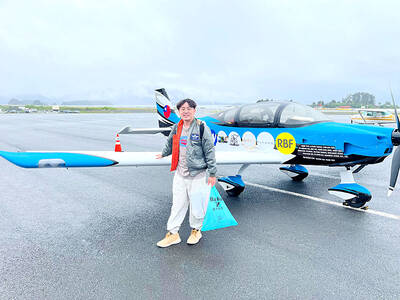
Taiwanese aviator Roger Lin (林睿哲) returned to Taiwan on Saturday after completing a nine-day round-the-world journey in a single-engine aircraft, becoming the first Taiwanese pilot to achieve the feat. Lin departed on June 5 from Los Angeles, California, and continued through Alaska, Japan, Taiwan, the Philippines, Indonesia, Malaysia, Thailand, Nepal, Jordan, Norway, Iceland and Canada before landing at the Taipei International Airport (Songshan) via Los Angeles and Japan. Lin shared numerous photos and videos of his journey on a Facebook page titled “Pilot Roger’s Around the World Flight,” including a video showing his aircraft flying over the Danjiang Bridge and


 RSS
RSS