


Tests conducted by the Industrial Technology Research Institute (ITRI, 工研院) revealed that a steel plant in Taoyuan County, which also serves as an incinerator for hazardous medical waste, has been emitting more than 1,000 times the tolerated amount of dioxin.
In light of the results, the Environmental Protection Administration (EPA,
EPA head Hau Lung-bin (
Since Taiwan's dioxin emission standards only apply to incinerators, the EPA commissioned the ITRI to sample and record the dioxin discharge volumes from incinerators in order to provide reference figures for other facilities such as steel plants. Dioxin can cause cancer in humans.
Even after halting the incineration of medical waste, the dioxin emissions of the Taoyuan factory were still found to be above acceptable limits after another test was carried out last October.
But without national standards for steel plants' dioxin discharges, the EPA cannot order the factory to close or to clean up its act, even given the alarming levels of emissions.
But Hau said the EPA would ask for the closure of the entire factory. If the factory would not comply with the request, Hau added, the EPA would order it not to handle any more medical waste.
Local environmental groups were shocked by the high volume of dioxin discharged by the factory. The groups said that in Japan, the government would adopt emergency measures when a facility was found to emit a dangerous level of dioxin.
The groups also said that the level of dioxin emitted by the factory could seriously harm human health, and hence the facility would have to cease its operations. They also demanded authorities conduct health examinations of neighboring residents to see whether or not their health has been affected.
Forty to 50 tonnes of hazardous medical waste is produced daily in Taiwan. Of the waste, the Taoyuan factory deals with approximately 12 tonnes, while an incinerator in Yunlin County handles 18 tonnes. The remainder is handled by smaller factories.
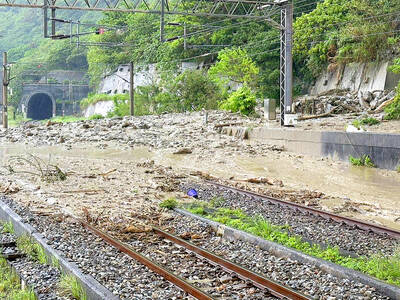
ROLLER-COASTER RIDE: More than five earthquakes ranging from magnitude 4.4 to 5.5 on the Richter scale shook eastern Taiwan in rapid succession yesterday afternoon Back-to-back weather fronts are forecast to hit Taiwan this week, resulting in rain across the nation in the coming days, the Central Weather Administration said yesterday, as it also warned residents in mountainous regions to be wary of landslides and rockfalls. As the first front approached, sporadic rainfall began in central and northern parts of Taiwan yesterday, the agency said, adding that rain is forecast to intensify in those regions today, while brief showers would also affect other parts of the nation. A second weather system is forecast to arrive on Thursday, bringing additional rain to the whole nation until Sunday, it
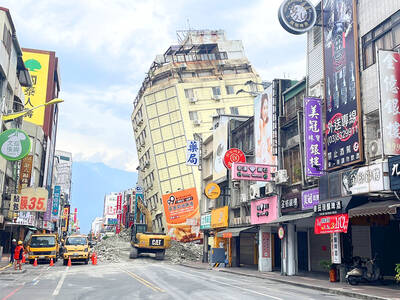
LANDSLIDES POSSIBLE: The agency advised the public to avoid visiting mountainous regions due to more expected aftershocks and rainfall from a series of weather fronts A series of earthquakes over the past few days were likely aftershocks of the April 3 earthquake in Hualien County, with further aftershocks to be expected for up to a year, the Central Weather Administration (CWA) said yesterday. Based on the nation’s experience after the quake on Sept. 21, 1999, more aftershocks are possible over the next six months to a year, the agency said. A total of 103 earthquakes of magnitude 4 on the local magnitude scale or higher hit Hualien County from 5:08pm on Monday to 10:27am yesterday, with 27 of them exceeding magnitude 5. They included two, of magnitude

CONDITIONAL: The PRC imposes secret requirements that the funding it provides cannot be spent in states with diplomatic relations with Taiwan, Emma Reilly said China has been bribing UN officials to obtain “special benefits” and to block funding from countries that have diplomatic ties with Taiwan, a former UN employee told the British House of Commons on Tuesday. At a House of Commons Foreign Affairs Committee hearing into “international relations within the multilateral system,” former Office of the UN High Commissioner for Human Rights (OHCHR) employee Emma Reilly said in a written statement that “Beijing paid bribes to the two successive Presidents of the [UN] General Assembly” during the two-year negotiation of the Sustainable Development Goals. Another way China exercises influence within the UN Secretariat is

Taiwan’s first drag queen to compete on the internationally acclaimed RuPaul’s Drag Race, Nymphia Wind (妮妃雅), was on Friday crowned the “Next Drag Superstar.” Dressed in a sparkling banana dress, Nymphia Wind swept onto the stage for the final, and stole the show. “Taiwan this is for you,” she said right after show host RuPaul announced her as the winner. “To those who feel like they don’t belong, just remember to live fearlessly and to live their truth,” she said on stage. One of the frontrunners for the past 15 episodes, the 28-year-old breezed through to the final after weeks of showcasing her unique


 RSS
RSS