

The Taipei District Court has issued its verdict on a case of physical violence that took place in the Legislative Yuan in 1998, but both parties concerned expressed dissatisfaction with the sentence.
Under the verdict issued on Friday, independent Legislator Lo Fu-chu (
Lo yesterday protested what he called "political interference" in the judicial system. Yu, on the other hand, accused the judge of deliberately handing down a light punishment to help the three to avoid imprisonment.
According to the Criminal Code, a person convicted of inflicting bodily injuries can face imprisonment of up to three years. A sentence of fewer than 60 days in prison, however, can be substituted by the payment of a fine.
Lo, a convener of the legislature's Judiciary Committee who also suffered injuries in the scuffle, denounced the verdict as unfair.
"The judicial authorities accepted the one-sided story of Legislator Yu Jan-daw and never examined the videotape recording the entire course of events," Lo said.
"Now the people who injured me remain beyond the reach of the law. Where is the fairness of such a judicial system?" Lo added.
Lo said it had been inappropriate for the judiciary to get involved in the case in the first place, because he said it was a matter concerning the "autonomy" and "self-discipline" of the legislature.
"How come the judicial branch is now siding with the DPP? Does this mean politics comes before the law?" Lo asked.
The incident took place on June 15, 1998, when legislators were reviewing proposed amendments to the Farmers' Association Law (
In the middle of the meeting, some DPP legislators, disagreeing with the way the meeting was being conducted, protested to the chairman and blocked the continuation of the meeting.
Lo later joined the quarrel and started the scuffle, which involved several dozen legislators. Yu was assaulted by Lo, Lin and Chou when he tried to mediate and stop the fight.
Yu said he had filed a suit against the three legislators "because there is absolutely no self-discipline in the legislature."
"The legislature's disciplinary committee has never held a meeting, and that's why I resorted to legal means. Furthermore, physical violence isn't protected by immunity from judicial prosecution enjoyed by lawmakers," Yu said.
Yu said he would file an appeal with the court, as the sentence was too light and insufficient to curb violence in the legislature.
"Since the detention can be replaced by a fine, isn't this a skillful way for the judge to accommodate Lo?" Yu said.
Rejecting Lo's claim that the court had not collected any videotape as evidence, Yu said there were in fact videotapes provided by several TV companies which recorded the entire chain of events.
Yu said that Lo was injured when he was scuffling with other legislators.

PATROL PARTNERS: The ‘Chiayi’ and the ‘Penghu’ departed for a two-day joint patrol of Palau’s exclusive economic zone, the CGA’s second diplomatic visit to the country The Coast Guard Administration (CGA) set a record for its southernmost deployment of a coast guard vessel as the vessels Chiayi and the Penghu reached Palau’s Pulo Anna Island on Saturday in a cooperative exercise between the two countries. The island, about 217 nautical miles (401km) southwest of Koror in the Palauan state of Sonsorol and 1,220 nautical miles from Taiwan’s southernmost point, Oluanpi (鵝鑾鼻), is the furthest south a CGA vessel has sailed. The two vessels are in Palau for the coast guard’s second diplomatic visit to the country. They docked at Malakal Harbor on Tuesday last week. The coast guard

The government is monitoring online rumors that a pneumonic plague outbreak has spread from Russia into China, and it might enhance quarantine measures, Premier Cho Jung-tai (卓榮泰) said yesterday. During a legislative meeting, Democratic Progressive Party Legislator Wang Ting-yu (王定宇) said that rumors had circulated that the disease had spread across several Chinese provinces. He asked Cho whether the government was prepared to prevent the disease spreading to Taiwan, given the volume of traffic between the two sides, and how concerned the government was about the alleged outbreak. The Ministry of Health and Welfare had implemented border quarantine measures after briefing the Executive
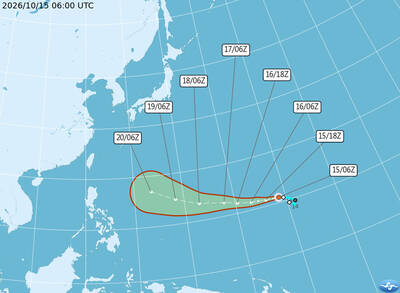
EAST OF GUAM: Tropical Storm Champi is forecast to strengthen into a typhoon, but its effect on Taiwan is uncertain due to the presence of a high-pressure system Tropical Storm Champi formed yesterday and has the potential to increase in strength, the Central Weather Administration (CWA) said yesterday. Forecasters are closely monitoring a Pacific high-pressure system that would dictate whether the storm turns north or moves toward Taiwan next week, the CWA said. The most likely scenario is that it turns northward after passing the Ryukyu Islands, CWA forecaster Cheng Chieh-jen (鄭傑仁) said. As of 8pm yesterday, Champi was east of Guam moving west-northwest at 20kph, CWA data showed. It had maximum sustained winds near the center of 72kph and gusts of up to 101kph, the data showed. If the Pacific high-pressure system
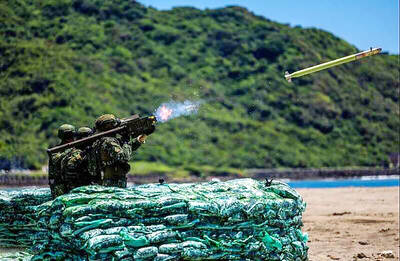
BATCH 1: The military has plans to assign the weapons to the army to defend Taiwan proper, as well as outlying islands and the navy for the Marine Corps, the official said Taiwan is to receive 500 Stinger missiles and 178 launchers from the US by the end of the year, the first batch under a planned two-stage acquisition totaling 2,621 missiles and 763 launchers, a defense official said yesterday on condition of anonymity. The portable missiles would play a vital role in the nation’s air defense capabilities, the source said. The army plans to deploy 2,235 missiles and 657 launchers to defend Taiwan proper and outlying islands, they said, citing military documents. The navy is allotted 295 missiles and 85 launchers to arm the Marine Corps and some surface vessels that lack air defense


 RSS
RSS