

The presence of DPP heavyweight Luo Wen-chia (
"There is never an easy election battle, but Luo's joining the race will certainly make the competition keener," Lin Chung-mo (
Luo -- a leading DPP campaign strategist, longtime aide to President Chen Shui-bian (陳水扁) and vice chairman of the Council for Cultural Affairs -- officially announced on Sunday that he would resign from his Cabinet post to run in the December elections. Luo plans to stand for a seat representing the northern part of Taipei.
As a heavyweight political figure with longstanding close relations with Chen, Luo's decision poses a threat to his party comrades who plan to court the same constituency.
Lin said the first obstacle for legislative hopefuls was the primary contest, which is comprised of two parts: opinion polls and the votes of party members. Opinion polls account for 70 percent of a candidate's score, while member votes account for 30 percent.
"Luo will enjoy an overwhelming advantage in the opinion polls due to his high public popularity," Lin said.
Incumbent DPP lawmaker Cho Jung-tai (
"Being a renowned public figure, Luo is very likely to get so many votes as to edge out other party members who are not as notable," Cho said.
Luo said during a radio interview yesterday that the reason he chose to run in Taipei was because he was able to communicate with younger voters, and because "some political issues draw more attention when discussed in the city."
Luo said that the DPP could not expand its turf if it stuck to its loyal base of supporters, adding there was plenty of room to attract new votes to the party.
While he welcomed Luo's decision to join the race, Liu I-te (劉一德), director of the DPP's department of organizational development, said he was worried. He said it was possible the heavyweight would draw too many votes from other DPP candidates in the December elections -- thus giving a seat to the opposition that could otherwise be held by a DPP member.
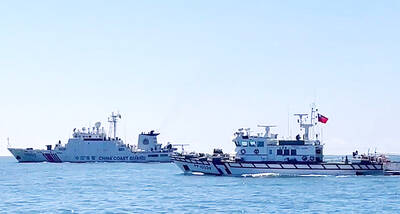
China deployed a record number of coast guard, scientific research and other ships near Taiwan’s waters last month, the Coast Guard Administration (CGA) said, as Beijing dials up pressure on Taipei. The coast guard warned of an increasingly severe situation, as analysts say the increased activity is part of China’s bid to map the region for submarine warfare. The number of Chinese ships detected around Taiwan proper soared to a record 244 last month — an average of nearly eight every day, official data showed. That compares with 55 ships detected in June and 30 in May, and 58 in July last year. In
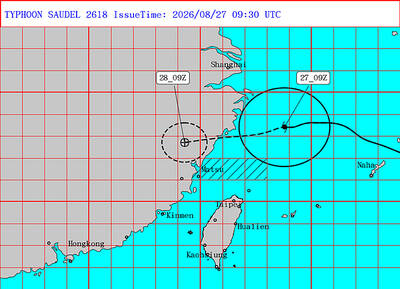
Taiwan is bracing for heavy rain in the south and rough seas around outlying Lienchiang County (Matsu), as Typhoon Saudel passes north toward eastern China, with forecasters yesterday warning of localized flooding over the next two days. Saudel is expected to pass closest to Taiwan today, when its outer rain bands are forecast to brush past Matsu, before making landfall at about noon in China’s Zhejiang Province and weakening significantly, the Central Weather Administration said. The storm’s outer bands, combined with strengthening southwesterly winds, are expected to bring heavy rain to southern and southeastern Taiwan today, it said. As the storm approaches Matsu,

LIMITED: The bill’s NT$40bn annual spending cap would prevent Taiwan from effectively building up its drone combat capabilities, National Defense Minister Wellington Koo said The legislature yesterday rejected the Executive Yuan’s NT$210 billion (US$6.62 billion) special budget proposal to buy military drones and instead passed its own plan, which earmarks NT$40 billion per year over six consecutive years. The Executive Yuan said its plan to buy about 210,000 drones by 2031 could not wait, as the wars in Ukraine and Iran showed the importance of uncrewed systems in modern warfare amid a rising threat from China. However, the Chinese Nationalist Party (KMT) and Taiwan People’s Party (TPP) used their opposition majority to pass a bill providing NT$240 billion through annual budgets over six years, with annual

INCREASING IMBALANCE: The percentage of working-age people is expected to shrink to 42.3% of the population, while older people would comprise 52.9%, the agency said Taiwan’s population is projected to shrink by almost half over the next five decades, intensifying labor shortages and placing a growing drag on economic growth as the technology-intensive economy confronts a rapidly aging workforce. The population is expected to fall to 12.15 million by 2075, a 48 percent decline from this year, National Development Council projections released yesterday showed. The decline would fundamentally alter Taiwan’s workforce. From 2037, more than half of the working-age population is projected to be aged between 45 and 64, signaling the end of an era when the economy could rely on a relatively large labor force. The shift


 RSS
RSS