


In the wake of the government's decision to scrap the Fourth Nuclear Power Plant, both energy experts and environmental officials have called on the government to consider the option of demand-side management (DSM) -- which focuses on energy conservation and improving energy efficency -- to help promote sustainable development in Taiwan.
As the government prepares to present its alternative solutions to the nuclear plant in December their solutions -- like those of the Ministry of Economic Affairs (MOEA) -- have largely focused on increasing the capacity of supply, while disregarding the possibility of controlling demand.
"Have people ever thought about how many power plants Taiwan can accommodate if we follow the present development path?" Lin Tze-luen, Taiwanese research associate at the US-based Center for Energy and Environmental Policy at University of Delaware, told the Taipei Times.
Environmental Protection Administrator Lin Jun-yi (
Demand-side management needed
One of the main solutions the MOEA is looking at is independent power plants or IPPs. According to Taiwan Power Company (Taipower, 台電), eleven IPPs, with a total installed capacity of 10,300MW, built by private companies have been approved by the MOEA.
Four are currently being operated by private companies. Other large-scale natural gas IPPs are also going to be proposed.
"The MOEA should focus on how to decrease the demand side, which would be more cost-effective both in the near and longer terms," Taiwanese research associate Lin said.
Lin suggests that the government should not overlook points raised by international energy experts who have visited Taiwan in droves over the past few months.
Lin said that while there were still many people in Taiwan saying that renewable energy was for the future, that argument was wrong. Energy experts in the international community have urged countries to rely on renewable energy and to adopt decentralized power generation plants -- smaller plants made for communities, factories or hospitals.
"Renewable energy alone cannot solve our energy problem, energy efficiency is a key too," Lin said.
Energy conservation
Although the KMT government has promoted a policy of energy conservation and energy efficiency in the past, economic analysts say that the effects of the approach were limited because goals were unclear and efforts focused mostly on research and less on development.
Based on the conclusions of the National Energy Conference in 1998, the government arranged about NT$10 billion for a five-year research and development project to promote energy conservation and clean energy.
In the industrial sector, the government promoted energy standards, expanded financial incentives and strengthened energy conservation technical services.
In a recently released research paper, Wang To-far (
Wang pointed out that four manufacturing sectors, including chemical engineering, steel-making, the cement industry, and papermaking consume one-third of the nation's energy and electricity but only created 7 percent of Taiwan's gross national product (GNP) in the past 17 years.
The MOEA's Energy Commission has made efforts to enhance the efficiency of generator units, promote transmission and distribution efficiency, popularize cogeneration systems, and implement demand management measures. A great inconsistency behind the policy, however, are the constant warnings of power shortages from Taipower.
"I don't think that Taiwan will face power shortages in the future. When the energy policy is adjusted to follow international trends, fundamental electricity infrastructures in Taiwan will be more efficient," said George Hsu (許志義), director of the Center for Economic and Financial Strategies at the Chunghua Institute for Economic Research.
Hsu said that in the future the government should invest in cost-effective power plants which adopt new technologies of efficient power generation, transmission, and distribution.
In Taiwan, DSM carried out by Taipower has disappointed environmental officials and discouraged energy officials.
Taking air conditioning as an example: The main appliance blamed for peaks in electricity use is air conditioners, which are often a target for load management. A simple measure to reduce the amount of energy used by air conditioners is to set their temperatures higher.
Chen Chao-yih (陳昭義), secretary-general of the Energy Commission, said more than once at public hearings at the Legislative Yuan that temperatures for air conditioners there were set too low.
Environmentalists in the past have urged the Energy Commission to present a comprehensive energy conservation project for the Legislative Yuan.
Activists said that many legislators consumed too much electricity and energy at the Legislative Yuan carrying out political struggles instead of debating issues that are related to people's livelihoods, including energy-related issues.
Energy officials, however, said that calls to reduce power demands at peak load times or to shift some of the load to off-peak times have drawn little response from the public.
US energy experts agree with Taiwanese energy experts on this point. Amory Lovins, CEO of the US-based Rocky Mountain Institute, told the Taipei Times in August during a visit to Taiwan that every building he went into in Taiwan had great potential for improving energy efficiency.
Although the government has raised electrical apparatus efficiency standards and promoted energy-saving technologies for buildings, the public still has little understanding of energy conservation.
It is common in Taiwan for people to bring coats with them on summer days because temperatures, adjusted by air conditioners inside buildings or vehicles, are too low.
EPA's concerns
One of the ways that Taiwan is trying to address this issue is through what is called an Energy Star standards program entrusted by the US Environmental Protection Agency.
Taiwan's EPA plans to use this program to promote energy conservation and provide impetus for Taiwan's participation in international activities.
Selecting office equipment for the first wave of the program, Taiwan's EPA began receiving applications for approval by the organization in July.
"We will call on the public's support to both reduce consumption of energy and avoid using energy resources inappropriately," EPA administrator Lin said.
Lin added that such actions were important for Taiwan, a densely populated country with limited natural resources.
Lin said that the EPA would propose more measures to reduce energy consumption early in 2001.
EPA officials said that the public's cooperation could play a key role in executing energy policy. The support, however, must be broad-based, crossing economic classes, political allegiances, education levels, geography and ethnicity.

NO-LIMITS PARTNERSHIP: ‘The bottom line’ is that if the US were to have a conflict with China or Russia it would likely open up a second front with the other, a US senator said Beijing and Moscow could cooperate in a conflict over Taiwan, the top US intelligence chief told the US Senate this week. “We see China and Russia, for the first time, exercising together in relation to Taiwan and recognizing that this is a place where China definitely wants Russia to be working with them, and we see no reason why they wouldn’t,” US Director of National Intelligence Avril Haines told a US Senate Committee on Armed Services hearing on Thursday. US Senator Mike Rounds asked Haines about such a potential scenario. He also asked US Defense Intelligence Agency Director Lieutenant General Jeffrey Kruse
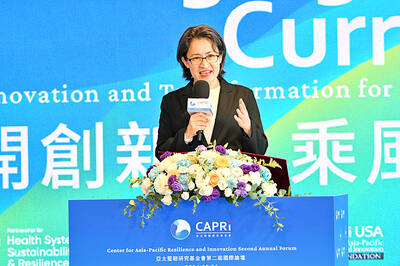
INSPIRING: Taiwan has been a model in the Asia-Pacific region with its democratic transition, free and fair elections and open society, the vice president-elect said Taiwan can play a leadership role in the Asia-Pacific region, vice president-elect Hsiao Bi-khim (蕭美琴) told a forum in Taipei yesterday, highlighting the nation’s resilience in the face of geopolitical challenges. “Not only can Taiwan help, but Taiwan can lead ... not only can Taiwan play a leadership role, but Taiwan’s leadership is important to the world,” Hsiao told the annual forum hosted by the Center for Asia-Pacific Resilience and Innovation think tank. Hsiao thanked Taiwan’s international friends for their long-term support, citing the example of US President Joe Biden last month signing into law a bill to provide aid to Taiwan,

China’s intrusive and territorial claims in the Indo-Pacific region are “illegal, coercive, aggressive and deceptive,” new US Indo-Pacific Commander Admiral Samuel Paparo said on Friday, adding that he would continue working with allies and partners to keep the area free and open. Paparo made the remarks at a change-of-command ceremony at Joint Base Pearl Harbor-Hickam in Hawaii, where he took over the command from Admiral John Aquilino. “Our world faces a complex problem set in the troubling actions of the People’s Republic of China [PRC] and its rapid buildup of forces. We must be ready to answer the PRC’s increasingly intrusive and
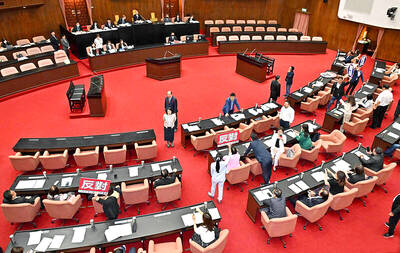
STATE OF THE NATION: The legislature should invite the president to deliver an address every year, the TPP said, adding that Lai should also have to answer legislators’ questions The Chinese Nationalist Party (KMT) yesterday proposed inviting president-elect William Lai (賴清德) to make a historic first state of the nation address at the legislature following his inauguration on May 20. Lai is expected to face many domestic and international challenges, and should clarify his intended policies with the public’s representatives, KMT caucus secretary-general Hung Meng-kai (洪孟楷) said when making the proposal at a meeting of the legislature’s Procedure Committee. The committee voted to add the item to the agenda for Friday, along with another similar proposal put forward by the Taiwan People’s Party (TPP). The invitation is in line with Article 15-2


 RSS
RSS