


The head of the Taiwanese crime syndicate known as the "Four Seas Gang" (
Taiwan's Criminal Investigation Bureau (CIB) confirmed yesterday that Shanghai police arrested Yang Kuang-nan (楊光南) at a restaurant in the city on Nov. 1.
Eight other people were reportedly arrested along with Yang.
CIB officials said they are working with the Straits Exchange Foundation (
This is the second time Yang has been arrested in China. He was first arrested for a brawl at a Shanghai bar in March last year. Yang was released and deported to Macau after almost two months in jail.
At the time, Yang narrowly escaped Taiwan police who were sent to pick him up at Macau's airport.
China has since blacklisted Yang.
Local media reported yesterday that Yang had fled to Hainan Island, Singapore and the US before finally returning to China to consolidate his power base there.
The Four Seas Gang has been running gambling dens and nightclubs in Shanghai in cooperation with local gangs, local media reports said.
Shanghai police were prompted to take action after the Four Seas Gang decided to move its headquarters to Shanghai, according to police sources.
Cooperation between crime syndicates in China, Hong Kong, Taiwan and Macau has been on the rise following the handover of Hong Kong and Macau to Chinese rule.
Taiwan's CIB officials said they are optimistic about Yang's repatriation to Taiwan, but also expressed concern that the Four Seas Gang may mobilize its political connections on both sides of the Taiwan Strait to arrange Yang's escape.
Taiwan police suspect Yang has been involved in numerous criminal cases here, ranging from bid-rigging to murder.
Yang was convicted in a murder case in the mid-1980s and was released after serving time in jail.
One report said that Yang had tried to dissolve his gang four years ago, wanting to shed his criminal background and start businesses in Shanghai, but did not follow through with his plan.

National Taiwan University (NTU) yesterday said it disqualified a person from an entrance examination for using AI smart glasses to cheat, along with two others for making untruthful statements in their curriculum vitae. The three applicants were given null scores, Taiwan’s highest-ranked university said, calling on prospective students to be honest in the admissions process. NTU registrar Lee Hung-sen (李宏森) said that the cheating applicant wore a hat and thick-rimmed glasses to the second written exam for medical school, claiming that they felt cold. Suspicions were aroused when the applicant stared oddly at the test for long stretches while steadily bringing the paper
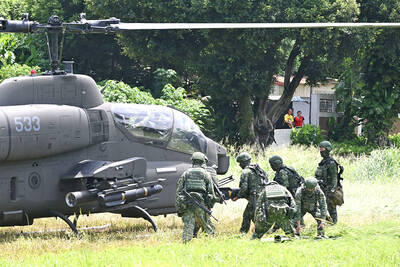
MILITARY ISSUES: A partisan divide between the Cabinet and the legislature ‘raised questions about Taiwan’s ability to adequately fund its defense,’ the report said Taiwan’s defense budget, military personnel numbers and resilience are challenges to its ability to meet national defense goals, the US Naval Institute said in a report published on Tuesday. In response to the perception of a growing military threat posed by China, Taiwan has embarked on an effort to enhance the capabilities needed to deter an attempt by Beijing to annex the nation by force, the institute said in the US Congressional Research Service report, titled Taiwan: Defense and Military Issues, which was filed on Thursday last week. Taiwan’s defense budget increased by about 7.5 percent from 2024 to last year, it
NOT JUST NUMBERS: What matters to intelligence work is crucial, reliable information, so even a few credible leads can be highly valuable to national security, a legislator said The National Security Bureau (NSB) yesterday said it has finished the establishment of an information-reporting channel for Chinese nationals, the aim of which is to broaden intelligence gathering on China’s political, military, economic and social developments. Chinese nationals can submit information on the Web page, https://report.nsb.gov.tw, the NSB said in a statement. The move aims to expand the bureau’s diverse intelligence sources and is pursuant to the National Intelligence Services Act (國家情報工作法), it said, adding that it referenced practices adopted by intelligence agencies in the US, the UK and Israel. An increasing number of people are approaching Taiwanese agencies to provide information, as

66 FIGHTER JETS: The aircraft is likely undergoing preparations for its transfer to Taiwan — a significant step forward in the nation’s modernization program, a lawmaker said The first of Taiwan’s order of F-16V Block 70 aircraft has been sighted in Texas ahead of delivery, Democratic Progressive Party (DPP) Legislator Wang Ting-yu (王定宇) said. Taiwan’s first F-16V Block 70 two-seat aircraft, tail number 6831, was seen flying from Lockheed Martin’s production facility in Greenville, South Carolina, to Naval Air Station Joint Reserve Base Fort Worth in Texas, Wang wrote on Facebook yesterday. The plane is likely undergoing preparations for its transfer to Taiwan, marking a significant step forward in the Republic of China Air Force’s modernization program, Wang said, citing military analysts. The F-16V Block 70 is a new-build version


 RSS
RSS