


Former residents of the Tunghsing Building (
The 12-story complex, situated on Taipei's Pateh Road, collapsed in seconds, killing 87 residents during the earthquake last year. The casualties and property damage at the Tunghsing Building are claimed to be the most serious in Taipei City.
Former residents of the ill-fated building, accompanied by lawyers and human rights activists, rallied at the Taipei District Court yesterday to file the suit against the management of the Hung Kuo Group, Lin Hsieh Han-chien (
Tunghsing residents said they are seeking compensation of NT$2.5 billion from the group as they believe the collapse of the building was due to poor structural design.
Reports conducted by the Control Yuan and by the Taipei Civil Engineers' Association have indicated the collapse resulted from structural and design problems inherent in the building, according to Cheng Wen-lung (
The report conducted by the civil engineers' association found that 60 percent of samples of debris taken from the building's ruins pointed to substandard building materials.
Cheng successfully assisted the residents of the Doctors' Home in Taipei County, which also collapsed in the quake, in reaching a settlement in September with the builders of the complex.
The lawyer said the Tunghsing Building was constructed in 1980 by Hung Gu Construction (鴻固營造), which he said was an affiliate of the Hung Kuo Group.
Hung Kuo has always claimed, however, that it did not become a shareholder in Hung Gu until 1981 and that it was not involved in the construction of the Tunghsing Building.
Hung Kuo has also stated that neither Lin Hsieh Han-chien nor her two sons are responsible for deaths and injuries of the former Tunghsing residents.
Tiffany Lee (
She said that she and other residents had been present at the district court exactly a year ago to file a criminal charge against Hung Gu Construction. Although a year has passed, none of those being blamed for the tragedy have accepted any responsibility, she said.
"Not a single word of apology, let alone any compensatory acts," she said.
Apart from legal action, the residents have pressed the Taipei City Government to mediate so that the disputes, and other similar ones, might be resolved as soon as possible.
According to Lee, the city government has told them it has invited three defendants of the Hung Kuo Group to negotiate with former Tunghsing residents on Nov. 6. Residents, however, said they thought it was unlikely the three representatives would show up for the meeting.
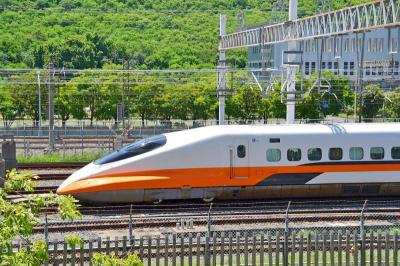
A signaling system malfunction disrupted high-speed rail (HSR) services beginning at 8am today, with trains temporarily reduced to three northbound and three southbound trains per hour as authorities conduct inspections. The malfunction occurred on a section of track in Miaoli County during pre-operation checks early this morning, forcing northbound and southbound trains to use a single track, the HSR operator said. The regular schedule has been replaced with three hourly trains offering only nonreserved seating in each direction, stopping at every station, it said, adding that business class cars would still have reserved seating. Departures from terminal stations are scheduled at the top

DRONE CENTRAL: Taiwan aims to become Asia’s democratic hub for drones, with most exports focused on high-quality military-grade models, an official said Taiwan’s drone industry is expected to expand significantly by 2030, producing 100,000 units per month and exporting half of them, the Ministry of Economic Affairs said yesterday. Current drone production capacity is about 15,000 units per month, but the industry can quickly scale up as demand increases, Industrial Development Administration Director-General Chiou Chyou-huey (邱求慧) told a news conference in Taipei. Taiwan’s drone output grew 2.5-fold last year to NT$12.9 billion (US$408.3 million) under a government program to develop the uncrewed vehicle sector, he said. The Executive Yuan in October last year approved plans to invest NT$44.2 billion into domestic production of uncrewed aerial
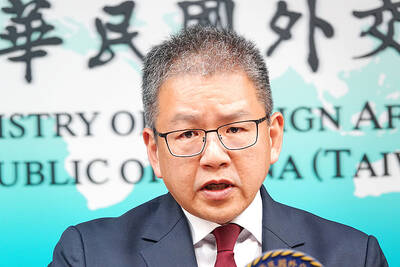
Taiwan is still in the process of assessing the possibility of recruiting workers from Eswatini, the Ministry of Foreign Affairs said yesterday, adding that its goal is to help Eswatini upgrade its vocational training centers. If there are plans to recruit workers from Eswatini, safeguarding national security, protecting public health and ensuring the employment rights of Taiwanese would be prerequisites, Department of West Asian and African Affairs Director-General Yen Chia-liang (顏嘉良) told a news conference. Key considerations would also include filling labor shortages in specific industries, and fostering bilateral professional and technical exchanges, he said. Yen was asked about the progress of labor
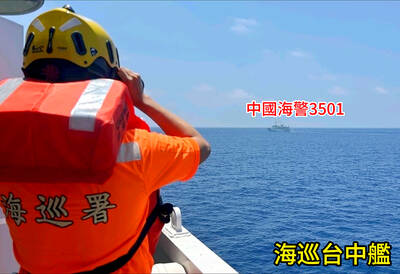
VERBOSE VESSELS: A CGA cutter and a China Coast Guard exchanged verbal barbs for more than a day in Taiwanese-controlled waters before the Chinese vessel left The Taiwanese and Chinese coast guards had a standoff near the strategically located Pratas Islands (Dongsha Islands, 東沙群島) in the north of the South China Sea, the Coast Guard Administration (CGA) said yesterday. The two sides engaged in intense radio exchanges over sovereignty claims during the 33-hour standoff. China Coast Guard vessel 3501 eventually left the restricted waters, 26.6 nautical miles (49.2km) west of the Pratas Islands, at 5pm yesterday, the CGA said. Lying approximately between southern Taiwan and Hong Kong, the Taiwan-controlled Pratas are seen by some security experts as vulnerable to Chinese attack due to their distance — more than


 RSS
RSS