


The Executive Yuan yesterday held a public hearing, chaired by Vice Premier Chang Chung-hsiung (張俊雄) to exchange views with the legislature on the budget for the next fiscal year. Less than a quarter of the 221 legislators attended.
In his opening remarks, Premier Tang Fei (
Tang said that the government intended to raise the ceiling on national debt or to issue extraordinary government bonds (bonds issued on an ad-hoc basis for specific purposes) in order to increase revenues.
According to Director-General Lin Chuan (林全) of the Directorate General of Budget, Accounting and Statistics, annual revenue for the 2001 fiscal year will be approximately NT$1.458 trillion, an increase of NT$98 billion or 7.2 percent compared to the projected figure for fiscal 2000. Meanwhile, annual expenditures will be approximately NT$1.608 trillion, an increase of NT$95 billion -- or 6.3 percent -- over fiscal 2000.
Lin further indicated that the shortfall of NT$150 billion between annual revenues and expenditures, along with domestic debt of NT$255 billion due for repayment soon, would be balanced, if government bonds worth NT$260 billions were sold, and an additional NT$100 billion in loans were raised to pay off the debts of the former government.
Legislators from every party had some criticism for the national budget.
KMT Legislator Liu Kuang-hua (
DPP Legislator Cho Jung-tai (
Cho further criticized the allocation for health insurance (NT$108 billion), labor insurance (NT$17 billion) and civil servants' insurance (NT$62 billion) as only sufficient to meet the current deficits of all three schemes.
DPP Legislator Wong Chin-chu (翁金珠) also voiced worries that funding for local government projects seemed to have been sacrificed in favor of the Executive Yuan's emphasis on President Chen Shui-bian's (陳水扁) campaign promises for social welfare programs.
New Party legislative whip Lai Shyh-bao (賴士葆), moreover, blasted the new government for not allowing sufficient funds for environmental protection, high-tech infrastructure and education, despite President Chen's campaign platform of a "green silicon island" (綠色矽島) in Taiwan.
Concluding the hearing, Vice Premier Chang admitted that the new budget plan had been prepared in a hurry and was based on the draft budget of the former Cabinet led by Vincent Siew (
Lin Chuan, nevertheless, told the Taipei Times that total governmental revenue and expenditure figures would not be changed, and that each government agency would make minor adjustments to meet its administrative priorities.
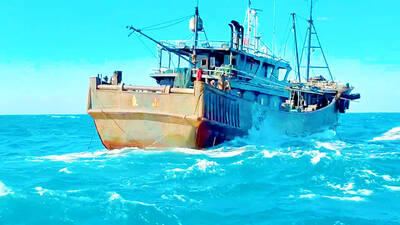
MAKING WAVES: China’s maritime militia could become a nontraditional threat in war, clogging up shipping lanes to prevent US or Japanese intervention, a report said About 1,900 Chinese ships flying flags of convenience and fishing vessels that participated in China’s military exercises around Taiwan last month and in January have been listed for monitoring, Coast Guard Administration (CGA) Deputy Director-General Hsieh Ching-chin (謝慶欽) said yesterday. Following amendments to the Commercial Port Act (商港法) and the Law of Ships (船舶法) last month, the CGA can designate possible berthing areas or deny ports of call for vessels suspected of loitering around areas where undersea cables can be accessed, Oceans Affairs Council Minister Kuan Bi-ling (管碧玲) said. The list of suspected ships, originally 300, had risen to about 1,900 as

Right-wing political scientist Laura Fernandez on Sunday won Costa Rica’s presidential election by a landslide, after promising to crack down on rising violence linked to the cocaine trade. Fernandez’s nearest rival, economist Alvaro Ramos, conceded defeat as results showed the ruling party far exceeding the threshold of 40 percent needed to avoid a runoff. With 94 percent of polling stations counted, the political heir of outgoing Costa Rican President Rodrigo Chaves had captured 48.3 percent of the vote compared with Ramos’ 33.4 percent, the Supreme Electoral Tribunal said. As soon as the first results were announced, members of Fernandez’s Sovereign People’s Party
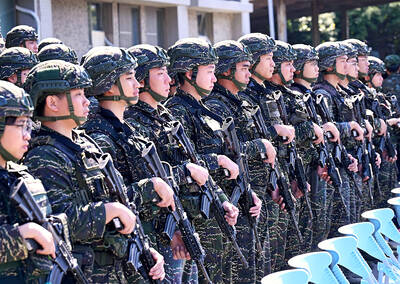
MORE RESPONSIBILITY: Draftees would be expected to fight alongside professional soldiers, likely requiring the transformation of some training brigades into combat units The armed forces are to start incorporating new conscripts into combined arms brigades this year to enhance combat readiness, the Executive Yuan’s latest policy report said. The new policy would affect Taiwanese men entering the military for their compulsory service, which was extended to one year under reforms by then-president Tsai Ing-wen (蔡英文) in 2022. The conscripts would be trained to operate machine guns, uncrewed aerial vehicles, anti-tank guided missile launchers and Stinger air defense systems, the report said, adding that the basic training would be lengthened to eight weeks. After basic training, conscripts would be sorted into infantry battalions that would take
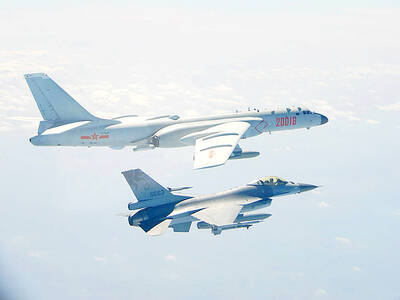
GROWING AMBITIONS: The scale and tempo of the operations show that the Strait has become the core theater for China to expand its security interests, the report said Chinese military aircraft incursions around Taiwan have surged nearly 15-fold over the past five years, according to a report released yesterday by the Democratic Progressive Party’s (DPP) Department of China Affairs. Sorties in the Taiwan Strait were previously irregular, totaling 380 in 2020, but have since evolved into routine operations, the report showed. “This demonstrates that the Taiwan Strait has become both the starting point and testing ground for Beijing’s expansionist ambitions,” it said. Driven by military expansionism, China is systematically pursuing actions aimed at altering the regional “status quo,” the department said, adding that Taiwan represents the most critical link in China’s


 RSS
RSS