


June, 1991 Taiwan takes delivery of four German-made minesweepers, purchased as "multi-purpose coastal boats" for the state-run Chinese Petroleum Corporation.
Aug, 1991 Taiwan signs Lafayette frigate deal with France.
April, 1993 The Central Trust of Taiwan signs, on behalf of the navy, a deal with an Italian company for a survey ship.
May, 1993 Navy General Headquarters' weapons procurement office is inaugurated, with Captain Yin as its chief executive. Yin was scheduled for promotion to rear admiral at the beginning of the following year.
Sept, 1933 Captain Yin visits France in connection with the Lafayette frigate deal, accompanied by procurement office colleague Captain Kuo Li-heng (
Nov, 1993 Letter of accusation against Yin, Kuo and many other naval officers is sent to the Presidential Office. It accuses Yin of receiving NT$5 million in bribes from an arms broker mediating the navy's purchase of a survey ship from an Italian company.
Dec 8, 1993 Yin takes action to fight the allegations. He visits, at night, three key people involved in the minesweeper, frigate and survey ship deals and secretly records conversations with them. The three are a military official and two former naval officials who became arms brokers after retirement. Yin is accompanied by Kuo on two of the visits.
Dec 9, 1993 Yin goes missing at around 8:50am after going to meet somebody for breakfast near Navy General Headquarters in Taipei's suburban Tachih district.
Dec 10, 1993 Yin's body is found off Suao (
Dec 11, 1993 The first of two cassette tapes recording conversations between Yin and the three key arms purchasers is recovered. It is later, suspiciously, demagnetized. Navy investigators, who obtained access to the tapes before anybody else, include Rear Admiral Liu Chin-an (劉錦安), currently director of the Ministry of National Defense's Judge Advocates Bureau, Rear Admiral Li Kun-tsai (李昆材), then director of Navy General Headquarters' weapons procurement office, and several others.
Dec 15, 1993 The murder is reported by the press despite a gagging order imposed by the military.
Dec 16, 1993 Yin's colleague, Kuo, is taken into custody for suspected links to the murder.
Dec 18, 1993 An autopsy by Taiwan's top coroner, Yang Jih-sung (楊日松), finds evidence that Yin might have been murdered.
Dec 20, 1993 Andrew Wang (
Jan 1, 1994 Lawmaker Chu Kao-cheng (
Jan 21, 1994 Shan Yi-chen (單亦誠), an arms broker who had tried to mediate Taiwan's purchase of minesweepers from Germany, flees the country amid suspicions of his involvement in the Yin murder. Shan was alleged to have bribed Kuo Li-heng with NT$2.5 million in an attempt to win a contract for parts provision for the German-made mine sweepers.
Feb. 14, 1994 Tu, the German arms agent, meets in Singapore with members of a task force investigating the Yin murder. Tu denies any connection with or knowledge of the murder.
March 18, 1994 Then lawmaker Chen Shui-bian (
April 19, 1994 Chen accuses navy Captain Chen Kuo-hsiang (
Oct 1994 Kuo Li-heng is sentenced to life for leaking military secrets and taking NT$12 million in bribes from arms brokers.
May, 1995 Ex-navy Deputy Commander-in-Chief Cheng Li-cheng (
Oct 1996 Commission-taking scandal surrounding the Lafayette frigate deal between Taiwan and France is exposed by the French media.
Nov 1996 Yang I-li (
March, 1997 Yin's widow, Li Mei-kuei (
March, 1998 Yin's younger brother, Yin Ching-luan (尹清楓), accuses Admiral Liu Ho-chien (劉和謙), who had been chief of the general staff at the time of the murder, of behind-the-scenes involvement in the Yin murder.
July 3, 2000 Arms broker Shan Yi-chen (

DRONE CENTRAL: Taiwan aims to become Asia’s democratic hub for drones, with most exports focused on high-quality military-grade models, an official said Taiwan’s drone industry is expected to expand significantly by 2030, producing 100,000 units per month and exporting half of them, the Ministry of Economic Affairs said yesterday. Current drone production capacity is about 15,000 units per month, but the industry can quickly scale up as demand increases, Industrial Development Administration Director-General Chiou Chyou-huey (邱求慧) told a news conference in Taipei. Taiwan’s drone output grew 2.5-fold last year to NT$12.9 billion (US$408.3 million) under a government program to develop the uncrewed vehicle sector, he said. The Executive Yuan in October last year approved plans to invest NT$44.2 billion into domestic production of uncrewed aerial

A signaling system malfunction disrupted high-speed rail (HSR) services beginning at 8am today, with trains temporarily reduced to three northbound and three southbound trains per hour as authorities conduct inspections. The malfunction occurred on a section of track in Miaoli County during pre-operation checks early this morning, forcing northbound and southbound trains to use a single track, the HSR operator said. The regular schedule has been replaced with three hourly trains offering only nonreserved seating in each direction, stopping at every station, it said, adding that business class cars would still have reserved seating. Departures from terminal stations are scheduled at the top
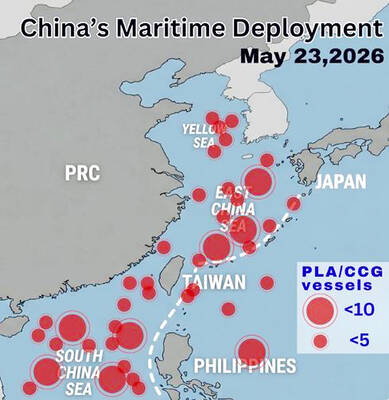
WARNING: China should stop engaging in actions that undermine regional peace and stability, as it would only build resentment among people across the Strait, the CGA said China has deployed more than 100 navy, coast guard and other vessels in waters from the Yellow Sea to the South China Sea and the western Pacific since US President Donald Trump and Chinese President Xi Jinping (習近平) met in Beijing, National Security Council Secretary-General Joseph Wu (吳釗燮) said yesterday. “In this part of the world, #China is the one & only PROBLEM wrecking the #StatusQuo & threatening regional peace & stability,” Wu wrote on X. In a separate post, he said Beijing was coercing Taiwan’s maritime domain, calling it illegal and provocative, after the Coast Guard Administration (CGA) expelled a

VERBOSE VESSELS: A CGA cutter and a China Coast Guard exchanged verbal barbs for more than a day in Taiwanese-controlled waters before the Chinese vessel left The Taiwanese and Chinese coast guards had a standoff near the strategically located Pratas Islands (Dongsha Islands, 東沙群島) in the north of the South China Sea, the Coast Guard Administration (CGA) said yesterday. The two sides engaged in intense radio exchanges over sovereignty claims during the 33-hour standoff. China Coast Guard vessel 3501 eventually left the restricted waters, 26.6 nautical miles (49.2km) west of the Pratas Islands, at 5pm yesterday, the CGA said. Lying approximately between southern Taiwan and Hong Kong, the Taiwan-controlled Pratas are seen by some security experts as vulnerable to Chinese attack due to their distance — more than


 RSS
RSS