


President Chen Shui-bian's (陳水扁) announcement of a re-launch of investigations into the mysterious 1993 murder of navy Captain Yin Ching-feng (尹清楓) has proceeded with great momentum and fanfare over the past week, but whether the renewed probe will yield any concrete results still remains to be seen.
This week's renewed efforts were immediately met by infighting between the newly established investigation task force and the military. The two spent a majority of the week arguing over copies of cassette tapes which contain interviews with a key witness already convicted in the case.
While national dailies fueled the building debate over the "new clues" supposedly contained on the tapes, a careful review of the investigation over the past six years shows that what is now being touted as "new clues" are actually old ones.
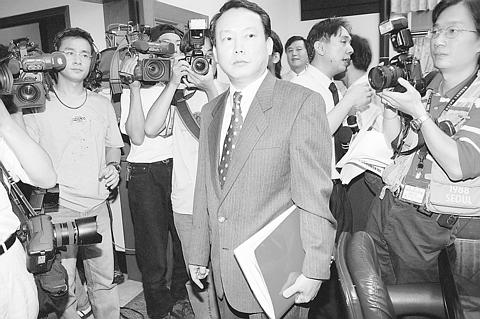
PHOTO: CHEN CHENG-CHANG, TAIPEI TIMES
Ex-Criminal Investigation Bureau director Yang Tze-chin (
Kuo made the confession on July 25 to People First Party lawmaker Lee Ching-hua (
"The pity is that a lot of clues are unavailable because several key witnesses left the country after the murder and cannot be contacted," Yang told the Taipei Times.
While he did not name them, Yang was referring to people like Andrew Wang (汪傳浦) and Tu Cheng Chun-chu (涂鄭春菊). Both have fled the country and now live abroad.
Yang also pointed to the importance of searching bank accounts of individuals suspected of involvement.
"The Yin murder is not an unsolvable case. The murder was a result of a weapons purchase scandal. We are confident we can crack this case as long as we can have access to data about cash flows in the bank accounts of all the suspects," he said.
"This is the biggest difficulty in the investigation. It is very difficult for Taiwan's legal authorities to investigate bank accounts of all the key witnesses who are abroad. As a matter of fact, evidence in this area has never been sought in the past," he added.
A military official, involved in the investigation of the murder for several years, said a crucial problem with the case was that investigators originally presumed Yin had drowned and not been murdered.
"The first week after a murder is the most important period for evidence gathering. But military investigators responsible for finding out the cause of Captain Yin's death missed that chance," said Colonel Yang Wen-hsien (楊文賢), deputy director of the discipline monitoring office of the Ministry of National Defense.
Yang, a member of a military investigation team formed specially for the Yin case, is the son of the country's former top coroner, Yang Jih-sung (

‘NO SECURITY RISK’: The Railway Bureau reassured the public that the technicians’ activities were limited to technical guidance and did not involve sensitive systems The Railway Bureau yesterday said it had invited eight Chinese technicians to assist with an airport MRT construction project. The bureau issued the confirmation after an Internet user said Chinese nationals had entered the construction zone of Taiwan Taoyuan International Airport’s Terminal 3 project. They asked why “individuals from an enemy state” were allowed access to such a major national infrastructure project, which raised serious concerns over Taiwan’s industrial safety, sensitive systems and information security. The bureau’s Northern Region Engineering Branch Office said subcontractor Taiwan Handle Industrial Co (台灣手把工業) of the Taoyuan airport MRT’s “Contract No. CU05 Project A14 Station Civil, MEP &

A US uncrewed surface vessel (USV) encountered multiple Chinese warships during an autonomous transit of the Taiwan Strait, US defense company Seasats said in a statement on Wednesday. Seasats announced that a Lightfish USV had completed the first autonomous transit of the Taiwan Strait. Over five days, the USV traversed the entire length of the Strait while constantly monitoring surface vessel traffic, the company said. The Lightfish encountered multiple Chinese warships, one of which was a Chinese People’s Liberation Army Navy (PLAN) Type 056 corvette, it said. The Chinese vessels were operating “well within Taiwan’s exclusive economic zone without transmitting their identity via the

‘BOOMING’: ’ The number of partners we have here is incredible. You can see from their stock prices. They’re doing so well, they’re so happy,’ Jensen Huang said Nvidia Corp’s spending in Taiwan has ballooned to about US$150 billion a year, 10 times the US$10 billion to US$15 billion the company spent five years ago, Nvidia chief executive officer Jensen Huang (黃仁勳) said yesterday, suggesting Taiwan’s strategic importance in the global artificial intelligence (AI) supply chain. “Taiwan is the epicenter of the AI revolution. This is where the chips come, packaging comes. This is where the systems are made. This is where AI supercomputers were created,” Huang said at a meeting for the company’s employees in Beitou-Shilin Technology Park (北投士林科技園區) in Taipei, the planned site of Nvidia’s Taipei headquarters. “Taiwan
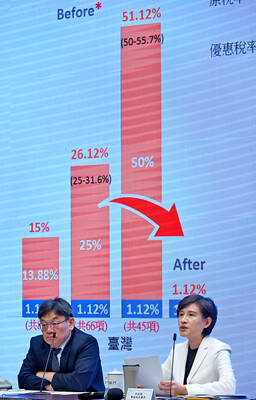
GREATER REACH? Auto parts and wood products would face tariffs of up to 15%, matching those targeting the EU, Japan and South Korea, Vice Premier said The US has announced that preferential tariff treatment for Taiwan’s non-semiconductor Section 232 goods would take effect retroactively from May 1, the Executive Yuan said yesterday. The US government yesterday posted a notice on the Federal Register’s public inspection Web site previewing tariff concessions for Taiwan under a memorandum of understanding (MOU) on Taiwan-US investment after two months of negotiations. The MOU signed on Jan. 15 stipulated three major preferential tariff arrangements: a 15 percent “reciprocal” tariff rate for Taiwan without stacking most-favored nation (MFN) rates; preferential Section 232 treatment for semiconductors and related products; and preferential Section 232 treatment for non-semiconductor


 RSS
RSS