


US energy experts urged the government yesterday to give up its push for nuclear energy, saying that out-of-date energy policies and conventional approaches would hinder Taiwan's competitiveness.
"An energy market liberalization strategy would be more effective than continuing construction of the Fourth Nuclear Power Plant," said John Byrne, leader of the team of US energy experts.
The team, sponsored by the US-based W Alton Jones Foundation, said they had provided Taiwan with objective and practical information on leading energy technologies and policies.
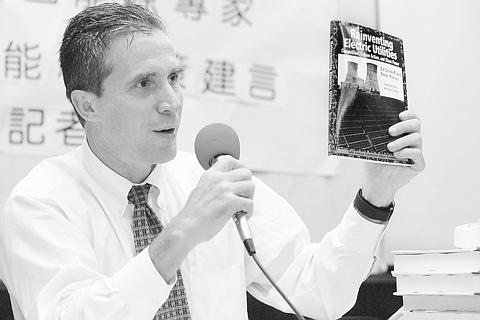
PHOTO: CHEN CHENG-CHANG, TAIPEI TIMES
Yesterday was the last day of the team's lobbying effort.
"We believe that such information can help societies meet their needs at the lowest cost and with maximum social and environmental benefits," Byrne said.
Byrne said that, after meeting with many of Taiwan's energy experts, he was convinced that a better strategy would be to pass a liberalization policy that opens the nation's electricity and natural gas markets to competition.
"This would create the opportunity for sustainable energy options, including energy efficiency, renewable energy and new modular, small-scale supply technologies rapidly developing around the world to meet Taiwan's near and long-term needs," Byrne said.
Fellow team member Edward Smeloff spoke of his experience in helping to close a money-losing nuclear power plant in California.
Smeloff said that the power company later adopted alternatives, such as solar energy and wind power.
"The power company ultimately had better rates, lower debts and better prospects than it could had achieved even with a smoothly running nuclear power plant," Smeloff said.
Smeloff suggested that Taiwan put nuclear energy aside and try adopting solar energy. As the market for solar energy is getting bigger, companies could be given incentives to produce solar panels, he said.
Another member of the team, Amory Lovins, who is one of the founders and CEOs of the Rocky Mountain Institute (RMI), also felt Taiwan Power Company should abandon nuclear energy, arguing that the recent sales of used-reactors confirmed a market perception of low or even negative asset value.
Lovins wife, Hunter Lovins, a co-founder of RMI, said centralized power systems -- such as nuclear power plants -- are very dangerous. This is especially for Taiwan, a small island with frequent earthquakes and typhoons.
Local anti-nuclear activists said the US experts' visit had offered useful opinions for the Taiwan government.
"We hope to see more emphasis on key issues, such as reforming Taiwan's energy policies, at follow-up meetings conducted by the MOEA's NPP-4 Re-evaluation Committee (
Shih said he believed the ideas presented by the US team had affected some key political figures.
"Some conservative officials, who might know the global trends in energy policy, are still reluctant to accept new ideas suggested by other countries and argue that Taiwan should take actions that suit local circumstances," said Wang To-far (王塗發), a professor of economics at National Taipei University.
Such conservative views will not help Taiwan, Wang said.
The US team said this week's visit would be followed by an international conference on Sustainable Energy and Environmental Strategies in Taiwan slated for September.
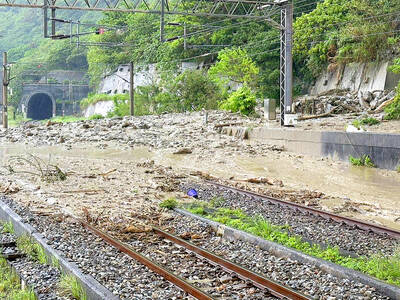
ROLLER-COASTER RIDE: More than five earthquakes ranging from magnitude 4.4 to 5.5 on the Richter scale shook eastern Taiwan in rapid succession yesterday afternoon Back-to-back weather fronts are forecast to hit Taiwan this week, resulting in rain across the nation in the coming days, the Central Weather Administration said yesterday, as it also warned residents in mountainous regions to be wary of landslides and rockfalls. As the first front approached, sporadic rainfall began in central and northern parts of Taiwan yesterday, the agency said, adding that rain is forecast to intensify in those regions today, while brief showers would also affect other parts of the nation. A second weather system is forecast to arrive on Thursday, bringing additional rain to the whole nation until Sunday, it

LANDSLIDES POSSIBLE: The agency advised the public to avoid visiting mountainous regions due to more expected aftershocks and rainfall from a series of weather fronts A series of earthquakes over the past few days were likely aftershocks of the April 3 earthquake in Hualien County, with further aftershocks to be expected for up to a year, the Central Weather Administration (CWA) said yesterday. Based on the nation’s experience after the quake on Sept. 21, 1999, more aftershocks are possible over the next six months to a year, the agency said. A total of 103 earthquakes of magnitude 4 on the local magnitude scale or higher hit Hualien County from 5:08pm on Monday to 10:27am yesterday, with 27 of them exceeding magnitude 5. They included two, of magnitude

CONDITIONAL: The PRC imposes secret requirements that the funding it provides cannot be spent in states with diplomatic relations with Taiwan, Emma Reilly said China has been bribing UN officials to obtain “special benefits” and to block funding from countries that have diplomatic ties with Taiwan, a former UN employee told the British House of Commons on Tuesday. At a House of Commons Foreign Affairs Committee hearing into “international relations within the multilateral system,” former Office of the UN High Commissioner for Human Rights (OHCHR) employee Emma Reilly said in a written statement that “Beijing paid bribes to the two successive Presidents of the [UN] General Assembly” during the two-year negotiation of the Sustainable Development Goals. Another way China exercises influence within the UN Secretariat is

Taiwan’s first drag queen to compete on the internationally acclaimed RuPaul’s Drag Race, Nymphia Wind (妮妃雅), was on Friday crowned the “Next Drag Superstar.” Dressed in a sparkling banana dress, Nymphia Wind swept onto the stage for the final, and stole the show. “Taiwan this is for you,” she said right after show host RuPaul announced her as the winner. “To those who feel like they don’t belong, just remember to live fearlessly and to live their truth,” she said on stage. One of the frontrunners for the past 15 episodes, the 28-year-old breezed through to the final after weeks of showcasing her unique


 RSS
RSS